
Boot 2: excursions persist with configuration retained
The second boot recovered 648 acquisitions and 23,444 native records, with complete diagnostics, restoration, release and terminal status. Recording, reset timing and configuration timing passed. All four frozen calibrations recognize 72/72 reference medians and 143/144 held-out medians. The complete held-out recognition criterion was not met.
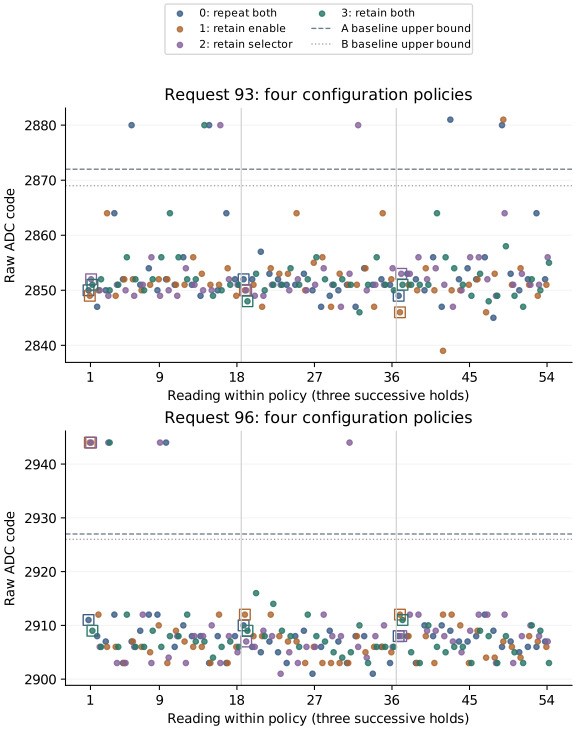
Combined retention now has two raw exceptions in 108 readings. Both occur after initialization, with reset, enable and selector reissues omitted. The absence of exceptions under that policy in boot 1 did not recur. Immediate reissue of those three configuration operations is therefore not necessary for these two excursions.
| Policy after initialization | Boot 1, both requests | Boot 2, request 93 | Boot 2, request 96 | Boot 2, both requests |
|---|---|---|---|---|
| 0: repeat both writes | 7 / 108 | 4 / 54 | 1 / 54 | 5 / 108 |
| 1: retain enable | 2 / 108 | 1 / 54 | 1 / 54 | 2 / 108 |
| 2: retain selector | 4 / 108 | 2 / 54 | 4 / 54 | 6 / 108 |
| 3: retain both | 0 / 108 | 1 / 54 | 1 / 54 | 2 / 108 |
Two boot-2 exceptions occur on first readings: request 96 under policies 1 and 2, both in visit 1. These readings perform the common reset, enable and selector initialization. After excluding them from the omission exposure, later-reading exceptions are 5, 1, 5 and 2 out of 102 for policies 0, 1, 2 and 3 respectively. Corresponding boot-1 later counts were 7, 1, 2 and 0. Initial readings remain in all overall results; they are separated only for interpreting which operations were omitted.
At request 93, later exceptions by policy are 4, 1, 2 and 1 out of 51; at request 96 they are 1, 0, 3 and 1 out of 51. Omitting enable is associated with fewer later exceptions in each within-boot request/selector comparison across these two boots. Selector omission has no consistent advantage: with enable repeated, request-96 exceptions increase from 1 to 3 in boot 2. These small counts from clustered holds do not establish a reliable effect size or identify a mechanism.
Boot 2 retains 417 correctly recognized raw held-out readings under every calibration. A baseline assigns seven of the remaining readings to a wrong state and rejects eight; each other calibration rejects all fifteen. Values outside the intended intervals are 2880 or 2881 at request 93 and 2944 at request 96. None is unavailable. Visits 1, 2 and 3 contain ten, two and three raw exceptions, compared with three, four and six in boot 1.
Omitted writes and the failed median
The two combined-retention exceptions are in visit 1: request 96, reading 3 of its hold, returns 2944; request 93, reading 14, returns 2880. Their native traces contain the outer reset-omission event and configuration action kinds 3 and 4 for omitted enable and selector. No corresponding transport call occurs. Result-octet pairs agree and the sampled CPU/pin fields remain unchanged in both cases.
The failed median is the first triple of the request-96 / policy-2 hold in visit 1: 2944, 2906, 2944. Its median is 2944. The expected identity is state 2; A baseline assigns state 3 and the other three rules reject it. The first reading initializes all three configuration operations; the third omits reset and selector reissue while repeating enable. Two excursions within the same disjoint triple defeat the median in this observed case.
Policy 2 at request 96 therefore recognizes 17/18 medians under every rule. Every other request/policy combination recognizes 18/18. The smallest margins among correctly recognized held-out medians are 8, 4, 5 and 1 ADC codes for A baseline, A candidate, B baseline and B candidate respectively. The failed median is retained separately and does not enter that correct-median margin summary.
Repeated diagnostic observations
All 22,092 CPU/pin snapshots again retain ISR=0, DAIF=0x3c0 and CurrentEL=8, with both PMIC lines high and released and both mux fields selecting GPIO. No within-access or consecutive-snapshot flag/context change was recorded. The retained quiet observer reports 150,789 iterations, no line transitions and no sampled pin contradiction. Its largest recorded gap is 7.704 microseconds within the one-millisecond observation intervals.
Conservative counter-based upper bounds on successive snapshot gaps reach 4.055 milliseconds within an acquisition and 10.524 milliseconds between acquisitions. Individual component registers are read sequentially. These observations supply no positive indication of competing control at the sampled points; they do not exclude activity between observations, upstream-masked or disabled sources, another CPU, DMA, internal component behavior or another interface.
The trace again contains 10,638 ADC-related transfers, 204 omitted enable writes and 204 omitted selector writes. Thirty resets are performed and 618 omitted. There are no inhibited accesses, transport failures or overflows. Reset, enable and selector slots remain within 4.000000–4.001630 milliseconds, with every performed transfer fitting its slot. All request readbacks and repeated ADC octet pairs agree. The four pre/post-quiet register observations are zero throughout; post-trigger status is 1 and cleanup status is 0. No recorded fault in these checks distinguishes the exceptions.
Six of the 216 raw reference readings fail at least one rule. At request 90, 2816 is accepted only by A baseline and 2832 is assigned to state 1 by both baseline rules. Request 99 again produces 3008, assigned to state 4 by every rule. Two request-102 readings of 3040 exceed both candidate bounds. Request 105 produces 3104, rejected by all rules. Reference raw counts are 213 correct / 2 wrong / 1 rejected for A baseline; 210 / 1 / 5 for both candidates; and 212 / 2 / 2 for B baseline. All reference medians remain correct.
Second-boot recording and provenance
Two read-only 96 MiB SD acquisitions match. All 283 preparation artifacts, including 274 frozen sources, verify. The frozen reader reproduces the returned analysis. Thirteen reconstruction checks cover both physical returns, independent classifications, omitted-write cases, the failed median, native signal fields, boot-specific comparisons and incomplete-record rejection. The byte comparison confirms unchanged experimental inputs and 70 instruction regions; the executable payload changes only in its run identity.
Acquisition occupied 33.737 seconds; the terminal counter corresponds to 957.254 seconds at the configured 54 MHz, approximately 15 minutes 57 seconds. Its timestamp follows all auxiliary journal readbacks and precedes its own write/readback. The prescribed allowance was twenty minutes; no workflow deviation was reported. Total powered duration and boot count were not independently measured.
The preserved older journal and boot-file bytes are unchanged. Seven boot-volume metadata sectors differ, without identifying their writer or modification time. The SD was acquired without repair or rewriting.
Capture SHA-256: cb00fef99f7de57c43ec97899feb255773ba0ee98a4f80837ccfd7fb75dfc8b0.
Decoded records · Diagnostic observations · Two-boot comparison · Provenance · Boot-volume comparison · Return index
Second boot: recurrence under unchanged conditions
Preparation 7F967FF3AD7A repeats the four-policy comparison to test whether the absence of raw exceptions under combined retention recurs across boots. All 70 instruction regions, acquisition orders, calibration bounds, timing and diagnostic operations match boot 1. The executable payload differs only in its 32-byte run identity. The original successful validation remains applicable because every validated source hash is unchanged.
Retain the same 648 acquisitions, 23,444 native records and 20-minute allowance. Assess initialization readings separately from subsequent readings under each policy. A later raw exception when both settings are retained would contradict elimination by that policy; another complete return with no such exception alongside exceptions in the other policies would support recurrence of the association, without proving its cause.
The SD installation passed all 6,144 transfer checks and two matching full readbacks under a volume lock, followed by successful ejection. The pre-write backup matches the preserved first-boot capture. Second-boot results and comparison are recorded above.
Second-boot protocol · Unchanged-input comparison · SD verification · Preparation index
Boot 1: configuration retained between conversions
The 2 October return recovered 648 acquisitions and 23,444 native records, including complete operation, control and configuration traces, restoration, release and terminal status. Recording and all three four-millisecond slot requirements passed. Every fixed calibration correctly recognizes all 72 reference medians and 144 held-out medians. No bound was changed.
Retaining both configuration values produced zero raw exceptions in 108 held-out readings. The other three policies produced thirteen in 324. All four calibrations identify the same thirteen readings as outside the intended state's interval, although wrong-state assignment and rejection differ between calibrations.
| Policy after first reading | Request 93: exceptions / raw readings | Request 96: exceptions / raw readings | Correct medians, each request and calibration |
|---|---|---|---|
| 0: repeat both writes | 2 / 54 | 5 / 54 | 18 / 18 |
| 1: retain enable; repeat selector | 1 / 54 | 1 / 54 | 18 / 18 |
| 2: repeat enable; retain selector | 2 / 54 | 2 / 54 | 18 / 18 |
| 3: retain both | 0 / 54 | 0 / 54 | 18 / 18 |
First readings always perform reset, enable and channel selection. Three exceptions occur during this common initialization: request 93 / policy 2 in visit 1, and request 93 / policy 1 and request 96 / policy 2 in visit 3. They cannot be attributed to configuration omissions on those readings.
| Policy | Request 93: later exceptions / readings | Request 96: later exceptions / readings |
|---|---|---|
| 0 | 2 / 51 | 5 / 51 |
| 1 | 0 / 51 | 1 / 51 |
| 2 | 1 / 51 | 1 / 51 |
| 3 | 0 / 51 | 0 / 51 |
These later readings supply the direct omission comparison. With selector reissue retained, omitting enable changes the observed exception counts from 2 to 0 at request 93 and from 5 to 1 at request 96. With selector reissue omitted, the corresponding counts are 1 to 0 at each request. With enable reissue retained, omitting selector changes 2 to 1 and 5 to 1; with enable retained after initialization, it changes 0 to 0 and 1 to 0. Each count has 51 readings. These are descriptive contrasts from three holds per condition in one boot, not independent estimates of a causal effect.
The raw held-out values outside the intended intervals are 2880 and 2881 at request 93, and 2944 and 2946 at request 96. A baseline assigns eight to the wrong state and rejects five; B baseline assigns one to the wrong state and rejects twelve. Each candidate rejects all thirteen. All four rules correctly recognize the remaining 419 raw readings. No observation is unavailable. The smallest correct held-out median margins are 14, 10, 13 and 9 ADC codes for A baseline, A candidate, B baseline and B candidate.
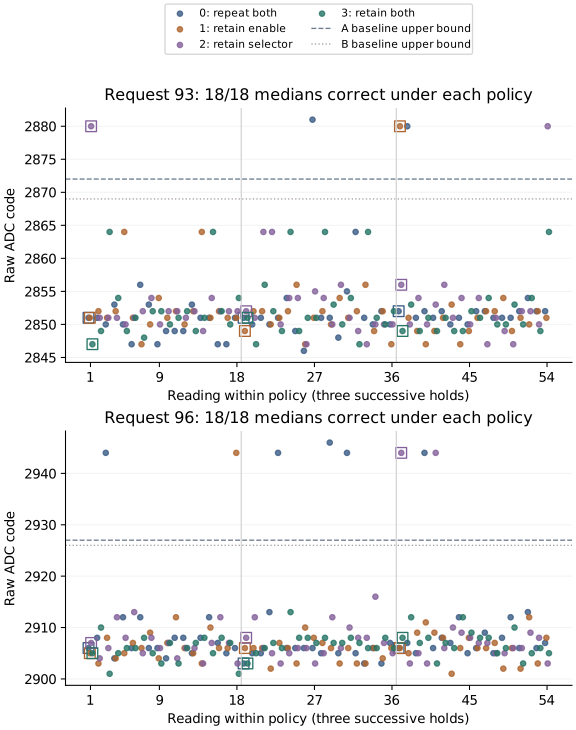
Visits 1, 2 and 3 contain three, four and six raw exceptions respectively. Policy 3 has none in any visit, at either request, including all six initialization readings and all 102 later readings. This is a useful recurrence within the run; the three visits share one boot and do not establish recurrence across boots.
CPU, pin and transaction observations
All 22,092 sequential CPU/pin snapshots retain ISR=0, DAIF=0x3c0 and CurrentEL=8 (EL2). No pending IRQ, FIQ or SError flag, within-access change or change between consecutive snapshots was recorded. Both PMIC lines were high and released, with both mux fields selecting GPIO, in every snapshot. There was no inhibited or failed transfer. The same observations apply to exceptional and ordinary ADC readings.
The retained quiet observer additionally records 150,774 pin-observation iterations, with no sampled line transition, unexpected direction or mux change. The intervals lasted 1.000000–1.004500 milliseconds; the largest recorded observation gap was 7.074 microseconds.
The access counters bracket the new snapshots but do not timestamp each component register read. Conservative upper bounds on gaps between successive snapshots reach 4.053 milliseconds within an acquisition and 10.535 milliseconds between acquisitions. These bounds include portions of the surrounding accesses and padding. The much shorter quiet-observer gap applies only inside its declared one-millisecond windows.
These observations provide no positive indication of competing control at the sampled points. They cannot exclude pulses between snapshots, interrupt sources disabled or masked upstream, another CPU, DMA, internal component activity or another interface. DAIF records the executing CPU's masks; it does not describe every upstream interrupt route. No source of communication is identified and exclusive ownership of the cluster is not established.
The configuration trace contains 11,046 events: 10,638 ADC-related register transfers, 204 omitted enable writes and 204 omitted selector writes. Thirty first-in-hold resets were performed; 618 later resets were omitted by the outer control operation. These omissions match the declared schedule. All four pre/post-quiet register values remain zero, post-trigger status is 1 and cleanup status is 0 throughout.
Reset slots lasted 4.000000–4.001500 milliseconds, enable slots 4.000000–4.001611 milliseconds, and selector slots 4.000000–4.001648 milliseconds. Every performed transfer fit its slot. All request readbacks and repeated result-octet pairs agree, including exceptions. No transport, pin, timing or trace-capacity failure was reported. Status agreement and repeated digital values do not independently establish analog conversion freshness.
Transfer of the fixed reference bounds
All 72 reference medians pass all four frozen calibrations. Four individual reference readings fail at least one rule. Two request-90 readings of 2816 are accepted only at A baseline's upper endpoint. A request-99 reading of 3008 is assigned to state 4 by every rule although the expected state is 3. A request-102 reading of 3007 falls below B candidate's lower bound and is accepted by the other three rules.
Out of 216 raw reference readings, A baseline gives 215 correct / 1 wrong-state / 0 rejected; A candidate and B baseline each give 213 / 1 / 2; B candidate gives 212 / 1 / 3. None is unavailable. The request-99 wrong-state reading recurs from the preceding return. Complete median recognition therefore does not establish reliable single-reading recognition across all six states.
Recording and provenance
Two read-only acquisitions of the 96 MiB region matched. All 282 frozen preparation artifacts, including 274 source snapshots, verify. The reader frozen before execution reproduces the complete analysis. Seven return checks independently reconstruct the classifications, policy exposures, native diagnostic fields, timing and missing-record rejection.
Acquisition occupied 33.736 seconds. The terminal counter corresponds to 957.251 seconds, approximately 15 minutes 57 seconds, at the configured 54 MHz frequency. The remaining interval includes native record encoding, storage and verification. The terminal timestamp follows all auxiliary journal readbacks and precedes its own write/readback; it does not measure total powered duration. The prescribed allowance was twenty minutes; no workflow deviation was reported.
The previous journal and boot-file bytes are unchanged. Seven boot-volume metadata sectors differ; their writer and modification time are not identified by these bytes. The captured medium was not repaired or rewritten.
Capture SHA-256: e9d33036ba1522ad6531bfb1ba9a7a33dda7ac89ad3b587a88e4675a59cc49c5.
Decoded records · Policy and diagnostic observations · Provenance · Boot-volume comparison · Return index
Question and rationale
Do repeated ADC enable or channel-selection writes contribute to the exceptional raw readings? Do sampled CPU interrupt flags or PMIC pin changes coincide with those readings?
The preceding conversion-control return correctly recognized every reference and held-out three-reading median under four fixed calibrations, while retaining eight held-out raw exceptions. Three occurred when the immediate reset was omitted. No pin contradiction appeared in the sampled quiet intervals. The immediate per-conversion reset is therefore not necessary for those cases; enable and selector writes remain common to both previous policies.
This investigation separates those two remaining configuration choices in a two-factor comparison. It adds the same diagnostic observations to every condition. Recognition intervals remain the four actual calibrations from the reference-repeatability return; neither current references nor held-out observations may refit them.
Conditions and exposure
Counts, requests, times and ADC values below are decimal; register addresses and instruction words are hexadecimal. Native journal encoding remains senary. Each hold begins with reset, enable and selector writes. Subsequent readings follow the assigned policy:
| Policy | Enable, 0x801a=1 | Selector, 0x8010=15 |
|---|---|---|
| 0 | Repeat each conversion | Repeat each conversion |
| 1 | Retain after first | Repeat each conversion |
| 2 | Repeat each conversion | Retain after first |
| 3 | Retain after first | Retain after first |
First acquire 36 readings at each nominal request 90, 93, 96, 99, 102 and 105: 216 reference observations. Reset occurs only at the first reading of each reference hold; both configuration writes repeat. These observations test transfer of the frozen bounds under the current instrumentation.
Then perform three visits, each containing all eight combinations of request 93 or 96 and policy 0, 1, 2 or 3. Each condition receives an 18-reading hold in each visit: 54 raw readings and eighteen disjoint triple medians per condition. There are 432 held-out readings, 144 held-out medians and 648 total acquisitions.
| Visit | Ordered request / policy holds |
|---|---|
| 1 | 93/0, 96/3, 93/1, 96/2, 96/0, 93/3, 96/1, 93/2 |
| 2 | 93/2, 96/1, 93/3, 96/0, 96/2, 93/1, 96/3, 93/0 |
| 3 | 96/0, 93/3, 96/1, 93/2, 93/0, 96/3, 93/1, 96/2 |
All later resets within a hold are omitted. The first reading remains separately identifiable because it initializes the retained configuration; it must not be pooled with omitted-write readings when estimating their association with exceptions. Three holds in one boot are not independent apparatus replications or complete order counterbalancing.
Native observations and controlled timing
SEIGRASM retains the previous one-millisecond released-pin observation and the two existing ADC register reads before and after it. Every delegated register access now also receives sequential CPU and pin snapshots before and after transport. CPU observations retain ISR_EL1, DAIF and CurrentEL; pin observations retain the already-used DATA, IODIR and two mux fields.
At the required EL2 entry, the architectural interrupt-status observation exposes pending IRQ, FIQ and SError flags at the executing processing element. The masks and exception level are recorded alongside them. Reading the status does not acknowledge an interrupt. Arm describes these fields and their read encoding in the AArch64 system-register reference in DDI 0500E, section 4.3.77; this architectural reference does not characterize the Pi's interrupt routing. No interrupt-controller acknowledgement, pending-bit clearing, interrupt enabling, FIFO consumption or additional peripheral address is introduced.
Both configuration writes occupy a minimum four-millisecond slot, whether transferred or omitted. The existing four-millisecond reset slot and subsequent twenty-microsecond reset delay remain. Individual transport end, padded slot end and original outer access brackets are retained. Timing failures are reported separately from recognition.
The added snapshot is non-acknowledging but is not temporally neutral: instructions and MMIO reads take time, and configuration padding changes cadence relative to the preceding run. Both choices receive the same instrumentation and budgets. Comparisons within this run concern the declared write policies; a difference from an older uninstrumented or differently paced run cannot isolate the policy effect.
A sampled low line, driven direction or non-GPIO selector before a delegated access inhibits that access and returns status 244; a contradiction after an access also fails it. The original ADC retains its existing transport-status mapping. Faults stop the acquisition prefix and preserve restoration and recording attempts. Pending CPU flags are recorded without clearing or acknowledging them and do not by themselves stop acquisition.
Instruction and recording path
The existing SD loader enters literal AArch64 SEIGRASM at EL2. The new reissue sample entry binds the declared policy and diagnostic row, then delegates to the existing control, acquisition, ADC and GPIO register-transport operations. Its read/write entries suppress only the selected enable or selector reissues. The new signals operation reads the CPU and pin fields. Electrical controls, guard checks, one-millisecond settling, trigger, status cleanup, busy polling, repeated result-octet reads and final restoration remain in their existing owners.
Both new operations are explicit literal opcode words. PC tooling places their bytes and interface data into the image, validates supplied-device executions and independently decodes returned native records. It does not compile a foreign target implementation. Existing boot firmware, supplied MMIO addresses and incomplete component register semantics remain apparatus limitations; these changes do not establish automatic discovery, firmware replacement or another Hyphos creation result.
Each observation retains the original 72-word sample, nine-word operation record and 152-word control trace, followed by 128 configuration words. The configuration header is schema, policy, hold-first flag, completion, completed-event count, overflow, counter frequency and slot budget. Twenty six-word slots follow: actual action kind, start, transport end, slot end, snapshot before and snapshot after.
Action 0 is a read, 1 a write, 3 an omitted enable write, 4 an omitted selector write and 5 an access inhibited by unexpected pins. An omitted reset has no delegated transport call and its additional slot stays empty. The original control trace's write kind records an attempted delegation; only the configuration trace distinguishes actual transfer from the new omissions. An inhibited access retains one contradictory snapshot in both fields; it must not be counted as two independent pin observations.
Each snapshot packs ISR in bits 0–15, DAIF in 16–31, CurrentEL in 32–39, line state in 40–41, direction in 42–43 and the SCL/SDA mux nibbles in 44–47 and 48–51. Observations are sequential. Counters bracket the encompassing access; they do not supply simultaneous timestamps for the individual register reads.
All acquisitions precede SD persistence. Four variable-length journals contain the acquisition and diagnostic rows; the primary journal retains restoration, release and terminal status. A complete run produces 23,444 native records.
Declared assessment
| Property | Requirement or reported comparison |
|---|---|
| Recording | 648 completed acquisitions, operation records, control traces and configuration traces; successful restoration/release; all journal footers and terminal record recovered. |
| Recognition | Report all four fixed calibrations separately. Each must recognize all 72 reference medians and 144 held-out medians to meet its median criterion. Raw correct, wrong-state, unresolved and unavailable outcomes remain separate. |
| Policy execution | First readings perform reset, enable and selection. Later reset omissions and each selected enable/selector omission must match the declared schedule. No unrecorded substitution, retry or exclusion. |
| Timing | Reset, enable and selector slots must each meet the four-millisecond minimum, with no more than fifty microseconds overshoot; successful transport must fit within its slot. Retain and report overruns. |
| Communication observations | Retain pending flags, mask/level context and pin fields for every attempted delegated access. Report persistent flags, changes, gaps between observations, and sampled contradictions alongside raw exceptions and ordinary readings. |
| Comparison | Compare policy 0 versus 1 and 2 versus 3 for enable reissue; 0 versus 2 and 1 versus 3 for selector reissue. Separate requests, visits, hold positions, first readings and later retained-configuration readings. Any interaction remains visible. |
A smaller exception count in a single boot is association evidence, not demonstrated elimination or causality. Pending flags do not identify the originating component or prove an ADC interaction. No pending flag at sampled instants cannot exclude pulses between samples, signals masked or disabled upstream, another CPU's activity, DMA, internal component activity or communication on another interface. The diagnostics do not independently prove analog conversion freshness.
Interpretation and next investigation
The unchanged repeat contradicts elimination of the raw excursions by combined configuration retention. Both exceptional policy-3 readings omit immediate reset, enable and selector reissue. Earlier initialization, trigger and cleanup sequencing, component conversion behavior and the interpretation of retained digital results remain unresolved. No sampled CPU flag or pin contradiction accompanies the exceptions; component interference is neither identified nor comprehensively excluded.
Retaining enable remains associated with fewer later exceptions in each observed request/selector comparison, but the exposures are small and clustered within holds. Boot-specific counts should remain visible; neither a pooled rate nor two zero/nonzero outcomes establish a general probability or causal mechanism. The request-99 wrong-state reference reading also recurs, so the phenomenon is not confined to the two held-out requests.
A next investigation should compare the placement of a controlled delay around the existing trigger/completion sequence, retaining zero added delay as the reference. Equal added intervals immediately before the trigger and after the observed completion status would separate two timing placements while holding the total added budget constant. Keep configuration retained after initialization, preserve the four recognition bounds, retain both requests, balance hold order and record actual trigger, status and result-read counters. Report first readings separately and preserve every raw exception and median failure.
This proposed contrast concerns trigger-relative timing. The earlier result-read investigation changed transfer dwell and padded each result-byte call; the repeated-snapshot investigation retained exceptional values during later reads. Neither directly compared equal delays on opposite sides of the trigger under retained configuration. A placement-specific difference would support a timing association; it would not by itself identify the source or independently prove a fresh analog conversion. The trigger-relative timing investigation specifies the next contrast.
The failed request-96 triple demonstrates that a median of three cannot guarantee rejection of these excursions when two occur together. The Hyphos measurement path must retain this failure boundary. This investigation adds no new Seigsit creation or firmware-independence claim.
Preparation and run interval
The powered allowance is 20 minutes. The preceding 10,116-record return reached its terminal counter at 418.966 seconds. The expanded 23,444-record journal and additional acquisitions support the longer allowance; completion still requires the returned terminal and journal readbacks.
Preparation 13365C0ABE1B passed all 31 supplied-device execution and physical-return reconstruction checks. The SD installation completed with 6,144 verified transfers and two matching full readbacks while the volume remained locked, followed by successful ejection. The pre-write backup matches the preserved preceding return. The returned recording and outcomes are reported above.
Image SHA-256: faf120ce721a96c1daf59d371ee33c3c0ce66fedeb89611fcf0714aef1e524f5.
Frozen protocol · Manifest · Validation · SD verification · Evidence index