
Question and rationale
Can raw Hyphos definitions, executed directly through SEIGRASM, create the experimental Seigsit before later content is supplied, preserve its connected identity and carrier relations, and recover Hyphos that performs a subsequent creation?
The interleaved-reference investigation established complete candidate recognition in two boots, while later acquisitions retained electrical exceptions. The within-bit comparison found agreement at both observed instants in all 10368 bit comparisons, including exceptional readings. These results provide an observable input and recording path for language development. They do not resolve analog accuracy or conversion freshness.
This experiment adds source-defined creation and use to that apparatus. Electrical uncertainty remains visible in the creation prerequisites. It does not select between Hyphos-defined first creation and SEIGRASM-defined first creation; the latter remains a later comparison under common requirements.
Held requests and operation diagnostics
Declared 1 October 2026. The two request-transition boots retained exceptions in different positions: an added request-91 median above state 0's upper bound in the first boot, and an original request-90 median below its lower bound in the second. The request-90 exception followed two accepted triples without a request-code change. This investigation examines longer held-request trajectories and whether bounded instruction activity before acquisition is associated with changes in readings or recognition margins.
Requests, operation profiles and order
Use requests 90 and 91, both evaluated against state 0, with three operation profiles. Values below are displayed in decimal; these are request-register and raw ADC codes, not independently calibrated voltages. Each 36-reading block holds one request: six baseline reference readings, 24 test readings and six baseline reference readings. References and tests are disjoint. Only the test readings receive the selected activity profile.
| Profile | Operation before each test acquisition | Recorded operation evidence |
|---|---|---|
| 0 | Acquisition alone | Zero iterations and zero sum; operation counters and completion retained |
| 1 | Sum integers 1 through 1296 in registers | 1296 iterations; sum 840456 |
| 2 | Write and immediately read integers 1 through 1296 in a private RAM region, while accumulating the same sum | Compare each read word with its intended value; retain iterations, sum and first failure |
The early order is (90, 0), (91, 0), (91, 1), (90, 1), (90, 2), (91, 2), where each pair identifies request and profile. The late order is its reverse. Each of the six conditions therefore occupies complementary positions across visits. Each visit contains 216 readings, including 48 disjoint test medians; the addition contains 432 readings and 96 medians. Each condition is observed once per visit. Reversal balances position across visits but does not isolate all order, carryover or timing effects.
Visits retain the earlier insertion positions after original ordinals 1175 and 3887. The early visit ends at request 91, preserving the request code at its original continuation. It changes intervening activity and elapsed time. The original 3888 readings, 24 carried-action readings and Hyphos creation, progression, retention and logging definitions remain scheduled, giving 4344 readings overall.
Native diagnostics and failure handling
activity.aarch64.seigrasm contains literal instructions for the bounded operations and their diagnostics. For every added acquisition, including references, it records the actual selected profile, operation start and end counters, completed iterations, sum, status and completion marker. Its seven-word diagnostic entry corresponds to the existing row ordinal. Counts and sums are checked against expected values during PC readback; the memory profile also compares each read word with its intended value on the target. The original 72-word observation retains request history, previous raw value and status, request readbacks, ADC register traces, repeated octet comparisons and acquisition counters.
The operation runs before the unchanged guard, mandatory 1 ms settling interval and ADC acquisition. Zero added acquisition wait remains the reference. Operation duration is measured, not equalized; any observed difference can include both instruction activity and elapsed time. These profiles do not impose concurrent activity during conversion. Immediate RAM readback may be served by processor mechanisms and does not independently qualify external memory behavior.
A mismatched memory read or invalid profile records failure and stops added sampling before the next electrical acquisition. Existing sample failures stop their visit; an incomplete early visit inhibits the late visit. The enclosing original sequence retains responsibility for restoration. No failed observation is retried or discarded.
Each visit records a header, 216 original-format observation rows followed by 216 seven-word operation entries, and a footer. The journal uses 1712 of its 1716 reserved sectors; both visits use 3424 records. The existing SEIGRASM senary record construction, CRC, SD transfer and full readback operations persist these records. Each journal has its own ordinal sequence and the new run identity. The fixed prior journal remains preserved.
Assessment and limits
Use the preceding original round-1 calibration for the early visit and round-5 calibration for the late visit. Keep those intervals fixed. The PC reconstructs each disjoint test triple's median, recognized state, outcome and signed distances from both interval edges. Report all individual readings, the first and later triples, pre/post reference distributions and movement, operation duration, and time from operation completion to acquisition. Neither reference nor test values revise the accepted intervals.
Compare each request, profile and visit separately. Excursions during baseline held acquisition would weaken an explanation requiring the added operation. Concentration after one profile would motivate a subsequent comparison that separates instruction activity from elapsed time. Movement in independent references would support investigating changing local distributions; isolated test excursions with stable references would require a different account. A clean boot would leave the previous exceptions unexplained. Sequential readings and shared apparatus do not supply independent reliability trials.
Report recording completion, original recognition and added recognition separately. Recording requires both complete journals, all 432 acquisition and operation records, correct operation counts and sums, ordered counters, no native operation failure, and the existing restoration, Hyphos and logging checks. Preserve all original 324 primary and 108 reserved decisions and all 96 added median outcomes. The overall existing completion criterion also requires original recognition; added recognition has its own denominator. Independent conversion freshness, absolute analog accuracy, thermal causation, firmware replacement and cross-cluster reliability remain unestablished.
The powered interval remains 60 minutes. The latest return's final recorded footer occurred at approximately 46 minutes 36 seconds. This preparation adds 302 journal records and bounded operation work while retaining the same number of acquisitions. The interval is a completion allowance; only the returned journals can establish whether the new run finished.
Held requests and operation diagnostics: returned observations
All 4344 acquisitions were recovered. Every added operation completed with the expected iteration count and sum. Original recognition was 323/324 primary and 108/108 reserved; added recognition was 94/96 disjoint medians. Two added exceptions occurred in the early visit, under different profiles. The declared overall completion criterion is not met. Complete diagnostic recording and correct handling of a rejected Hyphos prerequisite are separate results.
Recording and execution
Return 4583873BA6C0 was acquired on 1 October 2026. Two complete read-only SD captures agree. All 245 preparation artifacts and 141 image-source hashes were verified. The reader preserved before execution reproduces all 16 initial decoded JSON artifacts byte for byte. Both added journals contain 1712 records and all 216 acquisition and operation entries, with no journal or operation issue. All 761 native logging verifications passed. The prior journal and boot-file contents are unchanged; seven other boot-volume sectors changed without evidence identifying their modification time or writer.
The operation records include 240 baseline entries and 96 entries each for arithmetic and RAM write/read. References account for 144 of the baseline entries. Each nonbaseline operation records 1296 iterations and sum 840456; all 432 status fields indicate success. Native transfer and Hyphos consumption preserve the unresolved original decision. Progression, content retention, recovery and logging checks are met.
Three distinct recognition exceptions
Values are decimal request-register and raw ADC codes. Original decisions are made during target execution; added decisions below are reconstructed on the PC from the recorded disjoint triples and the preceding fixed calibration.
| Sequence | Request / state | Raw triple | Median | Accepted interval | Excursion |
|---|---|---|---|---|---|
| Original ordinal 584, round 0, trigger_B | 93 / 1 | 2864, 2880, 2881 | 2880 | 2827-2876 | 4 above upper bound |
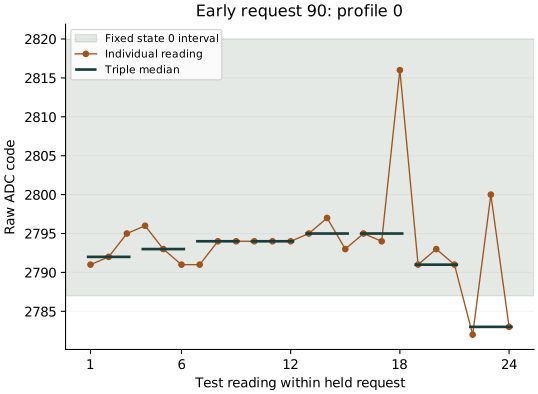
| Early baseline, eighth test triple | 90 / 0 | 2782, 2800, 2783 | 2783 | 2787-2820 | 4 below lower bound |
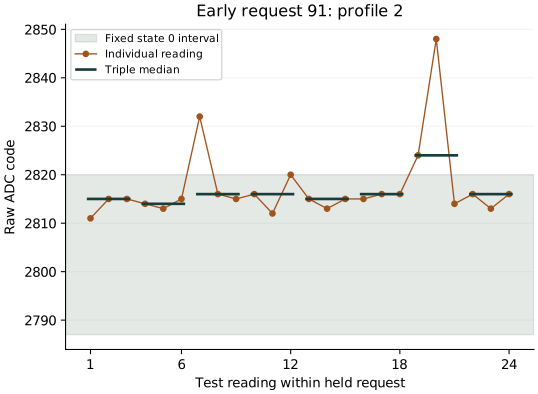
| Early RAM write/read, seventh test triple | 91 / 0 | 2824, 2848, 2814 | 2824 | 2787-2820 | 4 above upper bound |
The original state-1 exception occurs before either added visit. Its preceding request-93 omitted-trigger control retains median 2796; the exceptional trigger_B triple follows that control. The later request-92 probe produces median 2832 and is accepted. These are different operations and requests, not a repeat measurement demonstrating recovery under identical conditions.
The state-0 baseline exception appears after seven accepted triples while request 90 remains held. Its six pre-reference readings have median 2795.5 and its six post-reference readings median 2794, compared with the exceptional median 2783. The RAM-profile exception at held request 91 follows six accepted triples; its reference medians move from 2813 to 2816. The post-reference readings include 2824. These short reference groups neither eliminate transient changes nor establish a common cause.
For all three exceptional triples, request readbacks and repeated ADC octet pairs agree, and acquisition/guard statuses report no error. Agreement supports the consistency of the captured digital readouts; it does not independently establish conversion freshness or analog accuracy.
Recognition by visit and profile
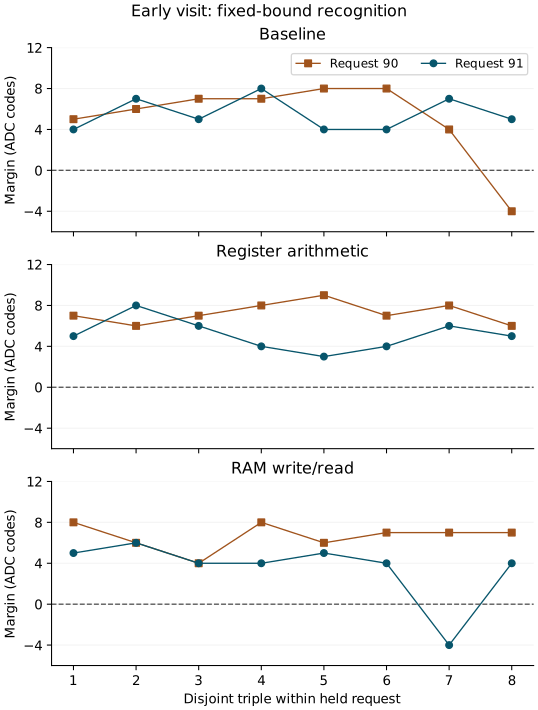
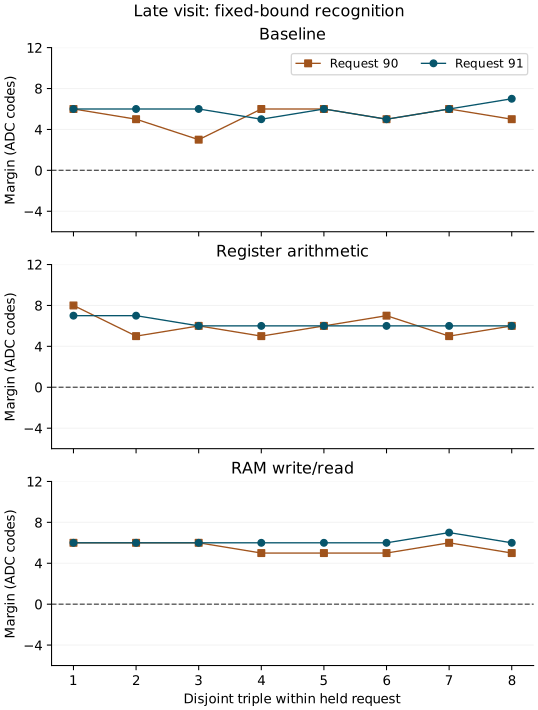
The early state-0 interval is 2787-2820; the late interval is 2792-2823. All 48 late medians are accepted. Each table row represents eight disjoint test medians. Negative margin denotes an interval excursion. References do not change these bounds.
| Visit | Request | Profile | Correct | Unresolved | Margin range |
|---|---|---|---|---|---|
| Early | 90 | Baseline | 7/8 | 1 | -4 to 8 |
| Early | 91 | Baseline | 8/8 | 0 | 4 to 8 |
| Early | 91 | Arithmetic | 8/8 | 0 | 3 to 8 |
| Early | 90 | Arithmetic | 8/8 | 0 | 6 to 9 |
| Early | 90 | RAM write/read | 8/8 | 0 | 4 to 8 |
| Early | 91 | RAM write/read | 7/8 | 1 | -4 to 6 |
| Late | 91 | RAM write/read | 8/8 | 0 | 6 to 7 |
| Late | 90 | RAM write/read | 8/8 | 0 | 5 to 6 |
| Late | 90 | Arithmetic | 8/8 | 0 | 5 to 8 |
| Late | 91 | Arithmetic | 8/8 | 0 | 6 to 7 |
| Late | 91 | Baseline | 8/8 | 0 | 5 to 7 |
| Late | 90 | Baseline | 8/8 | 0 | 3 to 6 |
Hyphos prerequisite handling
Of the 36 scheduled creation cases, 35 satisfy creation, later use and carried execution. The round-0 state-1 case associated with ordinal 584 rejects the unresolved input with recorded status 7 and blocks the dependent carried execution. All 468 source operations are recorded, and the source-defined outcomes match the supplied observations. This is evidence of the rejection path operating; it does not satisfy the all-cases creation criterion.
Timing and interpretation
Median operation durations in the early/late visits are approximately 0.630/0.630 microseconds for the baseline, 682.546/692.537 microseconds for arithmetic, and 969.444/984.917 microseconds for RAM write/read. These summaries use 48 test operations per profile and visit, excluding reference operations. The corresponding median intervals from operation completion to ADC acquisition start are about 3.239 ms early and 3.255 ms late. Profiles therefore differ in elapsed time as well as instructions; the comparison cannot attribute a difference solely to memory access.
The added acquisition visits start approximately 41.42 and 146.07 seconds after the original acquisition start and last 7.63 and 7.69 seconds. Their persistence occurs later. The final added-footer counter divided by the configured 54 MHz frequency is approximately 46 minutes 49 seconds; the footer precedes its own final write/readback. This is a recorded counter relation, not an independent powered-duration measurement.
The baseline excursion and the earlier original exception rule out an explanation requiring the added arithmetic or RAM operations for every exception. A single RAM-profile excursion does not establish that RAM activity raises their rate. The original exception also extends this return's observations beyond state 0. All exceptional medians lie four codes outside their respective bounds, but that common distance does not identify a mechanism or justify widening the intervals.
A proposed next comparison should repeat balanced condition blocks with duration-matched delay controls for arithmetic and RAM activity, while preserving zero added acquisition wait and the existing recognition criteria. Include request 93 alongside the held state-0 requests so the state-1 exception is represented. Keep operation completion, analog recognition and Hyphos prerequisite outcomes separate. Multiple balanced repetitions would distinguish a recurring profile association from isolated excursions; conversion freshness, thermal causation and absolute voltage accuracy remain unresolved.
Operation and exception observations · Decoded return · Acquisition provenance · Evidence index
Held-request diagnostics: preparation
Preparation 4583873BA6C0 adds one literal instruction region for operation execution and diagnostics while preserving all 62 preceding instruction regions and raw Hyphos definitions. Both 216-reading visits retain their original acquisition positions. The 432 seven-word diagnostic entries are recorded after their corresponding observation rows in the existing journal allocations. Current-run reservations are bound to a new identity; the fixed prior journal remains unchanged.
All 48 supplied-device checks passed, covering bounded arithmetic and RAM operations, per-acquisition diagnostics, complete native journal writes/readbacks, invalid profiles, memory mismatch, missing or corrupted diagnostic entries, fixed recognition intervals and reproduction of earlier returns. These checks validate the implementation with supplied inputs; the physical outcome is pending.
The 96 MiB image was written with 6144 verified transfers and two complete matching readbacks while the volume remained locked. The card was ejected. Its image SHA-256 is 2b13a524ef8e0176c961da636700151d90dc267b52fc28224ca72722682efddc. The preserved pre-write image matches the preceding returned capture.
Frozen protocol · Manifest · Validation · SD verification · Evidence index
Request transition and held-state comparison
Declared 30 September 2026. The preceding return recognized every added held-out median after triggered and omitted conditioning, but its original sequence retained one wrong-state decision. Request 91, intended as state 0, produced 2816, 2832 and 2832; its median lay inside state 1's accepted interval. A triggered request-90 triple immediately before it was correctly recognized. This investigation tests whether the 90→91 request change is associated with such excursions, compared with continued acquisition at 91.
Matched histories and placement
Compare two histories with the same number of observations and the same conversion modes. Both begin with independent request-91 references and a triggered prime at request 102. One then omits and triggers conversions at 90 before changing to 91; the other performs those steps at 91 and continues at 91. The controlled difference is the intermediate requested code. Both retain the omitted-conversion step from the exceptional history.
| Phase | Transition arm | Held arm | Readings / conversion |
|---|---|---|---|
| Independent pre-reference | 91 | 91 | 9 / triggered |
| Prime | 102 | 102 | 3 / triggered |
| Omitted control | 90 | 91 | 3 / omitted |
| Triggered predecessor | 90 | 91 | 3 / triggered |
| Held-out test | 91 | 91 | 9 / triggered |
| Independent post-reference | 91 | 91 | 9 / triggered |
An early visit follows original ordinal 1175, the preceding return's exception position in zero-based round 1. A late visit follows ordinal 3887 and its carried actions, before the enclosing restoration. Each visit has three matched pairs, each pair has two 36-reading episodes, and each episode supplies three disjoint held-out medians. The complete addition contains 432 observations, including 36 omitted controls, and 36 held-out medians. The existing 3888 original and 24 carried-action observations remain scheduled, giving 4344 observations overall.
Early pair order is transition/held, held/transition, transition/held; late order reverses it. Each arm therefore runs first three times across the six pairs. The 2:1 first-position imbalance within a visit reverses between visits. Every episode finishes at 91. The early visit consequently resumes after the same request code as the original ordinal-1175 observation. Its additional acquisitions still change the elapsed time and electrical history of later observations; unchanged original instructions do not make this an unchanged physical baseline.
Recognition and diagnostic separation
Use the existing nine-reading calibration from original round 1 for the early visit and round 5 for the late visit. Each was obtained before its respective added visit and remains fixed throughout that visit. The added medians and classifications are reconstructed on the PC from native observations and native calibration records; the original online decisions supplied to Hyphos remain unchanged. The recognition algorithm is unchanged; the numerical intervals may differ between rounds. The nine pre-reference and nine post-reference readings provide separate diagnostic medians at 91. They never shift or widen the recognition bounds, and no held-out value enters either reference.
Report the first held-out triple separately from the two later triples: each visit/arm cell supplies three first and six later medians. Preserve all raw readings, wrong-state, unresolved and unavailable outcomes, recognized state identities and signed margins. For each pair, retain the transition-minus-held difference in first median and margin. Compare reference movement, preceding triggered values and within-burst trajectories. A concentration of excursions after the request change would support a history-associated effect; similar excursions while holding 91 would require a broader explanation. A clean visit would leave the preceding exception's cause unresolved.
Zero added acquisition wait remains the reference. The existing operating guard, mandatory 1 ms settling interval, request readback, ADC modes and audit counters remain unchanged. These are request-register and raw ADC codes, not independently calibrated voltages. Repeated octet agreement cannot establish conversion freshness. Comparisons between early and late visits also include changes in calibration, intervening history and elapsed time; they do not isolate temperature or reference age.
Execution and recoverable recording
visit.aarch64.seigrasm supplies the literal instructions that select the two acquisition positions. Each visit runs once after a successful delegated sample, using the existing bounded acquisition routine. A failed early visit inhibits the late visit; failures are retained without retries. The original sample status and result are returned to its caller, and ADC trace/mode bindings are restored. The original acquisition retains responsibility for its enclosing voltage restoration.
All 61 preceding instruction regions and raw Hyphos creation, carried-action, content-retention and logging definitions remain unchanged. PC tools place literal instruction bytes and data and subsequently assess the returned records. The two visits use separate 216-row headers and journals in the existing auxiliary tail: 1716 reserved sectors per visit, 1561 records used per complete visit. The original recording runs first, followed by the early journal and then the late journal. Failure of the early journal write prevents the late journal write. The same SEIGRASM record construction, CRC, SD transfer and full readback operations serve both journals.
Recording completion requires both visit journals, their declared modes and descriptors, all 432 successful observations, ordered counters within the declared original acquisition positions, and the existing restoration, Hyphos and logging checks. Electrical recognition is assessed separately. Preserve the original 324 primary and 108 reserved outcomes and every added wrong-state or unresolved result. The SD/controller and boot dependencies remain shared; independent analog freshness, absolute voltage accuracy and firmware replacement are not established by this experiment.
The prescribed powered interval remains 60 minutes. The number of acquisitions is unchanged from the previous run, while splitting the journal adds six records. The interval allows the finite native recording sequence to finish.
Request transition comparison: second return
Both visits completed and all 4344 observations were recovered. The added comparison accepted 36/36 medians. Original recognition retained one unresolved decision: 323/324 primary and 108/108 reserved medians were correct. The original exception occurred at request 90 while that request was already held. The declared completion criterion is unmet because original recognition is incomplete; the diagnostic recording criterion is met.
Comparison between boots
| Boot | Original primary | Reserved | Added medians | Exception |
|---|---|---|---|---|
| 1 | 324/324 correct | 108/108 correct | 35/36 correct | Early added transition arm: 2824, three codes above the state-0 upper bound |
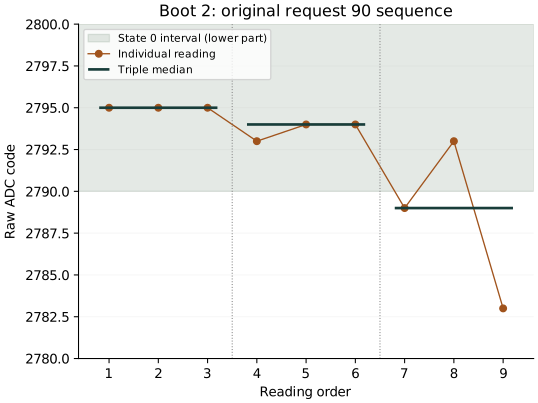
| 2 | 323/324 correct | 108/108 correct | 36/36 correct | Original held request 90: 2789, one code below the state-0 lower bound |
The 62 instruction regions, electrical settings, schedule and recognition algorithm were unchanged between boots. Each boot obtained its own calibration intervals. The first boot's added exception did not recur; the second boot's original exception is at a different request and on the opposite side of state 0's interval. These are separate observations, not repeated instances of an identified mechanism. Sequential triples are not independent reliability trials. Request and ADC codes are displayed here in decimal.
Lower-bound exception during a held request
In zero-based round 2, the original prime_A triple ending at ordinal 1802 contained 2789, 2793 and 2783. Its median, 2789, was below the fixed state-0 interval of 2790–2821. The native classifier reported unresolved, and Hyphos consumed that recorded decision successfully. The context journal identifies both previous and current requests as 90.
The preceding triggered and probe triples at the same request had accepted medians of 2795 and 2794. The other 41 original, non-omitted request-90 medians were accepted and ranged from 2793 to 2800. All three exceptional acquisitions retained matching request readbacks and agreeing repeated ADC octet pairs. Those checks establish agreement in the recorded readouts; they do not establish independent conversion freshness or identify the physical source of the excursion.
Added transition and held-state observations
All twelve first triples and all 24 later triples were accepted. Each early/late and transition/held cell had 9/9 accepted medians. Transition-minus-held first-median differences were −4, +1, +1 early and +1, 0, 0 late. Early state-0 bounds were 2789–2820; late bounds were 2791–2823. They remained fixed within each visit.
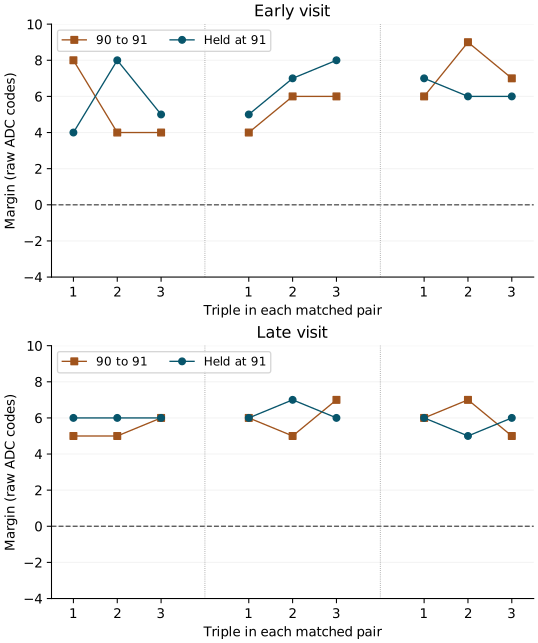
Individual readings still extended outside state 0 early: the transition arm had one gap value among 27 readings, and the held arm had one value inside state 1 among 27. Both late arms had 27/27 readings inside state 0. The declared triple-median estimator accepted all four cells; this does not imply acceptance of every individual reading. Independent reference medians moved by −2 to +2 codes. All 36 omitted-conversion readings retained their preceding prime value, all 432 request readbacks matched, and no repeated ADC octet pair disagreed.
Native execution and evidence recovery
All 36 Hyphos creation/use cases, twelve progression cases, two retention cases, five recovered entries and five current entries passed their existing checks. All 761 native verification entries passed. The original, auxiliary and progress journals contain 36774, 12952 and 12228 records; each added visit contains 1561 records and its footer. Six restorations, final restoration and pin release completed successfully. Successful transport and consumption preserve the unresolved electrical result; they do not turn it into an accepted state.
The early visit began 41.42 seconds after original acquisition began and lasted 7.57 seconds. The late visit began at 145.97 seconds and lasted 7.57 seconds. The last added footer was recorded at 2796.40 seconds, approximately 46 minutes 36 seconds, before its own final write/readback. These intervals use the configured counter frequency and do not independently measure powered duration.
The card returned on 1 October 2026. Two read-only captures were identical, and every decoded JSON artifact agreed byte-for-byte between the current reader and the reader frozen before execution. Verification covered 241 preparation artifacts, 229 frozen validation inputs and 138 image inputs. Both boot files and the prior journal remain unchanged. Seven boot-volume sectors differ; modification time and writer are undetermined. Seven return checks passed, covering the exceptional native decision, both visits, separate boot outcomes and incomplete-journal rejection.
Interpretation and next investigation
The two boots retain complete acquisition and native recording, with exceptions in different parts of the electrical sequence. A cause restricted to the 90→91 change does not account for the second boot's request-90 exception. The records leave supply variation, conversion behavior, acquisition effects and calibration margins unresolved. Early and late visits also differ in calibration and intervening history, so their different raw spreads do not isolate temperature.
The next proposed investigation should use longer balanced blocks held at requests 90 and 91, repeated early and late, with separate reference observations before and after each block. Retain zero added acquisition wait, the existing calibration algorithm and fixed per-visit bounds. Preserve individual readings, disjoint triple decisions, reference movement and signed distances from both interval edges. This would examine the distribution and sequence of held-request excursions without retrospectively widening intervals or discarding failed observations.
Two-boot comparison · Visit observations · Acquisition provenance · Evidence index
Request transition comparison: second boot
The first boot recorded the complete native sequence and one unresolved added median after an accepted triple in the early transition arm. The second boot tests whether this pattern recurs under the same procedure before changing calibration or adding delay.
Preparation 140DFD5F9384 retains all 62 instruction regions, raw Hyphos definitions, electrical settings, paired schedules, early/late positions and recognition rules. Only the 32-byte run identity differs in the executable payload. All 65472 current-run journal sectors are empty and bound to the new identity; the fixed prior journal is preserved. The 15-check preparation validation is reused after verifying all 229 validation source hashes and 138 image input hashes are unchanged.
Keep the same 60-minute powered interval. Each visit obtains its fixed bounds from its preceding original calibration; numerical bounds are not copied from the previous boot. Report both boots separately, including first-versus-later medians, raw excursions and reference movement. A clean repeat would leave the earlier cause unresolved. The method and criteria remain unchanged.
The SD write completed with 6144 verified transfers and two complete matching readbacks. The card was ejected. These checks establish preparation integrity. The second return is assessed separately.
Repeat protocol · Unchanged-input comparison · Manifest · SD verification
Request transition and held-state comparison: returned observations
All 4344 scheduled observations and the native journals were recovered. Original recognition was 324/324 primary and 108/108 reserved. The added comparison retained one unresolved median: 35/36 held-out medians were correct. The declared completion criterion combines original recognition with complete diagnostic recording and was met. Added recognition is assessed separately; its single exception remains part of the result.
| Visit | History | First triples | Later triples |
|---|---|---|---|
| Early | 90 → 91 | 3/3 correct | 5/6 correct; 1 unresolved |
| Early | Held at 91 | 3/3 correct | 6/6 correct |
| Late | 90 → 91 | 3/3 correct | 6/6 correct |
| Late | Held at 91 | 3/3 correct | 6/6 correct |
All twelve first triples were accepted. Transition-minus-held first-median differences were +1, 0, +2 in the early visit and +1, −1, +1 in the late visit. The early state-0 interval was 2789–2821; the late interval was 2791–2823. Each interval came from its preceding original calibration and remained fixed throughout its visit. Values are raw request-register and ADC codes, displayed here in decimal.
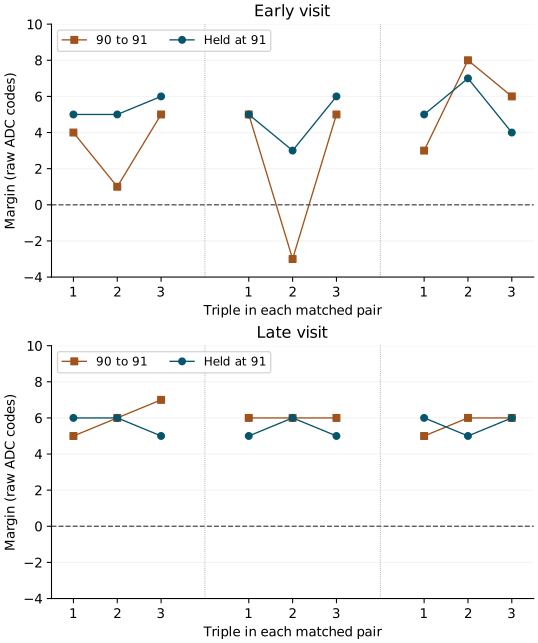
Exception after an accepted triple
Early episode 3, the transition member of the second pair, produced 2824, 2807 and 2848 at local ordinals 129–131. Its median, 2824, exceeded the state-0 upper bound by three codes and remained below the state-1 lower bound of 2827. It was therefore unresolved. The preceding test triple, 2816, 2816, 2817, and the following triple, 2816, 2811, 2818, both had accepted medians of 2816.
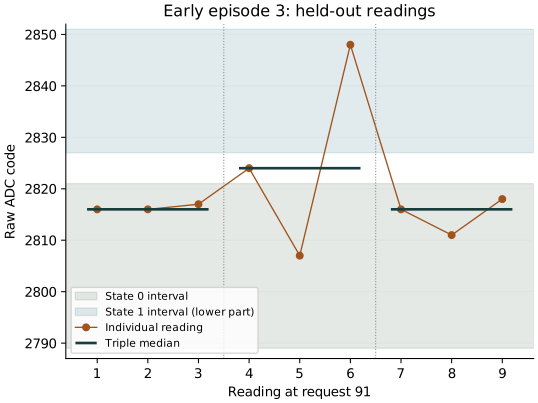
The episode's preceding triggered request-90 readings were 2796, 2796 and 2793. Independent request-91 reference medians were 2816 before the episode and 2814 after it. The exceptional readings completed 136.35–206.22 ms after the first test reading's recorded start counter. All request readbacks agreed, sample and operating-guard statuses were successful, and both observed ADC octet pairs agreed within each acquisition. These records locate the excursion; they do not distinguish supply behavior, conversion behavior or an acquisition effect.
Individual held-out readings also exceeded state 0 in the early held arm: one of its 27 readings lay inside state 1, while all nine triple medians were accepted. The early transition arm had three such readings and one gap value among 27; both late arms had 27/27 individual readings inside state 0. These raw counts are diagnostics, not replacements for the declared median estimator. A single boot with sequential pairs does not establish that the transition caused the excursion.
All 36 omitted-conversion readings retained their episode's last prime value. All 432 added request readbacks matched, and no repeated ADC octet pair disagreed. Reference medians moved by −2 to +2 codes across early episodes and −1 to +1 late. Stable readout pairs and triggered changes remain insufficient to establish independent conversion freshness.
Original execution and recording
The preceding return's original exception at ordinal 1175 did not recur: its three readings were 2812, 2816 and 2814, with an accepted median of 2814. All 36 Hyphos creation/use cases, twelve progression cases, two retention cases, five recovered entries and five current entries passed their existing checks. All 761 native verification entries passed. Six restorations, final restoration and pin release completed successfully. The original, auxiliary and progress journals contain 36774, 12952 and 12228 records; each added visit has 1561 records and its complete footer.
The early visit started 41.43 seconds after original acquisition began and lasted 7.57 seconds; the late visit started at 146.20 seconds and lasted 7.63 seconds. The last added footer was recorded at 2796.68 seconds, approximately 46 minutes 37 seconds, before its own final write/readback. These are counter-derived intervals, not an independent measurement of powered duration.
Two read-only SD acquisitions were identical. The current reader reproduced every decoded JSON artifact from the frozen reader. Verification covered 241 preparation artifacts, 229 frozen validation inputs and 138 image inputs. Both boot files and the previous journal are unchanged. Seven boot-volume sectors differ; their writer and modification time are undetermined. Four return checks passed, including preservation of the unresolved classification and rejection of a missing late footer despite complete acquired values.
Interpretation and next comparison
This return supports complete native recording and original recognition under the tested conditions, while retaining an intermittent exception in the added early sequence. It does not support an explanation restricted to the first triple after a request change: the exception followed an accepted triple at the same request. The lower spread late in the run is an observation; calibration, elapsed time and intervening electrical history also differ between visits.
The next comparison should repeat these matched early and late histories with the same instructions, settings, acquisition schedule and recognition rules, using a new run identity and empty current-run journals. This tests recurrence before changing calibration or adding delay. The repeated boot should retain the successful and exceptional raw trajectories, first-versus-later medians and separate recording result. Bounds remain fixed by each visit's preceding calibration. Firmware replacement, independent conversion freshness, absolute voltage accuracy and cross-cluster qualification remain unresolved.
Paired assessment · Visit and exception observations · Acquisition provenance · Evidence index
Request transition comparison: preparation
Preparation C2F94D8002B9; physical results pending. All 15 focused checks passed, covering native visit placement, one-shot execution, preserved original results, early-failure inhibition, restoration of ADC bindings, two disjoint journals, recording failure, calibration timing, held-out/reference separation and reproduction of the preceding physical return. The unchanged components retain their pinned prior validation. The archive preserves 229 validated inputs and 138 image-source hashes; all 61 preceding instruction regions remain unchanged.
The 96 MiB image passed 6144 chunk comparisons and two complete readbacks while the volume remained locked. Both full readbacks matched the prepared image, and the SD was ejected. The pre-write backup matches the archived preceding return, and the 18841600-byte earlier journal was preserved. These checks establish SD preparation; the two physical visits remain unobserved.
Frozen protocol · Controlled changes and schedule · Software validation · SD verification · Artifact index
Matched conversion history: returned observations
All 4344 scheduled observations and the native journals were recovered. All 48 added held-out medians were recognized correctly under both conditioning procedures. In the original sequence, 323/324 primary medians and 108/108 reserved medians were correct. The remaining primary median was recognized as the wrong state. The complete electrical criterion was therefore not met.
| Transition | Conditioning | First triples | Later triples | Median range | Margin range |
|---|---|---|---|---|---|
| 105 → 90 | Triggered | 3/3 correct | 9/9 correct | 2796–2800 | 5–9 |
| 105 → 90 | Omitted | 3/3 correct | 9/9 correct | 2797–2799 | 6–8 |
| 96 → 93 | Triggered | 3/3 correct | 9/9 correct | 2853–2856 | 23–25 |
| 96 → 93 | Omitted | 3/3 correct | 9/9 correct | 2852–2855 | 23–25 |
Ranges are raw ADC codes. Fixed intervals were 2791–2823 for request 90 and 2829–2879 for request 93. The six omitted-minus-triggered first-median differences, in pair order, were +1, +1, −1, +1, 0 and −1. Adjacent reference medians were unchanged in ten episodes and increased by one code in two. No reference was used to adjust these intervals.
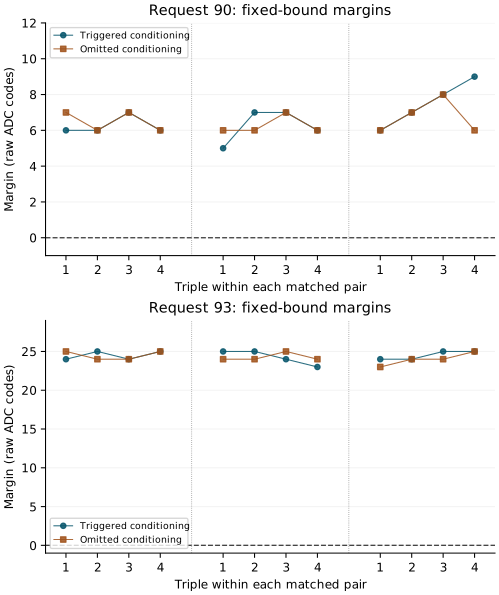
All 18 omitted-conditioning readings equalled their episode's last prime reading. Triggered conditioning changed the readout toward the requested test value. The three-reading conditioning phases occupied 109.40–109.66 ms when triggered and 104.09–104.28 ms when omitted. This difference remains part of the procedural contrast. Stable repeated register values and subsequent changes do not independently prove conversion freshness. The late comparison did not reproduce either earlier exception or show an acceptance advantage from triggered conditioning.
Wrong-state recognition in the original sequence
In zero-based round 1, state 0 at request 91 produced 2816, 2832 and 2832, ending at ordinal 1175. The median, 2832, exceeded the state-0 upper bound of 2820 by twelve codes and fell inside the state-1 interval, 2826–2876. This was a wrong-state recognition, rather than an unresolved value in the gap. The native decision entry, its context and its Hyphos consumption were recovered consistently.
The sequence primed request 102 with readings 3022, 3021 and 3023. Omitted-trigger reads at request 90 retained 3023. The next triggered request-90 triple gave 2816, 2792 and 2789, whose median 2792 was correctly recognized as state 0. The exceptional request-91 triple followed in probe_B. Thus this exception occurred after an already successful triggered triple and a request change, whereas both exceptions in the preceding return occurred in trigger_B. Across this return, prime_A and trigger_B each had 108/108 correct medians; probe_B had 107/108.
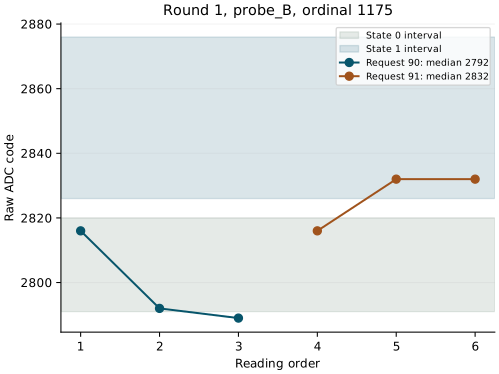
All three request-91 control readbacks matched the request, and the two observed ADC octet pairs agreed within each acquisition. The other eleven request-91 primary medians in this boot ranged from 2811 to 2818 and were accepted. These observations locate an intermittent excursion but do not distinguish a supply change, conversion behavior or an acquisition effect. The deliberately omitted controls remain outside the primary recognition denominator.
Native execution and evidence integrity
All 36 Hyphos creation/use cases, twelve progression cases, two content-retention cases, five recovered entries and five current entries passed their existing checks. The complete reports account for 2972 planned Hyphos operations. All 761 checkpointed native verifications passed, with 80 transfer pairs, a complete 256-row terminal trace, six restorations and successful final restoration and pin release. The original, auxiliary, progress and added journals contain 36774, 12952, 12228 and 3116 records respectively. Correct logging preserves the electrical exception; it does not turn it into a correct recognition.
Two read-only 96 MiB SD captures matched. Current and frozen readers produced identical assessments. All 234 indexed preparation artifacts, 222 frozen validation inputs and 137 image-source hashes were verified. The earlier journal and boot-file contents were unchanged. Seven boot-volume sectors differed; their writer and modification time are undetermined. Four focused return checks verify reproducibility, the wrong-state distinction, control separation and rejection of a missing final record.
The added acquisition occupied 15.2754 counter-derived seconds. The interval from original acquisition start to construction of the added footer was 2796.2669 seconds, approximately 46 minutes 36 seconds. That timestamp precedes the footer's own write/readback and is not a measurement of the powered interval. No additional wall-clock duration or boot count was reported for this return.
Implication for the next investigation
The matched 105→90 and 96→93 comparison provides no evidence of excess first-triple exceptions following omitted conditioning in this late phase. It does not exclude such effects elsewhere in the sequence. The new wrong-state event makes the 90→91 transition and continued acquisition at 91 a more discriminating next target than repeating only the clean late contrast.
A proposed follow-up would compare the exceptional 102→90→91 history with a matched sequence holding request 91, preserving fixed recognition rules, zero added wait, disjoint references, raw triples and native timing/context. Include early and late placement to examine the present timing limitation. The objective is to distinguish a transition-associated excursion from variation while a request is held. Widening state 0 to include 2832 would overlap the accepted state-1 interval in this return and cannot serve as a valid calibration remedy. General recognition reliability, independent conversion freshness and firmware replacement remain open.
Matched comparisons · Conditioning and exception observations · Returned assessment · Provenance · Artifact index
Matched conversion history
Declared 30 September 2026. The preceding return retained two unresolved primary medians, both in the first triggered triple following the deliberately omitted-conversion control: request 105→90 preceded a state-0 low excursion, and 96→93 preceded a state-1 high excursion. The later 94/95 boundary comparison accepted every held-out triple with either fixed or local references. A matched comparison of acquisition history now tests a relation that endpoint recalibration alone did not examine.
Question and controlled contrast
Does the first triggered triple at request B differ after three conditioning observations with conversion omitted, compared with three conditioning observations that trigger conversions? Test A→B transitions 105→90 and 96→93. Compare first-triple recognition, signed margin and raw trajectory with the later triples; retain independent reference observations at B before and after the sequence. These are raw request-register and ADC codes, not calibrated voltages.
Retain the complete original acquisition, Hyphos creation/use, content retention, recovery and native logging sequence. Replace the preceding late endpoint schedule with this matched schedule, at the same point after ordinal 3887 and carried actions but before the enclosing voltage restoration. Preserve all sixty earlier instruction regions, electrical settings, original recognition rules and zero added acquisition wait. The final-round nine-reading calibration supplies fixed intervals throughout the added phase.
Paired sequence
| Phase | Request | Readings | Conversion |
|---|---|---|---|
| Independent pre-reference | B | 9 | Triggered |
| Prime preceding request | A | 3 | Triggered |
| Conditioning | B | 3 | Triggered in one episode; omitted in its paired episode |
| Held-out test | B | 12 | Triggered |
| Independent post-reference | B | 9 | Triggered |
Three repetitions contain one pair for each transition. Transition order is 105→90 then 96→93, reversed in repetition two, then restored in repetition three. For 105→90, the first conditioning mode is triggered, omitted, triggered across repetitions; for 96→93 it is omitted, triggered, omitted. Each pair's second episode uses the other mode. Each transition therefore has three episodes per mode; across the six pairs, each mode runs first three times. Within one transition the first-mode allocation is necessarily 2:1 with three pairs, and that imbalance reverses for the other transition.
Twelve 36-reading episodes produce 432 added observations: 414 triggered acquisitions and 18 omitted-trigger control reads. Each transition/mode cell supplies three first triples and nine later triples, giving 48 held-out medians overall. No target value is reused as a reference or selected after seeing its outcome. Every observation retains the existing request selection, operating guard and mandatory 1 ms settling interval. Zero added wait does not remove those operations or transaction time.
Assessment
Classify each held-out median using the fixed final-round bounds. Retain correct, wrong-state, unresolved and unavailable outcomes, raw readings and the signed distance to the nearer bound. Report the first triple separately from the other three. For each pair, report the omitted-minus-triggered difference in first-triple median and margin. Preserve all pair outcomes; a favorable pair does not replace an unfavorable one.
The nine disjoint pre-reference readings and nine post-reference readings each supply a median at the actual test request, 90 or 93. Report target-minus-reference differences and reference movement as diagnostics. These references do not shift, widen or refit the recognition intervals. Omitted-trigger controls remain separate from the held-out recognition denominator, including when they retain a prior request's readout.
Inspect the complete 72-word observation records, trigger-slot and read counters, mode, availability/status fields, repeated result octets, control readback, preceding request/readout and phase durations. The omitted slot has no trigger write; its recorded counters do not mark a conversion edge. An excess of first-triple exceptions following omitted conversions would support acquisition history as a candidate explanation. Similar exceptions under both modes, or reference movement accompanying both, would favor other explanations or a combined effect. A clean return would leave the earlier cause unresolved.
Implementation, recording and limits
Two literal instruction words in boundary.aarch64.seigrasm change: word 92 loads the descriptor's ADC mode, and word 110 advances through six-word descriptors. The existing ADC operation performs status clear plus trigger in mode 1, or status clear with the trigger omitted in mode 2. The unchanged SEIGRASM guard, request selection, ADC transport, senary journal, CRC and readback operations execute on the target. Raw Hyphos continues to own the established creation, carried-action and logging definitions. PC tools place literal opcodes and data, then independently decode the returned records; no foreign target compiler or new firmware request is introduced.
The observation layout, acquisition capacity, previous-boot journal and SD extents remain as in the preceding phase. The additional journal requires 3116 of 3432 sectors and is written after the original recording sequence. Require all 432 rows, matching descriptor modes, ordered counters, available diagnostics, complete footer, original restoration and native logging reports before calling recording complete. Keep the original 324 primary and 108 reserved recognition outcomes separate from the added contrast. Record any failed or incomplete phase without retries or substituted readings.
This compares complete triggered versus omitted-conditioning procedures. Their durations can differ, so a detected difference cannot by itself isolate a conversion-count effect from elapsed time. The phase runs late and does not replay the earlier exceptions at their original boot positions. Sequential observations share an apparatus and are not independent reliability trials. Existing boot firmware and supplied component bindings remain dependencies; independent analog freshness, absolute voltage accuracy and cross-cluster equivalence remain unqualified.
The prescribed powered interval is 60 minutes. The previous return reached construction of its added footer about 46 minutes 37 seconds after acquisition began; this run retains the same observation and recording counts. The interval allows the finite recording sequence to finish rather than acquiring additional samples throughout the hour.
Matched conversion history: SD preparation
Preparation BD476874BE7A, returned on 30 September 2026. All 26 focused validation checks passed: per-observation native mode selection, matched pairs, ADC trigger/omission behavior with supplied register responses, restoration after failure, complete senary recording, corrupt-mode rejection, held-out/reference separation and unchanged decoding of the preceding physical return. The archive preserves 222 hashed inputs. All sixty earlier instruction regions remain unchanged; only words 92 and 110 of the added acquisition routine differ.
The 96 MiB image passed 6144 chunk comparisons and two complete readbacks while the volume remained locked, then the SD was ejected. The 18841600-byte previous-boot journal remained unchanged. The pre-write backup exactly matched the archived preceding return. These installation checks establish preparation; the returned observations establish the recorded execution outcome.
Frozen protocol · Controlled changes and schedule · Software validation · SD verification · Artifact index
Local boundary references: returned observations
All 432 added observations and their native journal were recovered. All 48 held-out medians were accepted by the fixed, pre-reference and post-reference intervals. The original sequence contained two unresolved primary medians; all 108 reserved medians were accepted. The complete experiment criterion was therefore not met, although acquisition, restoration, Hyphos execution and native recording completed.
| Measure | Returned result |
|---|---|
| Acquisitions | 4344: 3888 original, 24 carried-action and 432 added boundary observations. |
| Original primary recognition | 322/324 correct; two unresolved, no wrong-state classifications or unavailable results. |
| Original reserved recognition | 108/108 correct. |
| Late held-out recognition | 48/48 correct in each of the fixed, pre-reference and post-reference comparisons; 24 triples per request. |
| Hyphos relations | 36 creation/use cases, 12 progression cases, two retention cases, five recovered entries and five current entries passed. |
| Extended native logging | 761 verified entries, 80 transfer pairs and the complete 256-row terminal ring; no recorded transfer failures. |
| Recovered recording sectors | 36774 primary, 12952 auxiliary, 12228 progress and 3116 boundary records. |
| Restoration | Six completed block restorations; final restoration and pin-release statuses both 0. |
Late endpoint comparison
At request 94, the 24 held-out medians ranged from 2871 to 2873 ADC codes. Their minimum margin was six codes under the fixed bounds and five codes under either local comparison. At request 95, medians ranged from 2890 to 2892; the minimum margin was five codes in all three comparisons. All twelve pre-reference and twelve post-reference calibrations were valid. Both reference orders and both target positions retained correct classifications.
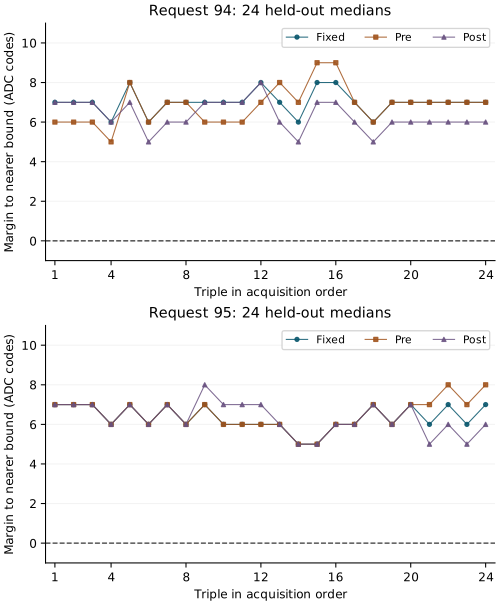
This return provides no evidence of improved held-out acceptance from local references: the fixed comparison already accepted every late triple. Local bounds changed margins by small amounts and reduced the minimum margin at request 94. This does not rule out a benefit during other conditions. The late phase did not reproduce the preceding reserved exception, and its six-reference/two-median estimator differs from the original nine-reading calibration. The comparison therefore does not isolate reference age as its sole variable.
Earlier primary exceptions
| Round / state | Request / final ordinal | Raw triple | Median / interval | Deviation |
|---|---|---|---|---|
| 1 / 0 | 90 / 1184 | 2783, 2783, 2794 | 2783 / 2790–2821 | 7 below lower bound |
| 2 / 1 | 93 / 1832 | 2880, 2847, 2880 | 2880 / 2827–2879 | 1 above upper bound |
Both exceptions occurred in trigger_B, the first triggered triple after the omitted-conversion control. Across the original schedule, this stage had 106/108 correct medians; prime_A and probe_B each had 108/108. The omitted-conversion control is assessed separately and is not included in the primary recognition denominator.
Before the state-0 exception, request 105 produced 3078, 3077 and 3077. Three reads at request 90 with conversion omitted retained 3077; the next triggered triple produced the low excursion. The following triple used request 91 and returned 2811, 2807 and 2811. Before the state-1 exception, request 96 produced three readings of 2910; the omitted-trigger reads at request 93 retained 2910. After the exceptional triple, another triggered triple at the same request 93 returned 2850, 2856 and 2853. The two octet-pair observations agreed within each exceptional acquisition, and control-register readbacks matched the request.
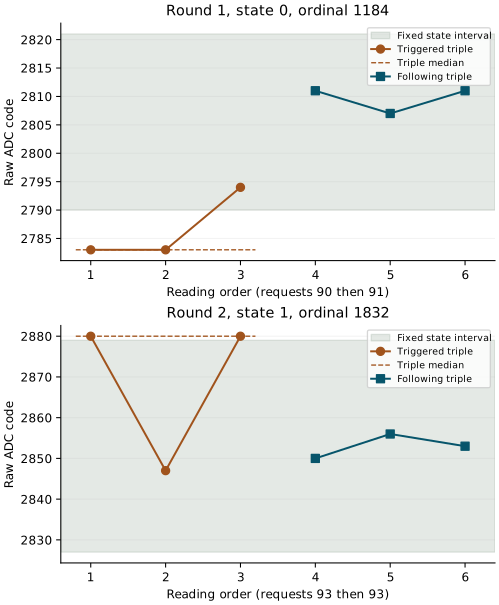
The shared acquisition position supports testing conversion history as a candidate explanation; it does not establish a causal mechanism. Agreement between repeated register reads does not prove a fresh conversion, and these records do not distinguish a supply excursion from conversion or acquisition effects. The preceding boot's exception occurred in a reserved burst at request 94. Exceptions are consequently neither confined to one request nor present as exactly one event in every return.
Recording assessment and provenance
Two independent read-only 96 MiB captures matched. The previous-boot journal and boot-file contents remained unchanged. Seven boot-volume sectors differed; their writer and modification time are not established. The added acquisition occupied 15.2584 counter-derived seconds. From the original acquisition start to construction of the boundary footer, 2796.6493 seconds elapsed at the configured 54 MHz counter frequency. The footer counter precedes its own write/readback; this is not an independent measurement of powered duration.
The frozen preparation reduced the auxiliary reservation from 16384 to 12952 sectors in its executable data but retained the old capacity in four descriptive manifest fields. The frozen reader therefore rejected the transport criterion for all 761 entries. Independent inspection of the hash-verified prepared image confirms that every affected group uses the same 12952-sector persistence context and extent; all returned capacity reports agree. The current reader binds the expected capacity to those prepared bytes, rejects inconsistent bindings and discloses the metadata discrepancy. Under that assessment all 761 native verifications pass. The original manifest, executable image, raw return and frozen-reader assessment remain preserved. Electrical outcomes and the unmet complete-experiment criterion are identical under both readers. Future image packaging now writes the matching descriptive capacities.
The return checks cover independent reproduction, preparation binding, preserved electrical exceptions, separation of held-out values from reference fitting, and rejection of an incomplete final record. Source and evidence hashes accompany the assessment. Neither correct native logging nor this one late boundary sequence establishes general six-state reliability, independent conversion freshness or full firmware replacement.
Next discriminating test
Retain the recognition bounds and zero added acquisition wait. Compare matched request histories around 105→90 and 96→93, alternating a deliberately omitted conversion with a triggered conversion before an identical held-out burst. Keep references independent and obtain them near the tested sequence, including the actual requests 90 and 93. Counterbalance the order, retain each raw value and trigger/read counter, and distinguish the first triggered triple from later triples. This would test whether exceptions concentrate after omitted conversions, recur after ordinary transitions, or accompany local reference movement. Repeating only the late 94/95 endpoint phase would leave those alternatives largely unresolved.
Endpoint and exception comparison · Returned assessment · Frozen-reader assessment · Provenance · Artifact index
Local references at the state-1/state-2 boundary
Declared 30 September 2026; returned observations assessed below. The preceding return preserved one unresolved reserved median at request 94: readings 2873, 2880 and 2880 gave a median five ADC codes above the state-1 upper bound. The preceding complete boot had no unresolved cases. The question is therefore when the boundary loses margin, rather than why an exception occurs on every boot.
This investigation separates three possibilities: reference bounds that cease to represent nearby observations, brief excursions confined to a held-out burst, and behavior associated with the preceding request or acquisition position. It adds a focused phase after the original 3888 observations and 24 carried-action observations, before the enclosing voltage restoration. All original instruction regions, Hyphos definitions, requests and acceptance rules remain unchanged. This is a late acquisition phase, not a replay at the earlier exception's position.
Paired acquisition
Six pairs contain twelve episodes. Each episode brackets a twelve-reading test burst at request 94 or 95 with separate six-reading references at both requests. The first target in each pair is 94, 95, 95, 94, 94 and 95; the other target follows. Reference order alternates between pairs and reverses after each burst. Each target/reference-order combination occurs three times, and each target occurs first in three pairs. Request 94 probes the state-1 upper endpoint and request 95 the state-2 lower endpoint in this apparatus. These are request-register and raw ADC codes, not calibrated voltages.
| Visit | Request | Readings | Role |
|---|---|---|---|
| 1 | A | 6 | Independent pre-reference |
| 2 | B | 6 | Independent pre-reference |
| 3 | 94 or 95 | 12 | Held-out test |
| 4 | B | 6 | Independent post-reference |
| 5 | A | 6 | Independent post-reference |
A/B is 94/95 or 95/94 according to the paired order. Every observation invokes the existing condition guard, request selection, mandatory 1 ms settling interval and triggered ADC acquisition. Zero added acquisition wait remains the reference; it does not mean zero transaction or settling time. The added phase contains 432 observations, bringing the maximum scheduled total to 4344. The first failed added observation stops this phase; the enclosing restoration and established recording path retain their original responsibility.
Reference-only comparison
The original final-round nine-reading calibration supplies the fixed comparison. For each episode, the six pre-reference readings at each request give two disjoint three-reading medians. Their maximum at request 94 replaces the state-1 upper reference extreme; their minimum at request 95 replaces the state-2 lower reference extreme. All other reference extremes remain fixed. Apply the same guard of two ADC codes and one-third-gap rule. Reject reversed or overlapping reference intervals; do not enlarge them to accept a test value. Repeat this calculation separately using the post-references.
Split the twelve held-out readings into four disjoint triples and compare each median with the fixed, pre-reference and post-reference bounds. Across twelve episodes this gives 48 matched comparisons per arm, 24 at each request. Retain every raw reading, all rejected calibrations, the signed margin to the nearer bound and correct, mismatched, unresolved or unavailable outcomes. The pre-reference comparison uses only earlier references; the post-reference comparison is retrospective. Both local comparisons are reconstructed on the PC from native records. They do not change the online recognition supplied to Hyphos.
Inspect endpoint changes before and after each burst, within-burst trajectories, preceding request and paired order. Improved held-out margins accompanied by reference movement would support local reference drift as an explanation. Excursions absent from both adjacent reference sets would instead support a transient or acquisition-history explanation. Overlapping local reference intervals would demonstrate insufficient separation under those conditions. These alternatives can coexist. The small, sequential sample does not support an independent-sample failure-rate estimate, and a return without an excursion cannot identify the earlier excursion's cause.
Native recording and completion criteria
boundary.aarch64.seigrasm contains the added literal AArch64 instructions. Each 72-word observation retains the existing 64-word sample and ADC audit trace, plus start/end counters, counter frequency, preceding request/raw value/status, descriptor ordinal and completion marker. The first predecessor is explicitly unavailable. The prior logging and raw Hyphos entry construction, retrieval and consumption remain in place.
A separate native senary journal occupies previously unused auxiliary sectors 180824–184255. Its header, 432 rows and footer use 3116 of 3432 sectors. It is written after the original recording sequence, using the same SEIGRASM stream, reservation checks, CRC, SD transfer and full readback. The original 12952 auxiliary records and progress reservation retain their addresses. The preserved previous-boot journal is unchanged.
Assess recording completion separately from electrical recognition: require all 432 added successful observations with matching descriptors, ordered counters, complete ADC diagnostics and control readbacks, the complete new journal and footer, plus the existing restoration, Hyphos and logging checks. Report the original 324 primary and 108 reserved recognition outcomes separately; an accurately logged unresolved value remains an electrical exception. A recovered footer does not independently prove its own final target readback. Boot dependencies, a shared SD/controller, ADC freshness and absolute voltage accuracy retain their existing limitations.
The powered interval remains 60 minutes. The preceding complete recording reached its terminal event after 44 minutes 7 seconds; this preparation adds 432 measurements and 3116 native write/readback sectors. The interval provides recording margin, not additional samples after the finite schedule finishes.
Local boundary references: SD preparation
Preparation 52ABD08531D2, returned on 30 September 2026. All 31 focused software checks passed, including native acquisition/recording, failure controls, independent decoding, reserved-sector separation and regression against earlier returns. The preparation preserves 216 validated inputs. Its 60 preceding instruction regions and all baseline source inputs remain unchanged; one literal boundary region adds the new sequence. Data changes bind that sequence, its fresh identity and the divided auxiliary reservation.
The 96 MiB SD image passed 6144 chunk comparisons and two complete readbacks with the volume locked. Both full readbacks matched the prepared image. The existing 18841600-byte previous-boot journal was preserved; the installation backup matched the independently archived return. The SD was ejected after verification. These checks establish preparation, not execution of the new measurements.
Frozen protocol · Controlled changes and recording layout · Software validation · SD verification · Artifact index
Diagnostic progress: third return and boundary exception
Native recording completed; the full electrical criterion was not met. Two read-only 96 MiB captures matched preparation 7392B308EDE5's run identity. All 3912 acquisitions, six restorations, Hyphos creation/use cases and extended logging groups were recovered. The native logger preserved one unresolved state-1 reserved recognition, including its readings, bounds and result code.
| Measure | Second return | Third return |
|---|---|---|
| Primary recognition | 324/324 correct | 324/324 correct |
| Reserved recognition | 108/108 correct | 107/108 correct; one unresolved |
| Hyphos creation/use/carried execution | 36/36 cases | 36/36 cases |
| Checkpointed native verifications | 761/761; all four groups | 761/761; all four groups |
| Transfer observations | 80 pairs; complete 256-row terminal ring | 80 pairs; complete 256-row terminal ring |
| Initial checkpoint to terminal event | 2647.1703 seconds | 2647.3282 seconds |
Both complete returns retained 36774 primary, 12952 auxiliary and 12228 progress records. This return had no invalid records, incomplete checkpoint reports or recorded transfer failures. All 12 progression cases, two content-retention cases, five recovered entries and five current entries passed. The complete reports account for all 2972 planned Hyphos operations. The 108 reserved, 324 primary and 324 context entries passed their transport, capacity-control, temporary-clearing, retrieval and Hyphos-consumption checks.
The recorded exception
In zero-based round 1, reserved ordinal 995 tested state 1 at request code 94. Its readings were 2873, 2880 and 2880; their median, 2880, exceeded the accepted upper bound, 2875, by five ADC codes. The lower bound was 2826 and the next state's lower bound was 2882. The median therefore occupied the unresolved gap rather than an adjacent accepted band. Native result code 2 was recovered and consumed as 2; recording an exception correctly satisfies the logging criterion without satisfying electrical recognition.
At the same scheduled position in the preceding boot, the readings were 2867, 2872 and 2863, with median 2867 and bounds 2826–2876. In this boot, the twelve readings at request 94 were 2869, 2867, 2871, 2867, 2869, 2872, 2869, 2870, 2872, 2873, 2880 and 2880. The final three form the reserved check. The other five rounds' reserved medians at that request were 2868, 2872, 2872, 2872 and 2872, all accepted. This sequence identifies the excursion's position; it does not establish its electrical cause or independent conversion freshness.
The instruction bytes and calibration rule were unchanged. The numerical bounds are derived from each round's reference observations and then held for that assessment; identical code does not imply identical bounds across boots. For the exceptional reserved sample, the recorded calibration counter follows acquisition. Its assessment is a comparison against selected reference observations, not evidence that calibration was updated before that sample.
Margins across states
The table gives the minimum signed margin in ADC codes, calculated as the smaller of median minus lower bound and upper bound minus median. Each state contributes 54 primary and 18 reserved cases per boot. A negative margin lies outside the accepted interval.
| State | Primary: second / third | Reserved: second / third |
|---|---|---|
| 0 | 0 / 2 | 3 / 1 |
| 1 | 4 / 4 | 4 / −5 |
| 2 | 3 / 1 | 2 / 4 |
| 3 | 5 / 6 | 5 / 5 |
| 4 | 4 / 3 | 4 / 5 |
| 5 | 4 / 4 | 4 / 5 |
The preceding zero-margin state-0 case at ordinal 563 now had median 2794 within 2789–2821, a margin of five codes. The smallest state-0 primary margin elsewhere was two codes; state 2 had the smallest primary margin overall, one code. These changes warrant examining boundary behavior across states rather than assigning all exceptions to state 0.
Duration, provenance and next investigation
The terminal event occurred 44 minutes 7 seconds after the initial checkpoint, within 0.16 seconds of the preceding boot at the configured 54000000-tick frequency. The recorded acquisition span was 138.4197 seconds. The complete terminal report was recovered, but its event timestamp precedes the final report write; exact powered duration, final-write completion time and counter-frequency accuracy are not independently established.
The reader frozen before this boot reproduces the complete assessment. The previous journal and both boot-file contents are unchanged. Seven boot-volume sectors differ, with a System Volume Information directory present; the capture does not establish the writer or modification time. The raw return is preserved without repair.
Proposed next investigation: isolate the state-1/state-2 boundary with balanced repeated requests and interleaved reference observations, keeping zero added acquisition wait and independent reserved checks. Compare the fixed and locally refreshed reference estimates using separate reference and assessment samples before changing online acceptance. The complete native logger can now preserve both accepted and unresolved cases for that comparison. Two complete recording returns establish recurrence on this apparatus; broader reliability, conversion freshness and silicon independence remain unresolved.
Native checkpoints and transfers · Reserved diagnostic entries · Primary diagnostic entries · Cross-boot comparison · Provenance · Artifact index
Diagnostic progress: unchanged recurrence test
Declared 30 September 2026. The complete second return met the electrical, Hyphos and extended recording criteria. One state-0 median equalled its lower accepted bound, leaving no positive margin in that case. A further boot with unchanged instructions tests whether complete native recording recurs and allows the recognition margins to be compared without changing calibration or acquisition timing.
Retain the two transfer windows and assessment criteria, all 3912 scheduled acquisitions, zero added acquisition wait, electrical requests, frozen calibration, inclusive recognition bounds, Hyphos definitions and recording order. Only the run identity and initially empty writable journals change. The five previous-boot entries continue to come from the same preserved recovery input used in the preceding preparation; the latest return is archived separately.
Require all 761 individual checkpointed verifications, four completed groups, 80 matched transfer pairs and the complete terminal ring, alongside the existing electrical, restoration and Hyphos criteria. Compare the signed distance of each primary and reserved median to its nearer acceptance bound, grouped by state and acquisition position, using the linked native context to inspect any exception. Report zero and negative margins explicitly. A successful repeat does not by itself establish a failure rate, conversion freshness or immunity to electrical excursions.
The powered interval remains 60 minutes. The preceding terminal-trace event occurred 44 minutes 7 seconds after the initial checkpoint; its report was written afterwards. Keeping the same interval allows the full recording path to finish while preserving the comparison conditions. Extra powered time adds no acquisitions to this finite schedule.
Diagnostic progress: third-boot preparation
Preparation 7392B308EDE5, returned on 30 September 2026. All 64 required software checks passed, including native supplied-response execution, failure and corruption controls, media preservation and regression checks against the complete physical return. The archive preserves 211 validated inputs.
All 60 instruction regions, image-input hashes, Hyphos definitions, electrical parameters, boot configuration and the previous-journal recovery input match preparation 240FEBFF5940. The executable differs only in its 32-byte run identity. The 36800 primary, 16384 auxiliary and 12288 progress reservations were verified empty for that identity.
The 96 MiB image was written with 6144 verified chunks and two matching complete readbacks while the volume remained locked. The retained 36800-sector previous journal was unchanged, the installation backup matched the archived second return, and the card was ejected. The physical return and its separate recording and electrical assessments are reported above.
Frozen protocol · Unchanged inputs and margin assessment · Software validation · SD verification · Artifact index
Diagnostic progress: complete second return
All experiment criteria met in this boot. The reported powered interval was one hour. Two read-only 96 MiB captures matched. All acquisition, restoration, Hyphos creation/use, prior-entry recovery and extended logging criteria passed. The complete individual reports and group reports agree with the independently decoded payloads and electrical observations.
| Relation | Recovered result |
|---|---|
| Electrical acquisition | 3912 acquisitions: 3888 original observations and 24 carried-action acquisitions. All six restorations completed; final restoration and pin-release status were zero. |
| Recognition and creation | 324/324 primary and 108/108 reserved recognitions passed. All 36 Hyphos creation/use/carried-execution cases, 12 progression cases and two content-retention cases passed. |
| Native logging | Five prior entries were recovered and consumed; five current entries also passed. All 108 reserved diagnostics, 324 primary diagnostics and 324 linked context entries passed native transport, capacity controls, temporary clearing, retrieval and Hyphos verification. |
| Persistent evidence | 36774 primary, 12952 auxiliary and 12228 progress records recovered without invalid records. All 761 checkpointed entries and all four group completions were verified. The progress journal retained 60 unused reservations. |
| Transfer observations | All 80 transfer pairs passed: 16 at sectors 168176–168179 and 64 at 168568–168583. Each sector had its reservation read, write, write readback and later retrieval recorded. The complete 256-row terminal ring ended at transfer sequence 44218. No transfer failures were recorded. |
Recognition margins
Complete diagnostic and context entries now retain successful readings alongside the narrowest margins. The smallest primary margin was zero: state 0, ordinal 563, had readings 2791, 2791 and 2816, median 2791, and accepted bounds 2791–2821. The existing inclusive criterion correctly accepted the boundary value. The native context recorded request 90, preceding request 90, preceding raw reading 2783 and calibration status zero. These fields describe the observed sequence; they do not identify the cause of the margin.
| State | Minimum primary margin (ADC codes) | Minimum reserved margin (ADC codes) |
|---|---|---|
| 0 | 0 | 3 |
| 1 | 4 | 4 |
| 2 | 3 | 2 |
| 3 | 5 | 5 |
| 4 | 4 | 4 |
| 5 | 4 | 4 |
Each state contributes 54 primary and 18 reserved cases; margin is the smaller distance from the median to its lower or upper accepted bound. The closest reserved case was state 2, ordinal 431, two codes below its upper bound. The previously exceptional primary positions 578 and 1160 were accepted with medians 2794 and 2793 against bounds 2791–2821. Passing this boot does not establish immunity to later excursions.
Recorded duration
At the recorded frequency of 54000000 ticks per second, the interval from the initial checkpoint to the terminal-trace event was 2647.1703 seconds: 44 minutes 7 seconds. The first diagnostic-group checkpoint to that event spanned 1062.9434 seconds. The recorded acquisition span was 138.3949 seconds; the finite acquisition was followed by extensive native recording and verification. Remaining powered time does not represent additional measurements.
The terminal timestamp precedes writing its 3072-word report. That complete report was recovered, but the final write/readback time and wall-clock power-on were not independently recorded. Counter frequency is configured rather than independently calibrated. The observed timing is consistent with the preparation's approximate 45-minute estimate and explains why a 27-minute interval could leave a partial diagnostic prefix; it does not retrospectively prove the cause of either preceding cutoff.
Comparison and next question
The shortened return verified 30 reserved entries before its missing suffix. This return verified all 108, both later 324-entry groups and the terminal record. Both previously targeted sector ranges were traversed successfully. The electrical sequence and criteria were unchanged, while the added four-sector trace window and longer reported powered interval are explicit differences. This is the first complete physical return of the extended diagnostic path.
An unchanged repeat can assess recurrence of complete logging and recognition margins across boots. State 0 remains a boundary-robustness concern because its closest median has no positive margin. Keep the frozen calibration and zero added acquisition wait while comparing the newly available native entries; the earlier excursion cause, conversion freshness and broader silicon independence remain unresolved.
The previous primary journal and both boot-file contents are unchanged. Seven boot-volume sectors differ, with a System Volume Information directory present; the capture does not independently establish the writer or time of those metadata/directory changes. The raw return remains preserved without repair or journal reset.
Native checkpoints and transfers · Primary diagnostic entries · Linked acquisition context · Comparison and timing · Assessment provenance · Artifact index
Diagnostic progress: extended transfer coverage
Declared 30 September 2026. The shortened return completed acquisition, electrical recognition and all 36 Hyphos creation/use cases. It independently verified 30 reserved entries before ending with the write intent for entry 31. The next auxiliary sector, 168176, lay outside the detailed transfer window. This second boot tests whether the full diagnostic sequence completes within the prescribed interval and adds observations at that earlier boundary.
Controlled change
Retain the checkpoint procedure and acceptance criteria, with a fresh run identity and empty writable reservations. Preserve the same previous-boot journal as the input to recovery. Keep all 3912 acquisitions, zero added acquisition wait, electrical instructions, frozen recognition bounds and Hyphos definitions unchanged. Extend only the literal SEIGRASM transfer-window selection: record transfer intent and result for sectors 168176–168179 as well as 168568–168583. Both windows use inclusive decimal addresses here; the stored upper bounds are exclusive. The additional recording follows acquisition and restoration.
The new window records four sectors, with four transfers per sector on the successful path: reservation read, payload write, write readback and later retrieval. Each before/after observation retains the transfer sequence, counters, direction, returned status, five controller registers and counter frequency. These 16 transfer pairs add 96 progress records. The complete path therefore requires 12228 of the existing 12288 progress sectors, including the terminal ring. The earlier window remains covered; progress writes bypass tracing, and failed payload writes are not retried.
Duration and interpretation
The prescribed powered interval remains 60 minutes. In the preceding return, 29 intervals between completed reserved entries had a median of 0.9714 seconds; 30 intervals from write-result to retrieval-intent checkpoints had a median of 0.04399 seconds. Extrapolating those costs over the remaining 726 entries, 7560 auxiliary report sectors, 308 terminal-ring sectors and 96 added trace sectors gives roughly 18 additional minutes after the reported 27-minute return. This planning estimate assumes comparable later transfer and verification costs and omits minor boundary overhead; it is not an observed completion time or an identification of counter zero with power-on. Sixty minutes provides margin until the complete native timeline is recovered.
Require all four groups and 761 independently verified entry reports, 80 complete transfer pairs across the two windows, the terminal ring, and the unchanged electrical and Hyphos criteria. Report any partial prefix without treating an absent result as a successful transfer. Both journals still share the SD and controller, so a hardware stall or power loss can prevent terminal recording. Additional tracing changes recording duration; this boot is an instrumented repeat, with no new electrical treatment.
Diagnostic progress: second-boot preparation
Preparation 240FEBFF5940, returned on 30 September 2026. All 59 supplied-response execution, failure, corruption, media-preservation and physical-prefix regression checks passed. The complete supplied path produced 761 verified entries, 80 transfer pairs and 12228 progress records. A supplied write failure at sector 168176 retained the preceding 30 verified reserved entries, recorded the transfer failure and attempted no payload retry. The earlier failure-window and shared-SD-failure checks also passed.
Only the transfer-window instruction region differs from preparation BEC3AAD768B8; the other 59 regions, electrical parameters, Hyphos definitions, previous-journal input and boot configuration remain unchanged. The archive preserves 211 validated inputs. The 96 MiB image was installed with 6144 verified chunks and two matching complete readbacks while the volume remained locked. The preserved journal was unchanged and the card was ejected. The installation backup exactly matches the archived shortened return.
The prescribed powered interval was 60 minutes. The returned records and their independent assessment are reported below.
Frozen protocol · Controlled changes and timing estimate · Software validation · SD verification · Artifact index
Recoverable native diagnostic progress
Declared 30 September 2026. The preceding return retained 87 complete reserved payloads and part of the next, but no group verification report. Its capture could not distinguish a transfer failure, an execution stop or power removal. This investigation adds independently recoverable entry reports and bounded transfer observations so a later incomplete group need not erase the evidence for earlier completed entries.
Controlled change
Keep all electrical instruction bytes, 3912 scheduled acquisitions, zero added acquisition wait, frozen calibration, recognition bounds, restoration and Hyphos creation/use criteria unchanged. Retain the existing five previous-boot entries, five current-boot entries, 108 reserved diagnostic entries, 324 primary diagnostic entries and 324 primary context entries. All additional recording executes after acquisition and restoration; it observes the existing records and introduces no additional ADC acquisition. Boot firmware and fixed apparatus bindings remain dependencies.
Native observations
- For each of the five recovered entries and 756 diagnostic/context entries, persist entry start, payload-write intent, payload-write result, retrieval intent after temporary clearing, and the complete individual verification report. The five current-boot entries retain their existing report.
- Record each group's delegate result and completed report. A native failure attempts to preserve the current entry report and the transfer ring before returning failure. Later diagnostic groups are not attempted after a failed delegate.
- Keep the last 256 prior-read and auxiliary SD transfers in RAM. Each row contains sequence number, start/end counters, physical sector, read/write direction, returned status, five controller-register snapshots and counter frequency. Register observations are preserved without assigning a hardware cause. In the persistent window, the start counter and first register snapshot precede the intent checkpoint; the end counter follows the actual transfer. That interval therefore includes the intent-recording overhead.
- Persist both the intent and returned observation for each transfer in auxiliary sectors 168568–168583, surrounding the preceding cutoff at 168578. Progress writes bypass this tracing entry to prevent recursive recording. Failed payload transfers are not retried.
Authored AArch64 opcode words in checkpoint.aarch64.seigrasm, journal.aarch64.seigrasm and trace.aarch64.seigrasm extend the existing SEIGRASM path. Raw Hyphos continues to define entry construction, verification and consumption. PC tools place the literal instructions and independently decode the returned bytes; they do not perform the target's logging operations.
Record layout and storage
Each progress event occupies one senary record: stage, group, entry index, counter, auxiliary cursor, auxiliary inhibition, last physical sector, last transfer status, transfer sequence and following report length. The optional report immediately follows in the same run-bound journal. A complete-entry event carries 100 words: native transport results and both Hyphos execution reports. A group event carries 20 words; a transfer event carries 12; the terminal ring carries 3072. A recovered event with an incomplete report remains incomplete.
The previous primary journal remains byte-identical at sectors 64–36863. The new primary journal uses 131072–167871, auxiliary records use 167872–184255, and progress uses 184256–196543. These inclusive ranges use decimal notation and fit the same 96 MiB capture. A complete successful path writes 36774 primary, 12952 auxiliary and 12132 progress records; the progress reservation has 12288 sectors. This is a fixed experiment placement, not a general allocation policy.
Assessment and limits
Require every complete-entry checkpoint to have its ordered preceding stages, matching recovered payload, successful native write/readback, deliberate capacity rejection, temporary clearing, retrieval and Hyphos verification. Compare diagnostic and context contents independently with the original acquisitions. Require all four groups, 761 independently verified entries, matched before/after transfer pairs and the terminal ring. Preserve electrical acceptance separately: 324/324 primary recognitions, 108/108 reserved recognitions, successful restoration and the existing creation/use criteria. Do not widen bounds in response to this return.
For a partial return, report the last intact event, any incomplete report, attempted transfer and independently verified preceding entries. A payload without its completed report is not counted as verified. A missing terminal observation does not identify why recording stopped. Both journals use the same SD and controller; power loss or a bus/controller hang may prevent failure recording. The added traffic changes recording timing, so this is not a timing-neutral observation of the preceding run.
The prescribed powered interval is 60 minutes, allowing for the additional native writes and readback checks after finite acquisition. Longer power does not imply additional samples. Software validation supplies counter and device responses; physical completion and the unresolved state-0 behavior require the returned card.
Diagnostic progress: preparation
Preparation BEC3AAD768B8, returned on 30 September 2026. All 53 supplied-response execution, corruption, interrupted-record and media-preservation checks passed. The complete native path produced 12132 progress records and 761 independently verified entry reports. A supplied write failure at sector 168578 retained the preceding 87 verified reserved entries and recorded the failed transfer; a supplied failure of the shared SD retained those entries without inventing a terminal status.
All 57 preceding instruction regions, electrical settings and boot configuration match the preceding preparation. Three added literal SEIGRASM regions implement checkpoints and transfer tracing. The archive preserves 210 validated inputs. These are software observations; the shortened physical return is assessed below.
The installed image passed 6144 transfer comparisons and two complete 96 MiB readbacks while the volume remained locked, then ejected successfully. The preceding 18841600-byte journal remains at its original addresses. Prescribed powered interval: 60 minutes. Image SHA-256: 3e704e2e2407f51de87cfa33f06468adbecddb90fad44f6bbbb4dbd0672fe26b.
Frozen protocol · Controlled changes · Software validation · SD verification · Artifact index
Diagnostic progress: shortened return
Returned 30 September 2026 after a reported 27-minute powered interval, compared with the prescribed 60 minutes. Two independent read-only captures of the 96 MiB extent matched. The electrical and Hyphos creation/use phases completed; the extended diagnostic recording did not. The complete experiment criterion remains unmet. The returned SD has been preserved without resetting its journals.
| Relation | Recovered outcome |
|---|---|
| Acquisition and restoration | 3912/3912 acquisitions, 36774 primary records, six completed restorations; final restoration and pin-release statuses both 0. |
| Recognition | 324/324 primary and 108/108 reserved medians recognized. Both three-reading and nine-reading comparisons had complete recognition in this boot. |
| Hyphos creation and later use | 36/36 creation/use/carried-execution cases passed; all 468 scheduled creation operations recovered. |
| Carried progression and content retention | All 12 progression cases and both retention cases passed. |
| Previous and current entries | 5/5 previous entries and 5/5 current entries passed retrieval and Hyphos consumption. The previous journal remained byte-identical. |
| Independent checkpoints | 35 verified entry reports: five previous entries and 30 reserved diagnostics. Progress retained 536 of 12132 planned records, without invalid records. |
| Auxiliary recording | 304 of 12952 planned records. The 31st reserved entry has a write intent but no recorded payload or completion. |
| Later diagnostics and terminal trace | The primary-diagnostic and context groups were not reached. The targeted transfer window and terminal ring were not recorded. |
What the checkpoints establish
The preceding preparation could not qualify its 87 reserved payloads because the group report was absent. This return independently qualifies 30 reserved entries through their completed native transport, clearing, retrieval and Hyphos verification reports, although their group report is again absent. Each entry agrees with the original acquisition fields. This demonstrates recovery of completed-entry evidence from a partial journal in this boot; it does not qualify the unrecorded remainder.
The last intact event is progress ordinal 535: group 2, entry index 30, stage 3, the payload-write intent for diagnostic acquisition ordinal 1019. It records auxiliary cursor 304, inhibition 0 and the preceding transfer status 0. Auxiliary physical sector 168176 onward and progress sector 184792 onward remain at their prepared values. There is no returned status for the intended payload write, failure checkpoint or terminal record. The reported early power removal is consistent with the incomplete sequence, but the capture alone cannot distinguish interruption from an execution or recording stop.
Electrical comparison
Both previously exceptional primary positions were recognized: ordinal 578 had readings 2793, 2791 and 2816, giving median 2793 within [2789, 2821]; ordinal 1160 had readings 2796, 2801 and 2792, giving median 2796 within [2788, 2821]. All six native nine-reading calibrations were accepted. These observations establish complete recognition for this boot, without resolving the cause of earlier excursions or establishing conversion freshness.
Repeat
Repeat the unchanged investigation with fresh run identity and journal reservations, retaining the prescribed 60-minute powered interval. The existing records must remain archived before preparing the card. Rebooting the returned card does not resume this sequence: its completed reservations are already occupied. The repeat must reach the remaining reserved entries, all 324 primary diagnostics, all 324 context entries and the terminal trace before full recording acceptance can be assessed.
Recovered checkpoints · Run comparison · Acquisition conditions · Assessment provenance · Artifact identities
Primary-triple diagnostics and acquisition context
Declared 30 September 2026. The preceding return recovered five previous-boot entries and verified all 108 reserved diagnostic entries. Reserved recognition was complete, while primary ordinal 578 in round 0 retained a state-0 median of 2783, below its lower bound 2788. The same position and median were unresolved in the first logging boot. This experiment extends native logging to every triggered primary triple so those excursions and their immediate acquisition context are carried, retrieved and verified by Hyphos.
Controlled change
Keep the electrical instruction bytes, request sequence, zero added acquisition wait, reference selection, frozen bands, guards, restoration, creation, carried-action and retention criteria unchanged. Acquire the same 3912 observations. All added logger operations execute after acquisition and restoration, using the already recorded values; they add no ADC observations. Existing boot firmware, initial hardware state and apparatus addresses remain dependencies. The larger payload and extra recording phases change preparation size and total execution duration.
- Recover and consume the five entries from preparation
CD856CA9799C, retaining their preceding identity and counters. Then construct and retrieve the five current-boot entries. - Retain all 108 reserved diagnostic entries, including successful checks.
- Construct, persist, clear temporary storage, retrieve and verify the same eight-field diagnostic entry for all 324 triggered primary triples: final ordinal, three readings, native median, frozen expected-state bounds and expected-band decision. The 108 omitted-trigger controls retain their existing acquisition records and stay outside this primary denominator.
- Construct and retrieve one additional eight-field Hyphos context entry for each primary triple: final ordinal, intended state, requested control value, preceding request, preceding raw reading, first-acquisition start counter, last-acquisition end counter and calibration status.
The diagnostic and context entries join by final ordinal. The predecessor is the observation immediately before the triple, at final ordinal minus three. Request order and all intermediate timing observations remain in the original journal. Bound decision 0 means inside inclusive bounds, 1 below and 2 above; calibration and acquisition validity remain separate requirements. Context entries preserve native counters as integers, with their frequency in the original run record. They do not identify distinct physical conversions.
Execution and storage
Raw Hyphos defines both entry shapes and their verification. Existing literal SEIGRASM executes construction, object encoding, senary journal writes, capacity controls, temporary clearing, SD retrieval and subsequent Hyphos consumption. The existing eight-field flat representation and target instruction encodings remain unchanged. PC preparation places source and literal opcodes and supplies the fixed experiment reservations; the independent PC reader reconstructs all expected fields from the preserved observations.
The latest previous journal stays at SD sectors 131072–167871. The new primary journal uses 64–36863; the auxiliary reservation expands to 167872–184255 within the same 96 MiB image. Ranges are inclusive and written here in decimal. The installer verifies the preserved journal and skips writes to that extent, including across transfer boundaries. Earlier journals remain in their captured archives. These placements do not establish a general storage-allocation or discovery policy.
Acceptance and comparison
Require five matching previous entries, five matching current entries, 108 reserved diagnostic entries, 324 primary diagnostic entries and 324 context entries, with successful native transport, clearing, capacity rejection and Hyphos verification. Prior recovery must precede current entries; reserved diagnostics precede primary diagnostics, which precede context logging. The previous journal must remain byte-identical. A complete return contains 2972 Hyphos operations, 36774 current primary records and 12952 auxiliary records. Logging acceptance remains distinct from the unchanged requirement for 324/324 primary and 108/108 reserved recognitions and all existing restoration and source criteria.
Compare every exceptional primary median with its frozen band, calibration references, predecessor request and readout, and acquisition interval. Retain the successful observations from the same state and sequence position as comparison cases. Ordinal 578 is a specified recurrence check; the full denominator remains 324. Do not widen bands or alter thresholds after observing the return. A repeated ordinal or raw code alone cannot identify the physical cause. No excursion in this run would leave that cause unresolved.
The prescribed powered interval is 40 minutes. The added 648 entries each undergo native write, retrieval and verification, with two further complete reports. This interval includes recording time beyond the earlier 30-minute preparation; it is not a claim of continuous sampling. The first return is assessed below.
Primary diagnostics: preparation
Preparation 1EF924E5538A, returned on 30 September 2026. All 51 execution, record-integrity, return-reader and installation-preservation checks passed with supplied device responses. The archive preserves 203 validated inputs. All 57 instruction regions and the electrical parameters match the preceding preparation; the added Hyphos definitions execute through the existing instructions.
The SD passed 6144 transfer comparisons and two complete 96 MiB readbacks while locked, then ejected successfully. Installation retained the preceding 18841600-byte journal at its original addresses. Image SHA-256: 1a5fb8c4bd0caffbf0ce9eb652d9bcd83f07efeec0c2645bdce28c8502de66cb. The returned capture and qualification limits are reported below.
Frozen protocol · Controlled changes · Software validation · SD verification · Artifact index
Primary diagnostics: first return
Returned 30 September 2026. Complete criterion not met. Two independent read-only captures of the 96 MiB extent matched. All 3912 scheduled acquisitions and 36774 primary records were recovered, with six completed restorations, final restoration status 0 and pin-release status 0. Both boot files and the previous journal remained byte-identical to the preparation. The auxiliary journal ended after 706 of 12952 planned records, with no invalid recorded sectors and 15678 untouched reservations.
| Relation | Observed result |
|---|---|
| Previous-boot recovery | 5/5 entries retrieved and consumed by Hyphos before current entries; previous journal unchanged. |
| Current native logging | 5/5 entries passed storage, capacity rejection, clearing, retrieval and Hyphos verification. |
| Reserved diagnostics | 87 complete encoded payloads agree with their raw observations. The next payload has 30/70 words. The group verification report is absent. |
| Primary diagnostics and context | Neither group was recorded; their declared 324 entries per group remain unqualified. |
| Electrical recognition | 323/324 primary medians and 108/108 reserved medians recognized. One primary state-0 median remains unresolved. |
| Hyphos creation and later use | 35 creation/use/carried-execution cases completed. The unresolved input was correctly rejected; its carried execution was blocked. All 468 scheduled creation operations were recovered. |
| Carried progression and retention | All 12 progression cases and both content-retention cases passed. |
State-0 exception and input rejection
The exception occurred at ordinal 1160 in round 1, during triggered B. Its readings were 2789, 2783 and 2783; median 2783 was seven codes below the frozen lower bound 2790, with upper bound 2821. All six native nine-reading calibrations were accepted. Unlike the preceding exception at ordinal 578, this observation was also selected for a creation case. Hyphos rejected that case and blocked the dependent carried action. The other 35 cases completed, and outcomes across all 36 cases matched their inputs. The unchanged requirement for 36 successful creations was not met.
Ordinal 578 was recognized in this run: readings 2800, 2795 and 2794 gave median 2795 within [2791, 2821]. Median 2783 therefore recurred at a different ordinal and round. The acquisition immediately before the failed triple retained raw code 3008 while request 90 was recorded; its omitted-trigger role remains part of the original sequence. These details come from the original acquisition journal, not the unrecovered new context entries. Recurrence of one ADC code does not identify its physical cause or establish conversion freshness.
The retained three-reading comparison rejected round 0 after guarded state-3/4 overlap, leaving 54 primary outcomes and 18 reserved checks unavailable. The native nine-reading calibration retained all six rounds: primary counts were 323 correct and one unresolved, compared with 269 correct, one unresolved and 54 unavailable under the three-reading comparison. This supports retaining the nine-reading reference in this boot; it did not eliminate the state-0 excursion.
Recording boundary
The last valid auxiliary record is ordinal 705 at physical sector 168577. Sector 168578 and the remaining auxiliary reservation are unchanged from preparation. The partial 88th reserved payload corresponds to acquisition ordinal 2999, round 4, state 0. The 87 preceding payloads match their observations, but payload presence alone cannot establish clearing, retrieval or Hyphos verification. Those outcomes are retained in a group report written only after all 108 entries; that report was not recovered. The three later group assessments remain incomplete.
The retained records establish 704 source operations in complete reports, compared with 2972 planned. They do not record a persistent stop reason at the cutoff. An interrupted write, transfer failure, execution failure or power removal cannot be distinguished from this capture. The journal does not establish whether recording was still active at shutdown. Additional powered time cannot be assumed to recover a path that may already have stopped.
Next investigation
Make recording progress and failure status recoverable: retain completed-entry checkpoints before a later group can fail, and record the attempted sector and native transfer status when the recording path permits it. Fault-injection checks should verify exactly which earlier entries remain assessable after each interruption point. Keep electrical requests, zero added wait, calibration and recognition bounds unchanged while establishing that recording behavior. The state-0 cause remains open; new electrical conclusions require the intended diagnostic records.
Comparison between boots · Recovered diagnostic payloads · Previous-entry recovery · Assessment provenance · Artifact identities
Prior-boot recovery and reserved-check logging
Declared 29 September 2026. Native entry retrieval and Hyphos consumption recurred in both logging boots. The second boot retained one unresolved reserved state-0 check: readings 2796, 2783 and 2783 gave median 2783, four ADC codes below the frozen lower bound 2787. This investigation tests recovery of previous-boot entries and adds Hyphos-defined diagnostic entries for every reserved triple. Recording all 108 checks retains the successful comparison cases as well as exceptions.
Controlled change and execution
Electrical instructions, request schedule, zero added wait, reference selection, frozen calibration, 3912 acquisitions, restoration, creation cases, carried actions and content-retention criteria remain unchanged. Added operations execute after acquisition, restoration and the original source report. Existing readings supply the diagnostics; no extra ADC observation or freshness test is introduced.
- Preserve the preceding boot's entire native journal at its original SD sector addresses. Prepare the new executable and fresh raw journal extents separately.
- Run the existing acquisition and source sequence. Read all five previous entries through SEIGRASM, validating the preceding run identity, ordinal, section, senary encoding and record integrity before reconstructing each flat object.
- Execute Hyphos on the recovered entries, preserve them in the current auxiliary journal, clear temporary entry storage, retrieve the entries again, and verify numeric fields and recover text through Hyphos. Retain the preceding entry counters and frequency as observations from that boot.
- Create and consume the five entries describing the current boot, using the established logging procedure.
- For every reserved triple, execute
reserved_entryin Hyphos. Its eight fields are final acquisition ordinal, the three raw readings, native median, expected-state lower and upper bounds, and a decision code: 0 inside inclusive bounds, 1 below, 2 above. Persist, clear, retrieve and verify every entry through the same native path.
The ordinal links each diagnostic entry to the original request, raw transfer details, counters, temperature-related observations and calibration references. The independent reader derives signed margins, raw spread and reference extrema from these linked records. Those derived quantities are distinguished from target-recorded fields. Its diagnostic summary counter is the calibration-completion counter; acquisition timing remains in the linked rows. Reserved triples precede completion of the round's reference set, so this comparison is retrospective. A below-bound result describes the relation to the expected state; recognition across all six bands remains assessed by the unchanged electrical reader.
Raw storage and implementation boundary
The capture expands from 64 to 96 MiB. The boot partition retains its extent; previous records remain at sectors 64–36863. The new primary journal occupies 131072–167871, and an auxiliary reservation occupies 167872–171967. All ranges here are inclusive and use decimal notation. The wider SD transfer bound is constrained by explicit journal extents and reservation checks. No target filesystem is introduced. Installation verifies the existing journal against the preserved capture before writing and retains those bytes at their original addresses.
The original configuration bounds describe the nominal journal addresses before extent mapping; the recovery manifest records their physical placement. The independent reader creates an explicitly declared logical view for the unchanged reference analysis, while preserving and hashing the complete physical capture separately. Installation skips writes to the previous journal and verifies its bytes again afterward.
Authored AArch64 opcode words implement extent checks and retrieval sequencing. Existing SEIGRASM executes the raw Hyphos declarations, object encoding, senary record construction, SD transfers and verification. PC tools place unchanged source and literal opcodes, prepare reservations and inspect returned evidence. They do not execute Hyphos on behalf of the Pi. Firmware boot, fixed apparatus bindings and the existing electrical-access limitations remain.
Acceptance and interpretation
Recovery requires all five previous entries to match their preceding observations and be consumed successfully by Hyphos before the current-boot entries are created. The old journal must remain byte-identical. All 108 diagnostic entries must match independently reconstructed readings, medians, bounds and decisions, with successful native storage, clearing, retrieval, capacity rejection and Hyphos verification. Ordered counters must establish the recording sequence within the new boot; counters from different boots are not treated as a shared epoch.
Complete acceptance also retains 324/324 primary recognitions, 108/108 reserved recognitions, successful restoration, and the existing creation, carried-action and retention criteria. Diagnostic logging may pass while electrical recognition fails. This experiment does not widen bands or fit them to reserved observations. It cannot by itself identify the cause of an excursion, establish independent conversion freshness, qualify interrupted-write recovery or demonstrate complete Seigsit persistence.
A complete return contains 1028 Hyphos operations, 36774 current primary records and 1932 auxiliary records. The prescribed powered interval was 30 minutes, allowing for additional native writes, retrievals and verification. The first return records the actual observations and the longer reported powered interval.
Recovery and diagnostics: preparation
Preparation CD856CA9799C, returned on 30 September 2026. All 40 execution, record-integrity, return-reader and installer-preservation checks passed. Unchanged baseline coverage remains separately identified in the validation record. The candidate preserves 54 preceding instruction regions and adds extent binding and prior-entry retrieval; one SD transfer-bound instruction admits the declared 96 MiB capture. Electrical instructions, parameters and existing Hyphos definitions are unchanged.
The SD passed 6144 chunk comparisons and two complete readbacks while its volume remained locked, then ejected successfully. Installation wrote 81821696 bytes and skipped the 18841600-byte previous journal. Its original bytes and sector addresses are preserved. Image SHA-256: 5c58734a56603fd17965f8d75e5c136eb7d4241359deb16dfe403298158ff478. These checks establish preparation integrity. The frozen protocol specifies 30 minutes and a 96 MiB capture. The inherited top-level manifest fields still contain 1620 seconds and 64 MiB; its dedicated recovery extent, installed image and returned capture specify 96 MiB. The original manifest is preserved, and subsequent packaging now sets both top-level fields explicitly.
Returned acquisition uses the declared 96 MiB extent; the dedicated recovery reader independently assesses the primary journal, prior-entry consumption and all 108 diagnostic entries.
Frozen protocol · Controlled changes · Software validation · SD verification · Artifact index
Recovery and diagnostics: first return
Returned 30 September 2026; complete criterion not met. The two read-only 96 MiB captures are identical. All 36774 current primary records and 1932 auxiliary records were recovered without journal-integrity issues. The previous journal remains byte-identical at its original sector addresses. The reader preserved with the preparation reproduces all eleven saved assessments.
| Observation | Result | Scope |
|---|---|---|
| Previous-boot entries | 5/5 recovered and consumed | Original identity, counters, numeric fields and text retained; consumption preceded current-entry construction. |
| Current-boot entries | 5/5 verified | Native write, temporary clearing, retrieval, capacity rejection and Hyphos consumption passed. |
| Reserved diagnostic entries | 108/108 verified | Every native raw triple, median, expected-state bound and decision matches the independent reconstruction. |
| Primary recognition | 323/324 correct; 1 unresolved | One state-0 median lies below its frozen band. |
| Reserved recognition | 108/108 correct | No mismatches, unresolved medians or unavailable checks. |
| Creation, continuation and retention | All declared source criteria met | 36 creation/use cases, 42 controls, six chain paths and two retention cases passed. |
| Restoration | 6/6 round restorations | Final restoration and pin release both returned status 0. |
What the diagnostic entries establish
At the preceding reserved exception's corresponding position, round 3 and ordinal 2183 (zero-based), this return records 2793, 2794 and 2796: median 2794 within [2788, 2821], six ADC codes above the lower bound. Previously the median was 2783, below [2787, 2822]. This particular exception did not recur. The smallest current reserved margin is two ADC codes: ordinal 2999, median 2794 within [2792, 2822]. Correct classification therefore coexists with a narrow observed margin.
The unresolved primary observation is in round 0, state 0, request 90, ending at ordinal 578. Readings 2783, 2789 and 2783 yield median 2783, five ADC codes below [2788, 2820]. The same primary position and median were unresolved in the first logging boot; the intervening boot recognized all primary observations. This recurrence identifies a comparison to investigate, without establishing the cause. The new diagnostic entries cover reserved triples; this primary exception remains documented in the original raw acquisition and native decision records.
Powered interval and recording boundaries
The reported powered interval was several hours; exact duration was not measured. The complete fixed sequence contains 3912 acquisitions and 1028 Hyphos operations. The original acquisition interval is nominally 138.395 seconds; subsequent persistence and source operations extend execution substantially. Reserved diagnostic entry processing spans a further nominal 41.076 seconds, excluding its final report write. Counter frequency is reported configuration, with no independent accuracy calibration. The code returns to its parked loop after the finite sequence; this capture does not establish continuous sampling or endurance over the additional hours.
Boot-file contents, partition geometry and the MBR match the preparation. Seven sectors in the boot volume changed; their byte differences are preserved, without attributing a writer or time. No bytes beyond the auxiliary reservation changed. The boot-volume assessment covers the first 64 MiB; capture identity and both current journals are assessed over the complete 96 MiB. The reader's inherited preparation digest refers to its declared logical journal view; acquisition metadata retains the physical image digest.
Interpretation and next comparison
Native retrieval and Hyphos consumption across a power cycle are now observed for five flat entries, with their previous journal preserved. This is one cross-boot recovery observation. It does not qualify interrupted-write recovery, nested-value persistence or persistence of the complete Seigsit. All reserved diagnostic decisions were inside their expected bands; physical below-bound diagnostic behavior remains unobserved in this run.
The next useful extension is to retain the same diagnostic fields for primary triples as well as reserved checks, including request sequence and acquisition counters. Keep zero added wait, frozen bands and acceptance unchanged, and use those records to compare state-0 excursions with their immediate predecessors and reference extrema. Repeat prior-entry recovery independently of the electrical outcome. Independent conversion freshness and broader silicon agnosticism remain open.
Returned image SHA-256: a4cb34a431a0ec5eae4b9db608cc25c728f5ccb0cc24513d5ad74eafaf0e5ce7.
Prior-entry recovery · Native diagnostic entries · Comparison between boots · Assessment provenance · Artifact identities
Hyphos log entries and native retrieval
Declared 29 September 2026. The content-lifetime return recovered text and executable Hyphos after supplying-buffer reuse. Its electrical reference retained one recognition mismatch. The next investigation adds structured entries created and consumed by Hyphos, using the existing SEIGRASM senary journal. The question is whether an entry can be retrieved from the SD after its temporary object and encoding buffers have been cleared, with its relation to the recorded operation preserved.
Controlled change
Retain all electrical parameters, zero added acquisition wait, calibration rules, restoration, chain paths, content-retention cases and acceptance criteria. Execute logging only after the complete electrical journal and original source report have been recorded. No new electrical acquisitions are added. Five entries refer to actual recorded creation, attachment, supplying-buffer reuse, content recovery and successor creation. Entry construction happens after those operations; this experiment does not test immediate event-time logging.
The raw Hyphos log_entry declaration defines eight fields: sequence, event, subject identity, parent identity, execution outcome, operation-end counter, counter frequency and content. Run identity belongs to the enclosing journal. The recorded outcome is an execution status; recognition, qualification and creation acceptance remain separately assessed from their original records. The last entry binds the actual successor identity. The reuse and recovery entries carry the actual emitted text.
Native write and retrieval
- Execute Hyphos entry construction from the retained operation outputs.
- Encode the flat object into 560 canonical octets and append its 70 words through seven senary journal records. Verify each SD write by full readback.
- Temporarily bound recording capacity to the current journal cursor. A further append must reject before I/O and preserve that cursor. Restore the original reservation limit.
- Clear the entry's entire temporary arena and encoding buffer; read every cleared word to confirm zero.
- Read the seven recorded sectors from the SD into separate storage. Check run identity, ordinal, section, senary digits, canonical encoding and integrity fields.
- Recover the object, encode it again and compare all 560 octets. Publish the recovered value only after this comparison.
- Execute Hyphos numeric-field verification and content extraction. Persist their results and the native transport report.
The flat transport admits at most eight integer or text fields, with field names and text each limited to sixteen octets. Nested objects are rejected. The SD representation carries values and names without process addresses. These bounds describe this first logging implementation; they do not define Seigsit layers or the eventual logger's capacity. Retrieved text borrows the recovered buffer, which remains available until the run ends.
Acceptance and interpretation
All five entries must match their independently recovered source observations. Every append, retrieval, canonical comparison and Hyphos consumption must succeed. Each capacity control must report rejection without cursor advance, and all earlier entries must remain intact. The independent PC reader compares the journal contents, original operation records and target consumption results. Any incomplete suffix leaves native retrieval unqualified. A complete return contains 3912 acquisitions, 689 Hyphos operations and 36774 of 36800 journal sectors; 26 reservations remain unused.
Logging acceptance and the unchanged electrical, chain and content-retention criteria are reported separately. Complete experiment acceptance requires all of them. A passing logging result would establish retrieval within the same boot after temporary storage is cleared. It would not establish recovery after a restart or power loss, arbitrary nested-content persistence, independent conversion freshness, complete logger policy or equivalence on another architecture. The existing boot and apparatus dependencies remain.
Native logging: two-boot comparison
29 September 2026: preparation 1D9DE66E61CA passed all five native logging cases and capacity controls. Entry retrieval and Hyphos consumption after temporary storage clearing have now recurred in two boots with unchanged instructions, definitions and settings. The complete experiment criterion was not met: one reserved electrical check remained unresolved.
| Measure | Boot 1 | Boot 2 |
|---|---|---|
| Native entry retrieval and Hyphos consumption | 5/5 passed | 5/5 passed |
| Capacity rejection without cursor advance | 5/5 passed | 5/5 passed |
| Content-retention cases | 2/2 passed | 2/2 passed |
| Carried-action paths | 6/6 passed | 6/6 passed |
| Reference creation/use cases and controls | 36/36; 42/42 passed | 36/36; 42/42 passed |
| Native primary recognition | 322/324 correct; 2 unresolved | 324/324 correct |
| Nine-reading reserved checks | 106/108 correct; 1 mismatch, 1 unresolved | 107/108 correct; 1 unresolved |
| Complete experiment criterion | Not met | Not met |
Entry recovery and carrier continuity
Every entry matches all eight fields of its independently recovered source operation. The entries retain empty-carrier creation, attachment, the borrowed replacement text Nye Seigr, the retained text Hei Seigr, and successor creation from retained Hyphos. The second boot records successor identity 7130296979 with parent 201, matching the actual created successor; the first boot recorded identity 7129464779. Entry sequence remains batch recording order, while operation counters retain the source chronology.
In each case, the native report confirms zero throughout the cleared temporary arena and encoding buffer, successful retrieval of all seven SD records, canonical equality of all 560 entry octets, and successful Hyphos verification and content extraction. Every capacity control rejected with status 1 without advancing the cursor. All entries remain intact. Both text and raw-Hyphos retention cases passed, including later creation of an empty successor from the retained source.
The complete return contains 3912 acquisitions, 689 Hyphos operations and 36774 journal records, with 26 reservations unused. All six block restorations, final restoration and pin release succeeded. The nominal logging interval was 1.887769 seconds at the reported 54 MHz counter frequency, excluding persistence of the final report. This is neither an independently calibrated time measurement nor the total powered duration.
Electrical exception and acceptance
The unresolved reserved check is in round 3 at ordinal 2183, using zero-based numbering. Its state-0 request code was 90 with offset 0. Raw ADC codes 2796, 2783 and 2783 give median 2783, below the native nine-reading state-0 interval [2787, 2822]. The three-reading estimator also rejects it against [2787, 2821]. All 324 primary medians were correctly recognized by both estimators; each retained 107/108 correct reserved checks. All six calibrations and 432 native decisions were reconstructed.
The inherited chain-length acceptance criteria require both 324/324 primary recognitions and 108/108 reserved checks. The latter requirement is unmet. The first boot also contained median 2783 in two unresolved primary triples, but this recurrence does not establish a common physical cause. Independent conversion freshness and the origin of the excursions remain unresolved.
Evidence and next capability
Two complete read-only SD acquisitions matched. The executable and boot configuration match preparation; partition geometry is unchanged and the FAT copies agree. Seven changed sectors outside the journal are retained in the media comparison; their writer and timing remain undetermined. All 195 preparation artifacts and 182 frozen source files verified. The frozen readers reproduce all eight saved assessments. All 21 current logging and retention return checks passed, including rejection of corrupt, incomplete or altered logging evidence and enforcement of the reserved-check requirement.
Capture SHA-256: adcc883c30a5252d46f234f8a721ec5c9115fa0e08fc9c472556b6ea60d8a58b.
The two boots establish recurrence of retrieval within each boot after temporary storage clearing. Each boot wrote and consumed its own entries. Target retrieval after a restart, interrupted-write recovery, nested-content persistence and complete Seigsit persistence remain untested. The next proposed capability is native recovery and Hyphos consumption of entries written during a previous boot, before replacement entries are created, preserving both run identities and recording recovery outcomes separately.
Two-boot comparison · Logging assessment · Retention assessment · Electrical assessment · Complete analysis · Media comparison · Provenance · Artifact index
Native logging: unchanged second boot
The first logging return passed all five entry-retrieval cases and all five capacity controls. Its electrical reference retained two unresolved primary recognitions and two reserved-check exceptions. A second boot tests recurrence of native retrieval and Hyphos consumption under the same conditions. Electrical, creation, chain and content-retention criteria remain unchanged and are assessed separately.
Preparation 1D9DE66E61CA preserves all 55 instruction regions, all 7921 data regions outside the run header, and all 182 validated source files from D032841E8E28. Payload bytes differ only in the run header. All 36800 journal reservations were verified empty under the new identity. Existing software-validation results are reused after exact source-hash comparison; execution tests were not rerun for this unchanged repeat.
The SD contents matched the preserved first return before replacement. The new 64 MiB image passed 4096 verified transfers and two complete readbacks while the volume remained locked; safe ejection succeeded. Image SHA-256: a13eff166cd82f232ea2a55a04a1ef3cc69bd9091b9015fd233207df3aa8ce03. The prescribed powered interval was 27 minutes. The second return records all five successful logging cases and the remaining electrical exception.
Frozen repeat protocol · Unchanged-input comparison · SD installation · Artifact index
Native logging: preparation
Preparation D032841E8E28 implements the declared logging investigation. All 43 current supplied-input and return-reader checks passed with source hashes unchanged during validation. The validation record separately identifies 204 inherited checks for unchanged baseline components; those checks were not rerun. The new checks execute the complete logging path, reject corrupted records and invalid extents, verify capacity rejection and cleared storage, reproduce earlier physical return assessments, and show that changed Hyphos changes the recorded entry.
The archive preserves 182 validated source files. Comparison with 8C63E07C8989 confirms all 52 preceding instruction regions, all preceding Hyphos definitions, electrical parameters and data regions are unchanged, except the run header and launch binding. Three added instruction regions provide flat values, journal retrieval and the logging sequence. The image contains the raw Hyphos entry, verification and content definitions.
The 64 MiB image was written in 4096 verified transfers and matched two complete locked readbacks. The previous SD contents matched the preserved content-retention return before replacement. Safe ejection succeeded. All 36800 initial reservations carry the new run identity. Image SHA-256: ebbd35b6c49fb90590123982b4f58df697871c62cd809e0a861ed6667b2f6202.
Prescribed powered interval: 27 minutes. The first physical return records completion of all five native retrieval cases.
Frozen protocol · Manifest · Preparation comparison · Validation record · SD installation
Native logging: first return
29 September 2026: preparation D032841E8E28 passed all five logging cases. Hyphos-created entries were written to the senary SD journal, retrieved after their temporary storage was cleared, and consumed by Hyphos. All five capacity-rejection controls passed. The complete experiment criterion was not met: the unchanged electrical reference contained two unresolved primary recognitions and two reserved-check exceptions.
Retrieved entries
| Recorded operation | Subject / parent | Recovered content | Retrieval and consumption |
|---|---|---|---|
| Empty-carrier creation | 200 / 0 | empty | Passed |
| Later attachment | 200 / 0 | attached | Passed |
| Borrowed-buffer check after reuse | 200 / 0 | Nye Seigr | Passed |
| Retained carrier content recovery | 200 / 0 | Hei Seigr | Passed |
| Successor creation from retained Hyphos | 7129464779 / 201 | successor | Passed |
All eight fields of every entry match the independently recovered operation record. The last entry identifies the actual successor and its parent. Entry sequence denotes batch recording order, not event chronology: the source content-recovery operation precedes the borrowed-buffer check, and their recorded counters preserve that ordering.
For every entry, the native report confirms zero across the cleared 64 KiB temporary arena and 560-octet encoding buffer, retrieval of all 70 words from seven SD records, canonical equality of all 560 octets, and successful Hyphos field verification and content extraction. Each capacity control rejected with status 1 without advancing the journal cursor; the original 36800-record limit was restored. All earlier entries remain intact.
The recorded interval from logging start through the fifth retrieval and consumption is 1.887766 seconds at the reported 54 MHz counter frequency. It excludes persistence of the final 52-record report. Counter-frequency accuracy and the total powered duration are not established by this interval.
Reference outcomes
Both content-retention cases passed again: original text and raw Hyphos survived supplying-buffer replacement, and retained Hyphos created an empty successor. This is a second retention observation with the appended logging phase, rather than an unchanged repeat. All six chain paths, 36 original creation/use cases and 42 controls passed. The return contains 3912 acquisitions and 689 Hyphos operations: 468 original, 176 chain, 30 retention and 15 logging operations. All six block restorations, final restoration and pin release succeeded.
Native primary recognition was 322/324 correct, with two unresolved medians and no mismatch. Reserved checks were 106/108 correct, with one mismatch and one unresolved median. The three-reading comparison has the same counts as the nine-reading estimator in this boot. All six calibrations and 432 native decisions were reconstructed; comparison integrity passed.
| Round / final ordinal | Condition | Captured triple; median | Classification |
|---|---|---|---|
| 0 / 560 | State 0, trigger_B | 2795, 2783, 2783; 2783 | Unresolved; below state-0 interval [2789, 2820] |
| 0 / 578 | State 0, prime_A | 2783, 2791, 2783; 2783 | Unresolved; below state-0 interval [2789, 2820] |
| 0 / 251 | Reserved state-3 check, offset +1 | 2992, 2992, 2980; 2992 | Unresolved; between state-3 upper bound 2987 and state-4 lower bound 2994 |
| 3 / 2171 | Reserved state-0 check, offset +1 | 2832, 2816, 2832; 2832 | Classified as state 1 within [2827, 2878]; state-0 upper bound 2822 |
These electrical exceptions precede the logging phase. The record does not identify their physical cause or independently establish conversion freshness. Logging success does not change their classification or the declared overall acceptance criterion.
Evidence and next comparison
Two read-only 64 MiB SD acquisitions matched. All 36774 completed journal records were recovered, with 26 reservations unused. The boot configuration and executable match the prepared image. Seven changed sectors outside the journal are retained in the media comparison; their writer and time of modification are undetermined. The partition geometry is unchanged and the FAT copies agree.
All 195 preparation artifacts and 182 frozen source files match their recorded hashes. The frozen readers reproduce all seven saved assessments. Fourteen current return checks passed, including corrupted-record rejection, altered entry and capacity evidence, incomplete logging, and reproduction of the preceding retention return. Capture SHA-256: 4f70e0d19a93e388a4b35c6ff8178dab803c674054ac85c612d677fb81bc81b5.
This establishes native retrieval and Hyphos consumption of the five bounded flat entries within one boot after temporary storage clearing. Recovery after restart or power loss, nested-content persistence, general logger policy and other architectures remain unqualified. The next proposed comparison is an unchanged logging repeat with a new run identity and empty journal, to assess recurrence while retaining the electrical criteria.
Logging assessment · Retention assessment · Electrical assessment · Complete analysis · Media comparison · Provenance · Artifact index
Retained content after buffer reuse
Declared 29 September 2026. The chain-length return recorded creation, later carrier use and source-controlled stopping with every supplying source still available. That condition leaves content lifetime unresolved. This investigation tests whether Hyphos can retain independent content through the created Seigsit, reuse the supplying buffer, and recover the retained content for later use.
Controlled change
Retain the electrical reference, native calibration, zero added acquisition wait, 1 ms settling, operating limits, restoration, original 36 creation/use cases and 42 controls, and all six chain-length paths. Append two content-lifetime cases after those paths and before restoration. The new cases use already recorded final-round observations and add no electrical acquisitions. The parent uses the first selected observation; the subsequent creation uses the next selected observation, with its later recorded counter. These are retained observations, not new conversions caused by content recovery.
Each parent is created by the existing raw Hyphos seigsit definition and checked with an empty carrier before content is attached. A raw Hyphos preserve definition invokes the experimental retain content value operation. SEIGRASM supplies bounded storage and copies text bytes; Hyphos continues to define the entity, its carrier relation, qualification and subsequent creation. Ordinary borrowed values retain their existing behavior. Integer retention returns the value directly; object retention is explicitly rejected in this slice.
| Case | Later supplied content | Intervention and expected observation |
|---|---|---|
| Text | Hei Seigr | Replace the supplying bytes with Nye Seigr. Recovery through the carrier must still emit the original text; the borrowed control must emit the replacement. |
| Raw Hyphos | The existing renew definition | Replace the supplying bytes with a valid definition that rejects creation. Execute the retained definition to create an empty successor linked to the parent. Executing the reused buffer must produce the declared rejection. |
Recording and acceptance
The target records three separate byte extents for each case: the supplied buffer before retention, that buffer after replacement, and the retained bytes after subsequent use. Each extent has a declared capacity of 1536 octets. The independent reader resolves returned content and retained function source only through these captured bytes; prepared source is used solely for comparison. The supplying buffer remains empty during creation and receives its content only after the empty-carrier check. Ordered counters bracket creation, supply and retention, replacement and subsequent execution. The records also retain source outcomes, empty-carrier checks, parent state and carrier snapshots, the successor and its parent identity.
Both cases must preserve the original content after buffer reuse, maintain the parent's identity, state and carrier relations, and meet every declared source outcome. The retained Hyphos must create and qualify an empty successor from the later recorded observation; the replacement definition must reject creation. Controls require integer retention, rejection of an unsupported object, rejection when the content allocation has no remaining capacity, and observation of replacement bytes through an ordinary borrowed reference. Failed allocation must publish no value. The electrical and chain-length reference criteria remain required and are assessed separately.
Configuration schema 32 appends 4608 words to the existing acquisition section. Thirty added Hyphos operations bring the scheduled total to 674; the acquisition total remains 3912, comprising 3888 reference readings and 24 chain-action readings. A complete record occupies 36687 of 36800 journal reservations. All target instruction bytes are authored literal SEIGRASM; PC tooling places the image and independently reads evidence. The existing boot and apparatus dependencies remain.
Interpretation boundary
A passing return would establish retained text and executable Hyphos content within the declared live arenas after supplying-buffer reuse. It would not establish arena reclamation, content persistence across boots, complete Seigsit relations, independent conversion freshness, or equivalence on other architectures. The 8192-octet text limit and the case storage bounds are current implementation and apparatus limits. They do not define the eventual size or layer structure of Seigsit.
Content lifetime: first return
29 September 2026: preparation 8C63E07C8989 passed both declared content-retention cases. Text and raw Hyphos remained available through the created carriers after the supplying buffers were replaced. The retained Hyphos created and qualified an empty successor. The complete experiment criterion was not met: the unchanged electrical reference contained one primary recognition mismatch.
Content recovery and subsequent creation
| Case | Retained content | Reused buffer and outcome |
|---|---|---|
| Text | All 9 octets of Hei Seigr recovered unchanged through the carrier. | The borrowed control recovered Nye Seigr. Parent identity, state and carrier were preserved. |
| Raw Hyphos | All 1144 octets of the supplied renew definition recovered unchanged. | Execution from the retained address created an empty successor linked to its parent. Execution from the replacement buffer returned the declared rejection. |
Each parent was recorded with an empty carrier before later content attachment. Ordered source counters place creation before supply and retention, then replacement before recovery. The retained text descriptors were the same values before and after reuse, while the captured supplying bytes differed. Both cases retained integer value 6, rejected the unsupported object, and rejected insufficient capacity with no published value. All 30 added Hyphos operations completed with their declared outcomes.
The raw Hyphos case preserved parent identity 201 and its state-2 observation. The successor retained that parent identity, qualified as state 3 and had an empty carrier. Its observation counter was 7129372521, later than the parent's 7060680429. These are the preselected, already recorded final-round observations; content recovery caused no additional acquisition. Execution used the independently retained source address, while the reused buffer produced {status: 1}.
Reference outcomes and electrical exception
All six chain paths met their criteria: eight actions, four source completions, one supplied-prerequisite rejection and one distinct capacity stop. Nine source opportunities executed and three remained unused. The original 36 creation/use cases and 42 controls passed. The complete journal recovered 3912 acquisitions and 674 Hyphos operations: 468 original, 176 chain and 30 retention operations.
| Measure | Chain-length boot | Content-retention boot |
|---|---|---|
| Native nine-reading primary recognition | 324/324 correct | 323/324 correct; 1 mismatch |
| Nine-reading reserved checks | 108/108 correct | 108/108 correct |
| Three-reading primary comparison | 324/324 correct | 322/324 correct; 1 mismatch, 1 unresolved |
| Three-reading reserved checks | 108/108 correct | 105/108 correct; 3 unresolved |
The mismatch occurred in round 0, at the state-2 prime_A triple ending at ordinal 458. The requested code was 96; captured ADC codes were 2944, 2944 and 2909. Their median, 2944, falls outside the recorded state-2 interval [2880, 2931] and inside the state-3 interval [2938, 2988]. Both comparison estimators misclassified this triple. The nine-reading estimator resolved the other primary exception and all three reserved-check exceptions of the three-reading estimator. All six native calibrations were accepted and reconstructed from the record.
This electrical exception precedes the retention phase. The record establishes the request, returned values and resulting classification; it does not distinguish conversion staleness, electrical behavior or another acquisition effect. The exception remains in the denominator and prevents complete experiment acceptance. It does not change the independently observed outcomes of the two retention cases.
Recovery and provenance
Two complete read-only 64 MiB captures matched. The journal contains 36687 occupied reservations and 113 empty reservations. All six block restorations completed, final restoration and pin release returned status 0, and no ADC ordering issue was reported. At the reported 54 MHz counter frequency, the retention phase spans approximately 66.379 ms and trial start to the final electrical section spans 1540.795 s. These counter-derived intervals do not measure the full powered duration or establish absolute clock accuracy.
The boot payload and configuration match preparation; partition geometry and both FAT copies agree. Seven sectors outside the journal changed. Their writer and timing remain undetermined. All 183 preparation artifact hashes and 170 frozen source hashes verified. The reader preserved before execution reproduces all six saved assessments. Seven focused retention-return checks and 22 earlier progression-return checks passed. Capture SHA-256: c1c9ec8d34071fd7af9828506c32f3ee1b9237c2458659e34cb948aa53a11ddd.
Interpretation and next comparison
This boot supports explicit retention of text and executable Hyphos through the experimental Seigsit after supplying-buffer reuse, within the declared live arenas. It also records a successful successor creation from the recovered Hyphos. Recurrence, reclamation, persistence across boots, complete Seigsit relations and independent conversion freshness remain unestablished. The next proposed comparison is an unchanged repeat with a new run identity and empty journal, to test recurrence of retention and the electrical-reference outcome without changing the acceptance criteria.
Acquisition · Retention results · Chain results · Electrical observations · Provenance · Boot comparison · Artifact identities
Content lifetime: preparation
Preparation 8C63E07C8989 implements the declared buffer-reuse comparison. All 204 supplied-input execution checks passed, with source hashes unchanged during validation. The archive preserves 170 validated source files. Byte comparison with 523CB2BC7F96 confirms all 50 existing instruction regions, the electrical parameters, chain descriptors and existing raw Hyphos definitions are unchanged. Two added SEIGRASM operations implement explicit content retention and the experimental supply/reuse sequence.
The checks confirm that the supplying buffer is empty during creation, holds the original content during retention and holds replacement content during recovery. They exercise retained-source creation, insufficient capacity, unsupported objects, altered source and corrupted records. Complete journal reconstruction retains the new captured bytes and the existing reference results. These are software execution checks with supplied device observations; the physical return is assessed separately.
The 64 MiB image was written in 4096 verified transfers and matched two complete locked readbacks. Safe ejection succeeded. Before replacement, the SD matched the preserved chain-length return. The new image has 36800 journal reservations; the complete declared record occupies 36687. Image SHA-256: b61d84808f2e800c88a135c81a8676e76d849c3110782c2e548faebd1427d941.
Prescribed powered interval: 27 minutes. The first return has been recovered and assessed.
Frozen protocol · Preparation manifest · Controlled comparison · Execution checks · SD verification · Artifact identities
Carried Hyphos chain lengths
Declared 29 September 2026. The continuation comparison recorded the same source decisions in two boots, but reserved exactly two opportunities per initial parent. This investigation tests source-controlled stopping over different chain lengths, including completion with unused capacity. It also tests whether a still-continuing source at the recording limit is distinguished from normal completion.
Procedure and controlled change
Retain the six-round electrical reference, native nine-reading calibration, zero added acquisition wait, 1 ms settling, operating limits, restoration path and original 36 creation/use cases with 42 controls. Retain the raw proceed definition and creation-before-content relations. The changed SEIGRASM capability consumes a disposition from the recovered Hyphos after each successor is created and used. Completion or prerequisite rejection ends that chain; its unused source and acquisition reservations remain empty. Each further action consumes the previous successor's live value and recovered carrier.
| Initial state | Capacity in actions | Expected path and stop |
|---|---|---|
| 2 | 1 | Complete immediately; no action |
| 3 | 2 | 3 → 4; complete with one unused reservation |
| 4 | 3 | 4 → 5 → 0 → 1; complete |
| 5 | 1 | 5 → 0; record capacity stop while the source requests state 1 |
| 0 | 2 | 0 → 1 → 2; complete |
| 1 | 3 | 1 → 2; reject the supplied unavailable prerequisite, leaving two reservations unused |
Terminal states and the availability control are supplied experimental inputs. The last path supplies availability 1 initially and 0 to the successor's decision; the other paths retain availability 1. This deliberate rejection does not represent an observed ADC failure. The capacities bound memory, acquisition and recording for this experiment; they do not define Seigsit termination. Completion after one action and the capacity stop after one action provide an equal-length comparison with different source outcomes.
Execution and recording
The target executes literal AArch64 instruction words from SEIGRASM. Those operations invoke the existing Hyphos definition, value, function and retention operations. The carried source selects the requested state and emits continuation, completion or prerequisite rejection. The PC places literal instructions, raw source and bounded descriptors; it does not evaluate target decisions. The existing boot and apparatus dependencies remain.
Configuration schema 31 retains 12 reservations and the previous journal extent. The six capacities are 1, 2, 3, 1, 2 and 3. Header words 8–13 retain each chain's stop reason: 0 unfinished, 1 source completion, 2 source rejection, 3 capacity while the source still requests continuation, and 4 invalid admission or disposition. The visited-reservation count includes skipped slots; executed opportunities are counted separately. A failed electrical acquisition stops all remaining chains through the existing restoration path.
Every continued action retains the three raw readings, median, calibration relation, newly created successor, exact source recovery and original/immediate parent relations. After-source dispositions are retained separately from the before-action decisions. Skipped reservations must contain no source or acquisition records. The independent reader reconstructs each stop from the emitted source result and remaining capacity, and verifies original-parent snapshots both before and after a continued action.
Acceptance and interpretation
All six paths must match the declared sequence: eight admitted actions, four source completions, one supplied-prerequisite rejection and one capacity stop. Nine source opportunities execute; three later reservations remain entirely unused. Immediate completion also leaves its dependent creation and acquisition regions empty. Recover all 24 added readings and 176 added Hyphos operations. Every admitted action must satisfy the unchanged recognition and creation/use criteria, with no replacement observation or retry.
The original 3888 acquisitions, 468 reference source operations, 36 creation/use cases, 42 controls, 324/324 primary recognitions and 108/108 reserved checks remain required. The complete expected record contains 3912 acquisitions and 644 source operations. A reported completion with a still-continuing source, any work after a recorded stop, a lost parent relation or any missing required observation fails the relevant criterion. An estimator advantage is not required.
A successful return would establish source-controlled stopping within these bounded chains, including a third successive action and an observable distinction between completion and capacity exhaustion. It would not establish unrestricted unfolding, complete Seigsit relations, independent conversion freshness or architecture-independent installation.
Chain lengths: preparation
Preparation 523CB2BC7F96 implements the declared chain-length investigation. All 185 supplied-input execution checks passed, with source hashes unchanged during validation. The archive preserves 160 validated source files. Byte comparison with 8E95715A8270 confirms 49 unchanged instruction regions, unchanged raw Hyphos definitions and unchanged electrical parameters. The progression instruction region adds after-source stopping and distinct chain outcomes; the bounded descriptors supply the declared capacities and controls.
The 64 MiB image was written in 4096 verified transfers and matched two complete locked readbacks. Safe ejection succeeded. The previous SD contents matched the preserved continuation return before replacement. All 36800 initial journal reservations carry the new identity. Image SHA-256: ffed19773a46ed1160b10641d2dcb2e805104af295a32799b4e68b2d58801707.
Powered interval: 27 minutes. The first return records all 3912 acquisitions and 644 source operations, with completion, supplied-prerequisite rejection and capacity exhaustion distinguished.
Manifest · Preparation comparison · Validation record · SD installation
Chain lengths: first return
Acquired 29 September 2026. Preparation 523CB2BC7F96 met the declared criteria in all six paths. Carried Hyphos controlled chains of zero, one, two and three actions. Four paths completed, one rejected a supplied unavailable prerequisite, and one reached its recording capacity while its source still requested continuation.
Recorded paths and stopping
| Path | Recorded stop | Acquisition medians |
|---|---|---|
| 2 | Complete immediately; no acquisition | — |
| 3 → 4 | Complete; one unused reservation | 3021 |
| 4 → 5 → 0 → 1 | Complete after three actions | 3077, 2798, 2854 |
| 5 → 0 | Capacity reached; source still requests state 1 | 2799 |
| 0 → 1 → 2 | Complete after two actions | 2854, 2909 |
| 1 → 2 | Reject supplied prerequisite; two unused reservations | 2909 |
Nine source opportunities executed and eight admitted electrical actions. All 24 added readings and 176 added source operations were recovered. The immediate-completion case contains its source decision and no dependent acquisition or creation. The three later skipped reservations contain no action or source records. The recorded stop codes are 1, 1, 1, 3, 1 and 2, agreeing with the independently reconstructed source outcomes and capacities.
The three-action chain consumed each preceding successor's live state and recovered source. Its third action used the second successor, rather than reconstructing an initial parent. Every admitted action created its successor with an empty carrier before attachment. Exact source recovery and the immediate and original parent relations were preserved. Completion after one action and capacity exhaustion after one action produced different source plans: the completed path emitted completion; the capacity-limited path emitted a valid request for another action. The rejected path emitted reason 6 after the supplied availability changed to zero.
Electrical reference and record integrity
The unchanged reference recovered 3888 acquisitions and 468 Hyphos operations. All 36 creation/use cases and 42 controls passed. Native nine-reading recognition was 324/324 primary observations and 108/108 reserved checks, with all six calibrations available. The three-reading comparison also recognized 324/324 primary observations and 108/108 checks; no nine-reading advantage was observed in this boot. The nominal baseline retained 15 unresolved primary observations. These remain in its recorded denominator.
The complete return contains 3912 acquisitions and 644 source operations. All 36226 occupied journal sectors were recovered, followed by 574 unchanged empty reservations. The journal and ADC-ordering assessments contain no integrity issues. Six block restorations completed; final restoration and pin-release status were zero. The chain phase spans approximately 1.306 seconds using the recorded 54 MHz counter frequency; this interval does not include the subsequent full-journal recording.
Two complete read-only SD captures match. The returned executable and boot configuration match the prepared image. The partition geometry, MBR and agreement between FAT copies are preserved. Seven changed sectors outside the journal are retained in the boot-volume comparison; their writer and timing are not established by this capture. The reader frozen before the run reproduces all five saved assessments, and all 160 frozen source files and 173 preparation artifacts match their recorded hashes.
Interpretation and next investigation
This boot establishes source-controlled stopping within the declared bounded chains, including a third successive action and completion with unused capacity. Recording capacity remains an apparatus limit with an explicit outcome. The result does not establish unrestricted unfolding, complete Seigsit relations, independent conversion freshness or cross-architecture equivalence.
The next proposed run repeats these paths with unchanged instructions, source, capacities, controls and electrical criteria. Only the recording identity and empty journal should change. Recurrence is the remaining question for this capability before extending chain execution or testing continuation after a capacity stop.
Capture SHA-256: 73bcb2b4ac15dc74edf3819f05fe7c058ed93d8d12238609b55c98678ae452ae.
Acquisition record · Chain assessment · Source and observation relations · Boot-volume comparison · Artifact identities
Carried Hyphos continuation
Declared 28 September 2026. The two successive-action boots completed every prescribed chain. The apparatus still scheduled both actions, so those returns did not test whether a decision carried through a created successor could prevent the next action. This investigation makes continuation, completion and prerequisite rejection observable before electrical admission.
Procedure and controlled change
Retain the six-round electrical reference, native nine-reading calibration, zero added acquisition wait, 1 ms settling, operating limits, restoration path and 36 reference creation/use cases with 42 controls. Preserve the six initial states and two action opportunities per initial parent. The changed capability is admission from a decision emitted by carried Hyphos; the second opportunity may now finish without an action or reject an unavailable prerequisite.
Raw proceed source is attached after each initial creation and recovered through its carrier. It checks the entity's identity links and observation availability, checks a supplied prerequisite, and compares the observed state with a terminal state. It emits continuation with a requested state and control code, completion, or rejection with a reason. The terminal states and supplied availability controls are fixed experimental inputs. They do not define general Seigsit termination semantics.
| Initial state | Terminal state | Second prerequisite | Expected path |
|---|---|---|---|
| 2 | 4 | 1 | 2 → 3 → 4; two actions |
| 3 | 4 | 1 | 3 → 4; complete before another action |
| 4 | 0 | 0 | 4 → 5; reject the supplied unavailable prerequisite |
| 5 | 1 | 1 | 5 → 0 → 1; two actions |
| 0 | 1 | 1 | 0 → 1; complete before another action |
| 1 | 3 | 0 | 1 → 2; reject the supplied unavailable prerequisite |
All first opportunities receive prerequisite 1. Each second opportunity consumes the first successor's live value slot and recovered source. The deliberately unavailable prerequisite in two cases is a supplied control; it is not a measured ADC failure. Every real rejected calibration or observation remains a failure of that scheduled path, with no replacement observation, retry or reclassification as planned completion.
- Create the initial entity from its selected final-round observation; verify the empty carrier, attach the raw source and recover it. Execute the source, retain its plan and expose its disposition through Hyphos.
- SEIGRASM accepts only a successfully emitted integer disposition. For continuation, retain the existing command bounds, calibration and electrical checks, acquire three readings, recognize their median and let Hyphos create the successor before attaching content. Completion and rejection skip both electrical acquisition and the dependent creation sequence.
- Recover the same source through the successor. Its emitted next plan must agree with the plan evaluated at the next opportunity under the same declared inputs. Record the successor and original parent's state and carrier before the decision; preserve both after any admitted second action.
- Restore voltage and pin ownership through the unchanged enclosing procedure. Preserve all 12 opportunity records, including the empty acquisition and after-source regions of deliberately declined opportunities, alongside the complete reference journal.
Implementation and evidence
The target executes literal AArch64 instruction words from SEIGRASM, which invoke the existing Hyphos definition, value, function and retention operations. The carried proceed definition owns the decision; disposition exposes its result. Completion and prerequisite rejection are distinct source outcomes. Invalid or failed dispositions inhibit the action. The PC places instruction literals, raw Hyphos and bounded interfaces, and later decodes the journal. It does not compute target decisions or compile a substitute implementation. Existing boot and apparatus dependencies remain.
Configuration schema 30 retains the same journal extent. All 12 opportunity slots remain reserved; skipped acquisition ordinals are not reassigned. Action word 15 records 1 for continuation, 2 for completion, 3 for prerequisite rejection and 4 for an invalid disposition; zero indicates no recorded decision. The source journal preserves the plan, disposition and rejected command/request values. Declined opportunities must leave every acquisition row and the entire dependent source region zero. The returned reader compares those records with the raw source, retained parent relations and frozen case bindings.
Acceptance and interpretation
The declared outcome is eight admitted actions with 24 added readings, two completion decisions and two supplied-prerequisite rejections, across all six paths. All 198 expected added source operations must be recovered. Every admitted action must meet the existing recognition, creation-before-content, exact source recovery and ancestor-continuity criteria. A declined opportunity must have its correct recorded source reason and no electrical or dependent creation record. All original 3888 acquisitions, 468 reference source operations, 36 creation/use cases and 42 controls remain required, together with 324/324 primary and 108/108 reserved-check recognitions. No estimator advantage is required. The independent reader must reproduce the target's native calibration and decisions.
Any request after completion or rejection contradicts admission control. A missing disposition, unexpected source exception, unavailable real prerequisite, changed ancestor, missing journal or incomplete restoration cannot count as success. Electrical acquisition failure inhibits the remaining opportunities. All scheduled cases retain their original denominator. The two-action limit remains an apparatus bound; a plan emitted after the second admitted action is recorded but receives no third opportunity.
A complete return would support extending Hyphos-controlled continuation while preserving explicit completion and rejection. An unsuccessful return should identify the earliest broken source, admission, observation, creation or retention relation. This experiment does not establish unrestricted continuation, general reliability, full Seigsit semantics, independent conversion freshness or architecture-independent installation.
Carried Hyphos continuation: recurrence
Acquired 29 September 2026. Preparation 8E95715A8270 repeated all six declared continuation paths and met the complete experiment criterion. Its instructions, raw Hyphos definitions, electrical parameters and acceptance rules match the first boot. Only the run identity and initial journal differ.
| Measure | Boot 1 | Boot 2 |
|---|---|---|
| Continuation paths meeting criteria | 6/6 | 6/6 |
| Admitted actions / completions / supplied-prerequisite rejections | 8 / 2 / 2 | 8 / 2 / 2 |
| Added readings / Hyphos operations | 24 / 198 | 24 / 198 |
| Reference creation/use cases / controls passed | 36 / 42 | 36 / 42 |
| Native primary recognition | 323/324 | 324/324 |
| Native reserved-check recognition | 107/108 | 108/108 |
| Complete experiment criterion | Not met | Met |
Continuation and carrier relations
The source decisions, requested states and control codes recurred at every opportunity. Each second opportunity consumed its first successor's live state, carrier and recovered source. Both ancestors were retained. Each admitted action created its successor before content attachment and recovered the exact carried Hyphos afterward. The four declined opportunities again contain no acquisition or dependent creation records. Across the eight admitted actions, median differences from boot 1 were 0, 1, 1, 0, 0, 1, 0 and 2 ADC codes in execution order.
Reference observations
All six native nine-reading calibrations were available. Every primary triple and reserved check was recognized. At the two positions unresolved in boot 1, boot 2 recorded state-0 readings 2793, 2794 and 2796 at ordinals 432–434, with median 2794 inside the independently established interval 2788–2820; state-3 readings 2945, 2935 and 2943 at ordinals 225–227 had median 2943 inside 2937–2990. ADC codes and ordinals are decimal. Calibration was rerun by the unchanged procedure; thresholds were not edited between boots.
The three-reading comparison recognized 324/324 primary observations and 107/108 reserved checks. Its unresolved check was state 1 in round 0 at ordinals 393–395: readings 2869, 2876 and 2880 gave median 2876, one code above that estimator's interval 2825–2875. The same median lies at the nine-reading interval's upper limit, 2876. The declared nine-reading improvement criterion was not met because primary recognition was equal; an estimator advantage is not required by this continuation experiment.
Recovery and provenance
Both complete read-only SD captures match. The journal recovered all 36226 occupied sectors and 574 unchanged empty reservations, with no journal issues: 3912 acquisitions and 666 source operations in total. All six block restorations completed; final restoration and pin-release status were zero. No ADC ordering issue or terminal Hyphos exception was recorded. Boot files and partition geometry match preparation; both FAT copies agree. Seven metadata sectors outside the journal changed, with writer and timing undetermined.
At the reported 54 MHz counter frequency, the added continuation sequence spans 1.352355 nominal seconds, compared with 1.352116 in boot 1. Calibration-to-decision intervals range from 7.768 to 8.941 seconds. Reference acquisition spans 138.367562 seconds, trial start to the final electrical-section counter 1522.484037 seconds, and the later reference Hyphos sequence 1.165524 seconds. These intervals do not measure absolute clock accuracy or the final target SD readback.
All 172 preparation artifacts and 159 frozen validation-source hashes verify. The frozen pre-run reader reproduces the saved assessment exactly. Eighteen focused physical-return checks pass, covering the new return, both earlier reference exceptions, source continuity and rejection of fabricated post-completion observations. Capture SHA-256: 41cc08358e4fe3912952b77eb687badb1da77b8ec728585bdb8fa7c34399de71.
Interpretation and next question
The bounded continuation relation recurred in two boots: carried Hyphos admitted actions, completed a sequence or rejected a supplied unavailable prerequisite, while retaining its carrier and ancestor relations. Complete electrical-reference recognition occurred only in the second boot. The first result remains below its declared criterion, and this repeat does not identify the cause of its two unresolved triples. Independent conversion freshness, complete Seigsit relations and general unfolding remain unestablished.
The next bounded question is whether carried Hyphos can determine different chain lengths beyond the current two-opportunity schedule. Such an investigation should retain zero added acquisition wait and the existing electrical reference, while distinguishing source-requested completion from exhaustion of an explicit acquisition and recording limit. This would extend the observed continuation relation without treating an apparatus-imposed stop as Hyphos completion.
Complete assessment · Continuation records · Comparison and provenance · Reference observations · Read-only acquisition · Boot-volume comparison · Preserved capture · Artifact identities
Continuation: unchanged second boot
Prepared 29 September 2026. The first return recorded all six continuation paths, but two early-round reference triples remained unresolved. This repeat tests recurrence of both the source-controlled decisions and reference recognition under the same acceptance criteria. Source rules, supplied prerequisites, electrical requests, calibration, thresholds, timing and denominators remain unchanged.
Preparation 8E95715A8270 differs only in its run identity and empty journal. All 50 instruction regions, 97 image inputs and raw Hyphos definitions match the first preparation. Its 168-check software validation is retained with all 159 frozen source files; the only later validation-source change adds physical-return checks and is not an image input. All 36800 journal reservations verify empty. The expected complete return remains 3912 acquisitions and 666 source operations, including eight admitted actions, two completions and two supplied-prerequisite rejections.
The 64 MiB image was installed in 4096 verified transfers. Two complete locked readbacks matched, and safe ejection succeeded. The replaced bytes match the preserved first return. The prescribed 27-minute powered interval is unchanged. The second return records the same continuation outcomes and complete reference recognition.
Image SHA-256: bcad01a5cb96cf4f064135154b014e711443636bfa335060ba0908b9dc0ed5ad.
Preparation manifest · Unchanged-input comparison · Retained software validation · SD installation · Artifact identities
Carried Hyphos continuation: first return
Acquired 29 September 2026. Preparation 3D6A04FA1E2E recorded all six declared paths: eight admitted actions, two completions and two supplied-prerequisite rejections. The continuation criteria were met. The complete experiment criterion was not met because the electrical reference contained one unresolved primary triple and one unresolved reserved-check triple.
Source decisions and dependent actions
| Initial state | First action | Second opportunity | Medians |
|---|---|---|---|
| 2 | 2 → 3 | 3 → 4 | 2966, 3021 |
| 3 | 3 → 4 | Complete; no acquisition | 3020 |
| 4 | 4 → 5 | Reject unavailable prerequisite; no acquisition | 3077 |
| 5 | 5 → 0 | 0 → 1 | 2797, 2853 |
| 0 | 0 → 1 | Complete; no acquisition | 2854 |
| 1 | 1 → 2 | Reject unavailable prerequisite; no acquisition | 2908 |
All twelve opportunities retained their source decisions. The four declined opportunities contain no acquisition rows or dependent creation operations; their supplied controls and source reasons agree. Each second opportunity consumed the first successor's live state, carrier and recovered Hyphos. Each admitted action produced an observation-based successor with an empty carrier before attachment. Exact source recovery and both ancestor relations were preserved. All 24 added readings and 198 added source operations were recovered.
Electrical reference and unresolved observations
The reference recovered all 3888 acquisitions and 468 Hyphos operations, passing all 36 creation/use cases and 42 controls. Nine-reading calibration was available in all six rounds. Native recognition was 323/324 primary observations and 107/108 reserved checks. Both unresolved triples occur in round 0; all corresponding outcomes in rounds 1–5 were correct. Neither unresolved observation was one of the fixed observations selected for reference creation or the later continuation paths.
| Observation | Ordinals | Readings | Median | Accepted interval |
|---|---|---|---|---|
| Primary, state 0, nominal request | 432–434 | 2783, 2783, 2794 | 2783 | 2789–2820 |
| Reserved check, state 3, lower probe | 225–227 | 2935, 2935, 2946 | 2935 | 2937–2988 |
The medians lie six and two ADC codes below their respective intervals. Both triples repeat their first value before increasing by eleven codes; this pattern alone does not establish conversion freshness or its cause. The three-reading comparison rejected round 0 because the state-0/1 reference ranges overlap, leaving 54 primary and 18 reserved outcomes unavailable. It recognized 270/324 primary and 90/108 reserved observations. The nominal baseline recognized 310/324 primary observations, with 14 unresolved. The nine-reading improvement criterion was met, but the declared complete-recognition criterion was not. No readings were replaced or excluded.
Recovery and provenance
The journal contains 36226 occupied sectors and 574 unchanged empty reservations, with no journal issues. All six block restorations completed; final restoration and pin-release status were zero. No ADC ordering issue or terminal Hyphos exception was recorded. The complete return contains 3912 acquisitions and 666 source operations.
At the reported 54 MHz counter frequency, the added continuation sequence spans 1.352116 nominal seconds, with calibration-to-decision intervals of 7.770–8.943 seconds. The reference acquisition spans 138.392997 seconds, trial start to the final electrical-section counter 1522.499738 seconds, and the later reference Hyphos sequence 1.165518 seconds. These local intervals do not establish absolute clock accuracy, powered duration or completion of the final target SD readback.
The initial PC acquisition on 28 September recovered no bytes because of CRC read errors. Acquisition after reconnection on 29 September produced two matching 64 MiB reads. Partition geometry, boot files and both FAT copies verify; seven metadata sectors outside the journal differ from preparation. Their writer and timing remain undetermined. Reconnection preceded successful recovery; it does not identify the cause of the earlier read errors.
All 172 preparation artifacts and 159 frozen validation-source hashes verify. The frozen reader reproduces the saved assessment exactly. Fifteen focused physical-return checks pass, including reconstruction of the two unresolved triples and rejection of fabricated observations after completion. Capture SHA-256: 29019066d37f7ee989bb928d82c4a63b51ebdc2f78859ea2efc93b061d1de35f.
Interpretation and next test
Carried Hyphos controlled whether a further electrical action and creation occurred, including completion and rejection with retained ancestors. This is one successful observation of that bounded relation. The electrical reference did not reproduce the preceding boots' complete recognition, so the overall result remains below the declared acceptance criterion. Full Seigsit relations, independent conversion freshness, general unfolding and cross-architecture installation remain unestablished.
The next proposed test is an unchanged repeat with a new run identity and empty journal. It should retain all source rules, electrical inputs, thresholds and denominators, and compare both continuation decisions and the early-round reference exceptions. Widening intervals or extending the chain now would change the conditions before recurrence of this new control relation has been assessed.
Complete assessment · Continuation records · Provenance and reference exceptions · Read-only acquisition · Boot-volume comparison · Preserved capture · Artifact identities
Continuation: prepared first boot
Preparation 3D6A04FA1E2E implements the declared continuation test. All 168 software checks passed, covering literal source execution, changed-source admission, deliberate completion and rejection, invalid dispositions, ancestor integrity, native wire transactions and restoration, complete journal recovery, early boot failure and earlier physical returns. These checks use supplied device responses and do not establish the new physical outcome.
The archive preserves 159 validated source files and 97 image-input hashes. All 49 other instruction regions match preparation 7162DB45BFD6; only the progression instruction region changes. Electrical parameters, boot configuration and the original reference Hyphos program are unchanged. The expected complete record contains 3912 acquisitions and 666 source operations, including 24 added readings and 198 added operations. All 36800 journal reservations were verified empty before installation; a complete return occupies 36226 sectors.
The 64 MiB image was installed in 4096 verified transfers. Two complete locked readbacks matched, and safe ejection succeeded. The replaced SD contents matched the preserved preceding return. The prescribed 27-minute powered interval is unchanged. The returned record contains all declared continuation decisions and two unresolved reference triples.
Image SHA-256: 57d5425b315a905f2fceb91d630b5dabc761829b9893441aa3e88b9d0ba518e2.
Preparation manifest · Controlled-change comparison · Software validation · SD installation · Artifact identities
Successive carried Hyphos actions
Declared 28 September 2026. The two preceding boots each completed six carried-action cases. Their successors recovered Hyphos and emitted another plan, but the apparatus did not execute that further plan. This investigation tests the missing connection: can the first created successor supply the carried source and entity used for a second electrical action, followed by another observation-based creation?
Procedure and controlled change
Retain the existing six-round acquisition, native nine-reading calibration, 1 ms settling interval, operating limits, bus deadlines, restoration path and 36 reference creation/use cases. The changed variable is the number of successive actions per initial parent: two instead of one. The existing literal SEIGRASM instructions and raw Hyphos definitions are reused. PC placement supplies bounded descriptors, storage and source spans; Hyphos executing on the target selects both electrical requests and defines both successors.
- Create each initial parent from its final-round selected observation, verify its empty carrier, attach the raw
advancedefinition and recover it. Execute that recovered Hyphos to select the first request. - Acquire three readings and classify their median using the unchanged final-round frozen calibration. Execute
renewto create the first successor from this new observation. Verify its initially empty carrier, attach the recovered source and execute it through that carrier. - Pass the first successor's live target-produced value directly to the second sequence. Inspect its state and carrier, recover its Hyphos and execute the next plan. Do not create another initial parent or substitute a copied observation.
- Acquire three further readings and create the second successor from their recognized median. Verify creation before content, later attachment, exact source recovery and execution. Recheck the first successor and the initial parent's state and carrier after this use.
The six chains start at states 2, 3, 4, 5, 0 and 1. Their declared expected paths are 2→3→4, 3→4→5, 4→5→0, 5→0→1, 0→1→2 and 1→2→3. These expectations assess the emitted plans; the electrical instructions obtain their actual commands from Hyphos. Recognition receives the acquired median and calibration, without the requested state as an input.
A rejected first successor cannot supply a valid carried plan for the second action. That dependent action must issue no electrical request. Independent chains remain separately assessable after source rejection; an electrical acquisition error stops every remaining added action. Record partial, rejected, unavailable and unattempted cases. No retry, fallback calibration or replacement reading is permitted.
Assessment and recording
The primary criterion requires all six complete chains: twelve electrical actions, 36 added acquisitions and 216 added source operations, with recognized medians matching their source-selected requests. Each second action must consume the first successor, and every new identity, observation origin and decision counter must reconstruct from its own acquired evidence. Creation must precede attachment. Both ancestor checks and all reference creation, control, acquisition and restoration criteria must pass. Estimator superiority is not required.
The complete schedule contains 3924 acquisitions and 684 source operations. Configuration schema 29 retains the original record prefix and adds twelve action records plus their before/after source records. The maximum journal occupancy is 36226 of 36800 sectors, leaving 574 reservations. The boot partition and journal limits are unchanged; additional input and live-value storage remains disjoint from the original experiment. The prescribed powered interval remains 27 minutes.
Successful completion would establish two successive carried-source actions per initial parent under this fixed apparatus schedule. It would not establish unrestricted unfolding, global identity, complete Seigsit layer behavior, independent conversion freshness or cross-architecture equivalence. A failed chain must identify the first unavailable or inconsistent relation before any extension of the sequence.
Preparation
Preparation BFC35E561439 passed all 151 software checks with supplied device responses and unchanged validation-source hashes. The checks cover live successor binding, ancestor preservation, dependent-action rejection, electrical failure inhibition, complete journal reconstruction, restoration and earlier-return compatibility. All 50 instruction regions, all 18 image-input Hyphos source files and the electrical parameters match the preceding one-action preparation; the schedule, data placement and journal extent change as declared above.
The archive preserves 156 validated source files. The 64 MiB image was written in 4096 verified transfers, matched two complete locked readbacks and was safely ejected. The preceding SD contents matched the preserved second-boot capture before installation. The first physical return completed all six two-action chains.
Image SHA-256: b32fc96ccbf8604f3440c9eb60c5eba9c637c7c1d47bd124e420df0ecf403457.
Preparation manifest · Controlled changes · Software validation · SD installation · Artifact identities
Successive actions: unchanged second boot
Repeat declared 28 September 2026. The first boot completed all six two-action chains. This second boot tests recurrence of the successor-to-action connection, with the same procedure and acceptance criteria. Both ancestor relations, creation before attachment, exact carried-source recovery, electrical observations and reference outcomes remain required. Rejections and unavailable observations remain in their scheduled positions.
Preparation 7162DB45BFD6 retains all 50 instruction regions, raw Hyphos definitions, case bindings, electrical parameters and boot configuration. The executable is byte-for-byte identical outside its 32-byte run identity. The image differs only in that identity and the empty journal; all 36800 reservations were verified as unacquired. The original 151-check validation and its 156 frozen source files are preserved. The 95 image-input hashes still match the active sources. The complete schedule and 27-minute powered interval are unchanged.
The 64 MiB image was installed in 4096 verified transfers. Two complete locked readbacks match, and safe ejection succeeded. The previous SD contents matched the preserved first-boot capture before replacement. The second return completed all six chains under the unchanged criteria.
Image SHA-256: 189966b22b070ea2f1da9231bf522d1240ed0992d2d480ff28aa3d5edc74ad41.
Repeat manifest · Byte comparison · Preserved validation · SD installation · Artifact identities
Successive carried actions: recurrence
28 September 2026: preparation 7162DB45BFD6 met the unchanged criteria in all six two-action chains. Each second action consumed its first successor's live value, recovered its Hyphos and produced another observation-based creation. Both ancestors retained their recorded state and carrier. The repeat preparation changed only the run identity and empty journal.
Comparison between boots
| State path | Boot 1 medians | Boot 2 first action: readings (median) | Boot 2 second action: readings (median) |
|---|---|---|---|
| 2 → 3 → 4 | 2966, 3022 | 2966, 2967, 2967 (2967) | 3023, 3021, 3022 (3022) |
| 3 → 4 → 5 | 3021, 3077 | 3022, 3021, 3020 (3021) | 3078, 3078, 3078 (3078) |
| 4 → 5 → 0 | 3078, 2798 | 3078, 3078, 3077 (3078) | 2797, 2797, 2800 (2797) |
| 5 → 0 → 1 | 2795, 2854 | 2798, 2797, 2796 (2797) | 2853, 2854, 2856 (2854) |
| 0 → 1 → 2 | 2853, 2909 | 2854, 2855, 2853 (2854) | 2909, 2909, 2910 (2909) |
| 1 → 2 → 3 | 2909, 2966 | 2909, 2910, 2910 (2910) | 2966, 2967, 2964 (2966) |
All twelve medians were recognized as their source-selected states using each boot's final-round frozen nine-reading calibration. Corresponding medians changed by −1 to +2 ADC codes. Each boot completed twelve actions, 36 added readings and 216 added source operations, with no rejected, unresolved, unavailable or unattempted chain. Every successor was created with an empty carrier before attachment, recovered the raw Hyphos exactly and retained the preceding entity's identity as its parent. The second action used the first successor's recorded value slot; no replacement parent was constructed for it.
Both boots also passed all 36 reference creation/use cases and 42 controls, recovering all 468 reference source operations and 3888 reference acquisitions. Native recognition was 324/324 on primary observations and 108/108 on reserved checks in each boot. The three-reading comparison tied those counts, and the full-reference candidate recognized 324/324. Nominal-baseline recognition changed from 300/324 with 24 unresolved observations to 309/324 with 15 unresolved. These baseline exceptions remain recorded; no estimator advantage was observed or required by the chain criterion.
Recovery and provenance
The second return contains all 3924 acquisitions and 684 source operations across 36226 occupied journal sectors, with 574 unchanged empty reservations and no journal issues. All six block restorations completed. Final restoration and pin-release status were zero; no diagnostic-ordering issue or terminal source exception was recorded.
At the reported 54 MHz counter frequency, the added sequence spans 1.827350 nominal seconds, compared with 1.827643 in boot 1. Calibration-to-decision intervals span 7.766–9.433 seconds. The original acquisition interval spans 138.846 seconds, trial start to the final electrical-section counter 1523.010 seconds, and the later reference Hyphos sequence 1.165534 seconds. These are local counter intervals; absolute time accuracy, total powered duration and completion of the final target SD readback are not independently established.
Two read-only 64 MiB captures match. Boot files and partition geometry are unchanged, and both FAT copies agree. Seven metadata sectors outside the journal changed in boot 1 and six in boot 2; their writer and timing remain undetermined. All 169 preparation artifacts and 156 frozen validation-source hashes verify. The frozen reader reproduces the saved assessment exactly. All eleven focused return checks pass, reconstructing both boots and rejecting reused predecessor counters or altered ancestor records.
Interpretation and next question
The complete successor-to-action connection recurred in two boots: twelve successful two-action chains and 24 electrical actions in total. This supports continuation through a Hyphos-created successor under the declared conditions. The apparatus still schedules the two dispatches. General reliability, unrestricted source-controlled continuation, full Seigsit relations, independent conversion freshness and architecture-independent installation remain unestablished.
The next proposed investigation makes carried Hyphos determine whether another action occurs. Include explicit continuation, completion and rejected-prerequisite cases, preserve the electrical reference, and record every decision before any dependent request. This tests control of continuation and termination through the carrier; a third unchanged repeat would add recurrence evidence without testing that capability.
Returned image SHA-256: e09be8f258426955f710769822e6458ebb4c5fc08bc4e80c8901318586374162.
Second-boot actions and creation · Chain provenance and boot comparison · Reference Hyphos outcomes · Reference observations · Boot-volume comparison · Artifact identities
Successive carried actions: first return
28 September 2026: preparation BFC35E561439 met the declared criteria in all six two-action chains. Each first successor supplied its state, carrier and recovered Hyphos for the second electrical action. The subsequent observations supplied another Hyphos-defined creation. All twelve actions, 36 added readings and 216 added source operations were recovered.
Observed chains
| State path | First action: readings (median) | Second action: readings (median) | Outcome |
|---|---|---|---|
| 2 → 3 → 4 | 2966, 2966, 2967 (2966) | 3022, 3021, 3022 (3022) | Complete; both ancestors retained |
| 3 → 4 → 5 | 3021, 3021, 3023 (3021) | 3077, 3077, 3080 (3077) | Complete; both ancestors retained |
| 4 → 5 → 0 | 3077, 3079, 3078 (3078) | 2795, 2798, 2798 (2798) | Complete; both ancestors retained |
| 5 → 0 → 1 | 2795, 2796, 2795 (2795) | 2854, 2854, 2852 (2854) | Complete; both ancestors retained |
| 0 → 1 → 2 | 2853, 2853, 2851 (2853) | 2912, 2909, 2907 (2909) | Complete; both ancestors retained |
| 1 → 2 → 3 | 2907, 2909, 2910 (2909) | 2966, 2965, 2967 (2966) | Complete; both ancestors retained |
Every median was recognized as its source-selected state using the final round's frozen nine-reading calibration. Each successor was created with an empty carrier before source attachment. Recovery preserved the raw Hyphos exactly, and execution from that recovered source returned the next plan. Each second sequence consumed the first successor's live result slot; its recorded parent state and carrier matched the preceding successor. The second creation retained the first successor's identity as its parent. Final observations preserved both the first successor and the initial parent's state and carrier. No chain was rejected, unresolved, unavailable or unattempted.
Reference observations and recovery
The original 3888 acquisitions, 36 creation/use cases, 42 controls and 468 source operations also completed. All six native calibrations were accepted. Native recognition was 324/324 on primary observations and 108/108 on reserved checks. The three-reading comparison tied both counts. Full-reference recognition was also 324/324; nominal-baseline recognition was 300/324, with 24 unresolved observations. Those baseline exceptions remain recorded and do not change the declared chain criterion. No estimator advantage was observed or required.
The complete return contains 3924 acquisitions and 684 source operations across 36226 occupied journal sectors, with 574 unchanged empty reservations and no journal issues. All six block restorations completed; final restoration and pin-release status were zero. No diagnostic-ordering issues or terminal source exception were recorded.
At the reported 54 MHz counter frequency, the added two-action sequence spans 1.827643 nominal seconds. Calibration-to-decision intervals range from 7.766 to 9.434 seconds. The acquisition interval spans 138.850 seconds, trial start to the final electrical-section counter 1522.891 seconds, and the later reference Hyphos sequence 1.165528 seconds. These are intervals between recorded counters; they do not establish absolute time accuracy, total powered duration or completion of the final target SD readback.
Two read-only 64 MiB acquisitions match. Boot files, partition geometry and both FAT copies pass their comparison checks. Seven metadata sectors outside the journal changed; their writer and timing remain undetermined. All 156 archived validation-source hashes verify, and the frozen reader reproduces the complete saved assessment. Seven focused return checks pass, including rejection of a reused predecessor counter and an altered retained ancestor.
Interpretation and next investigation
The preceding two boots established one carried-source electrical action and subsequent creation per initial parent. This return extends that observed relation through a created successor: the successor supplies another action and another observation-based creation. The two-action connection passed in all six fixed chains in one boot. The apparatus still supplies the bounded sequence of dispatches; this result does not establish unrestricted source-controlled continuation, full Seigsit semantics, independent conversion freshness or architecture-independent installation.
The unchanged second boot tested recurrence of this connection. Its return also completed all six chains under the same criteria.
Returned image SHA-256: 43504a11f6437aaad4f5830b59e1a2f18c15bfbd741a1fe3c54585c0d11d67fb.
Action and creation outcomes · Chain and counter provenance · Reference Hyphos outcomes · Reference observations · Artifact identities
Carried Hyphos electrical progression: recurrence
28 September 2026: preparation 42F881B0A765 met the unchanged criteria in all six cases. The complete carried-action connection recurred in a second physical boot: recovered Hyphos selected an electrical request, SEIGRASM acquired three readings, and Hyphos created a successor from the recognized median. Later attachment, exact source recovery, execution from the successor and parent continuity passed in every case.
Comparison between boots
| Parent → requested state | Boot 1 median | Boot 2 readings | Boot 2 median |
|---|---|---|---|
| 2 → 3 | 2967 | 2967, 2966, 2967 | 2967 |
| 3 → 4 | 3020 | 3022, 3022, 3022 | 3022 |
| 4 → 5 | 3077 | 3078, 3079, 3077 | 3078 |
| 5 → 0 | 2797 | 2797, 2797, 2797 | 2797 |
| 0 → 1 | 2854 | 2854, 2853, 2856 | 2854 |
| 1 → 2 | 2909 | 2908, 2909, 2910 | 2909 |
All six medians were recognized as requested under each boot's final-round frozen nine-reading calibration. The state-4 median increased by two ADC codes and state 5 by one; the other four medians were unchanged. All eighteen added acquisitions passed their operating, control-readback, repeated-result and counter-order checks. All 102 added source operations completed. Every successor was created with an empty carrier before content was attached, retained the new observation's origin and decision counter, and preserved its parent relation. No added case was rejected, unresolved, unavailable or unattempted.
Both boots also completed the original 3888 acquisitions, 36 creation/use cases, 42 controls and 468 source operations. Native nine-reading recognition was 324/324 on primary observations and 108/108 on reserved checks in each boot. The three-reading comparison tied those counts. The full-reference candidate also recognized 324/324; nominal-baseline recognition changed from 303/324 with 21 unresolved observations to 304/324 with 20 unresolved. These baseline exceptions remain in the record and do not alter the declared carried-action criterion.
Recovery and provenance
The second journal contains all 3906 acquisitions and 570 source operations across 35141 occupied sectors, with 1659 unchanged empty reservations and no journal issues. All six block restorations completed; final restoration and pin-release status were zero. At the reported 54 MHz counter frequency, the added sequence spans 0.927 nominal seconds, with calibration-to-decision intervals of 7.767–8.540 seconds. Original acquisition spans 137.967 seconds, trial start to the final electrical-section counter 1479.319 seconds, and the later reference source sequence 1.166 seconds. These counters do not independently establish total powered duration or completion of the final target SD readback.
Two read-only 64 MiB captures match. Boot files, partition geometry and FAT copies pass the comparison checks. Seven metadata sectors outside the journal changed; their writer and timing remain undetermined. All 155 archived validation-source hashes verify, and the archived decoder reproduces the saved assessment exactly. Returned SHA-256: 27cec13a377a539f2e4b3e81067feeba373de7d8ae19c2c776cf4545dae35f4b.
Interpretation and next question
The same bounded connection passed in two independent boots, covering twelve carried-action cases. Each case still performs only one electrical action. Its successor emits a further plan, but that plan is not acted on. Recurrence therefore supports the existing connection without establishing a chain of successive actions, general reliability, complete Seigsit semantics or architecture-independent operation. Independent conversion freshness and absolute ADC accuracy remain unresolved.
The next proposed investigation executes a second action from Hyphos recovered through the first successor, then creates and uses another successor from that action's observations. Retain the electrical parameters and recognition criteria, verify both parent relations and creation before content, and stop dependent actions when their prerequisites are unavailable. This tests whether the observed connection can continue through a created successor; another unchanged one-action repeat would not answer that question.
Second-boot actions and successors · Input and counter provenance · Reference Hyphos outcomes · Reference observations · Artifact identities
Carried Hyphos electrical progression: first return
28 September 2026: preparation 9429227A6846 met the declared criteria in all six cases. Carried Hyphos selected each electrical request, SEIGRASM performed three subsequent acquisitions, and Hyphos created a successor from their recognized median. All eighteen added readings and all 102 added source operations were recovered. Every parent retained its state and carrier after the successor was used.
Source-selected actions and observed states
| Parent → requested state | Control code | ADC readings | Median |
|---|---|---|---|
| 2 → 3 | 99 | 2965, 2967, 2968 | 2967 |
| 3 → 4 | 102 | 3020, 3020, 3022 | 3020 |
| 4 → 5 | 105 | 3076, 3078, 3077 | 3077 |
| 5 → 0 | 90 | 2797, 2798, 2797 | 2797 |
| 0 → 1 | 93 | 2854, 2856, 2854 | 2854 |
| 1 → 2 | 96 | 2908, 2909, 2909 | 2909 |
All six medians were independently classified as the requested state using the final-round frozen nine-reading calibration. Every recorded command matches the corresponding Hyphos emission. All repeated ADC result pairs agreed, acquisition counters were ordered, and the unchanged 1 ms settling requirement was met. No added action was rejected, unavailable or unattempted; no retry or replacement observation was used.
In every case, renew emitted a successor with the new decision counter as its identity and timestamp, the new observation origin, the recognized state and the retained parent identity. Those counters follow the acquisitions and differ from the parent observation counters. Each successor initially had an empty carrier. Later attachment recovered exactly the parent's carried Hyphos, which executed and emitted another plan. That final plan was recorded without another electrical action. Parent state and carrier checks passed after this use.
Reference outcomes and recording
The original 3888 acquisitions, 108 burst summaries, six native calibrations and 432 decisions were recovered. Native nine-reading recognition was 324/324 on the primary observations and 108/108 on the reserved checks. The three-reading comparison tied those counts; an estimator advantage was not observed or required. Full-reference recognition was 324/324; the nominal baseline was 303/324 with 21 unresolved observations. All 36 original Hyphos creation/use cases, 42 controls and 468 source operations passed. Together with the added sequence, the journal contains 3906 acquisitions and 570 source operations.
All 35141 occupied sectors were recovered, leaving 1659 empty reservations. Six block restorations completed, with final restoration and pin-release status zero. At the reported 54 MHz counter frequency, the added sequence spans 0.927 nominal seconds and the calibration-to-decision intervals are 7.767–8.539 seconds. The original acquisition span is 137.962 seconds, trial start to the final electrical-section counter is 1479.206 seconds, and the later reference source sequence is 1.166 seconds. These local intervals do not independently measure total powered time or prove completion of the final target SD readback.
Both read-only SD acquisitions match. Boot files, partition geometry and FAT copies match the preparation's relevant checks; seven metadata sectors outside the journal changed, with writer and timing undetermined. Returned SHA-256: 30a6d7f71bda95cfbf194eb6c11ae2215c69dc8199b613776c18b64f32d71278. The decoder preserved with the preparation reproduces the assessment exactly.
Interpretation and next decision
This return establishes the bounded connection from carried Hyphos through a subsequent electrical action and measured recognition to Hyphos-defined creation and later carrier use. Each of the six cases executes one action under the fixed apparatus schedule. It remains one physical boot. Full Seigsit layer behavior, unrestricted successive creation, independent conversion freshness, absolute ADC accuracy, cross-architecture equivalence and complete firmware replacement remain outside this result.
The unchanged second boot tests recurrence of the complete connection before increasing the number of successive actions.
Actions and successor outcomes · Input and counter provenance · Reference Hyphos outcomes · Reference observations · Artifact identities
Carried action: unchanged second boot
Repeat declared 28 September 2026. The first return completed all six carried-action cases. A second boot tests recurrence of the same connection before increasing the number of successive actions. The method and assessment criteria remain unchanged, including all fixed cases and reference outcomes.
Preparation 42F881B0A765 preserves all 50 instruction regions, 155 validated source files, raw Hyphos, action order, calibration rules, operating limits and boot configuration. The payload differs only in its 32-byte recording identity; the complete image differs only in that identity and the corresponding empty journal. The earlier 142-check validation remains applicable because all of its source hashes match. The powered interval remains 27 minutes.
Image SHA-256: e273eded231d6e84cbe20812413da93eb4dcd2a9ae9da93f8cfd4963b5ad2011. SD installation completed 4096 verified transfers and two matching full readbacks while locked; ejection succeeded. The manifest, byte comparison and installation record bind this preparation. The second return met the unchanged criteria.
Native nine-reading calibration: first return
28 September 2026: preparation 9A9B68089857 met the declared transfer criteria. All 3888 acquisitions, 108 burst summaries, six native nine-reading calibrations and 432 subsequent decisions were recovered. The recorded calibrations and decisions match independent reconstruction from the raw readings. All 324 primary observations and all 108 reserved checks were recognized correctly by the nine-reading calibration. No primary observation or reserved check was wrong, unresolved or unavailable.
Calibration supplied to Hyphos
All 36 fixed cases completed Hyphos-defined creation, later text and raw-source attachment, exact recovery, and execution of the carried Hyphos successor. All 468 source operations were recovered, and all 42 control assessments passed. In every created entity, the retained quantity and origin match the selected observation, and its timestamp matches the nine-reading decision counter while differing from the full-reference counter. This identifies the recorded decision stream consumed by Hyphos even though both streams produced the same classifications.
All six selected calibrations qualified. This boot therefore adds successful creation under the native nine-reading path; it does not add a physical case in which that path rejects an unavailable calibration. The explicit unavailable-input controls passed, while rejection without fallback under a failed selected calibration remains supported by the pre-run supplied-input checks.
Comparison on the same observations
| Calibration | Primary correct | Checks correct |
|---|---|---|
| Nine-reading | 324/324 | 108/108 |
| Three-reading | 324/324 | 108/108 |
| Full-reference | 324/324 | — |
| Nominal baseline | 305/324 | — |
Nine-reading and full-reference decisions were computed natively; the three-reading calibration is a PC comparison. Reserved checks are assessed only against the two reduced estimators. Their readings are part of the full-reference calibration. The nominal baseline left 19 boundary probes unresolved.
The three-reading and nine-reading estimates tied on recognition in this boot. The earlier estimator-improvement criterion was therefore not met here; improvement was not required by the declared transfer protocol. Full-reference and nine-reading bounds differ in every round, but their status, identity, availability and measured median agree for all 432 subsequent decisions. The earlier two comparison boots remain a separate acquisition series: their nine-reading assessments recognized 648/648 primary observations and 215/216 reserved checks, including one unresolved check.
| Round | 0/1 | 1/2 | 2/3 | 3/4 | 4/5 |
|---|---|---|---|---|---|
| 0 | 4 | 6 | 5 | 4 | 6 |
| 1 | 4 | 6 | 5 | 6 | 5 |
| 2 | 6 | 6 | 5 | 6 | 5 |
| 3 | 5 | 6 | 5 | 6 | 4 |
| 4 | 5 | 6 | 5 | 5 | 4 |
| 5 | 5 | 6 | 5 | 6 | 5 |
Before interval expansion, guarded neighbouring gaps ranged from 10 to 16 integer ADC codes. Expansion retained four to six unassigned codes between final intervals. These are separations in the observed ADC code space, not independently calibrated analog uncertainty margins.
Recovery and interpretation
All 34055 occupied journal sectors were recovered; 2745 reservations remained empty. Six block restorations completed, with final restoration and pin-release status zero. At the reported 54 MHz counter frequency, acquisition spans 137.014 nominal seconds, trial start to the final electrical-section counter spans 1435.703 seconds, and source execution spans 1.166 seconds. These intervals do not independently measure total powered duration or establish completion of the final target readback.
The two read-only SD acquisitions agree. Both boot files match the preparation, partition geometry and FAT copies agree, and seven boot-volume metadata sectors changed outside the journal. Their writer and timing remain undetermined. Returned SHA-256: 8dd62e82f966876cfdcbdae48c1a235e6f84e26b27bfe10a544410835db913b3.
The observed connection now extends from acquired references through native nine-reading calibration and recognition to Hyphos-defined creation and subsequent carrier use. It is one successful boot on this apparatus. Independent conversion freshness, ADC accuracy, broader Seigsit relations, cross-architecture equivalence and complete firmware replacement remain unresolved.
The subsequent carried-action return connects this calibration supply to an electrical request and creation from a later observation. The native-supply return remains its reference.
Native calibrations and decisions · Hyphos outcomes · Reference trajectories and paired estimates · Artifact identities
Carried Hyphos, electrical action and subsequent creation
Protocol declared 28 September 2026. The preceding return demonstrated native nine-reading calibration supplying Hyphos-defined creation, later attachment and execution of carried source. That source reused an existing observation and emitted a request. This investigation tests whether carried Hyphos can select a subsequent electrical action whose acquired result supplies a new creation.
Defined relation and ownership
Hyphos creates each parent before attaching raw Hyphos. The recovered advance declaration selects the next of six admitted identities and its apparatus control code from the parent's state. SEIGRASM checks the emitted integer command against the unchanged operating range, performs three supervised acquisitions and recognizes their median using the final frozen nine-reading calibration. The requested identity is excluded from recognition.
The Hyphos renew declaration accepts or rejects that result. On acceptance, it creates a successor with an empty carrier, retains the parent's identity and the new observation's quantity, origin and counter, then permits later source attachment and recovery. The new decision counter supplies identity within this boot and must follow the parent's observation. The parent's state and carrier are inspected again after successor use. This adds an explicit parent relation; it does not establish the complete multilayer Seigsit or identity across boots.
Sequence and fixed conditions
- Retain the original 3888 acquisitions, six nine-reading calibrations, 432 decisions and all comparison records.
- After original ordinal 3887, use the same six fixed final-round parent observations. Create the parents, verify their empty carriers, attach and recover Hyphos, and execute the carried declaration.
- For each admitted plan, request the selected nominal control code three times. Keep guard 2, the 1 ms settling interval, clear-and-trigger ADC mode, existing thermal and frequency guards, and zero added wait. Record every attempted sample and the independent median recognition.
- Execute Hyphos successor creation or rejection. For accepted creation, verify empty content before attachment, recover the later source exactly, execute its next-state selection, and inspect the original parent's retained state and carrier. That further selection is recorded but does not initiate another action in this run.
- Return through the existing voltage-restoration, pin-release and recording path. Retain the original 36-case creation/use sequence and its 42 controls after electrical persistence.
The fixed parent order is states 2, 3, 4, 5, 0, 1. Carried Hyphos selects targets 3, 4, 5, 0, 1, 2, corresponding to control codes 99, 102, 105, 90, 93, 96. These displayed codes are decimal apparatus register values; source numerals remain senary. Six actions and eighteen additional acquisitions are scheduled. The new source sequences contain 102 operations. No unavailable parent or calibration is replaced. An electrical failure inhibits all remaining added actions; all scheduled cases remain in the assessment.
Assessment
Complete progression requires all six parent-to-successor cases: source-owned selection, three complete acquisitions, exact independent reconstruction of the native decision, correct requested-state recognition, source-defined creation from the new observation, creation before later content, exact source recovery and parent continuity. Report rejected, incorrect, unavailable and unattempted outcomes separately. An explicit rejection is valid behavior but does not count as successful creation. The original acquisition and creation criteria remain separate reference outcomes.
Supplied-input execution checks alter carried source while keeping executable opcodes fixed, substitute an out-of-range command, remove observation availability, reject calibration and interrupt acquisition. These checks establish predicted execution and rejection behavior, not physical observations. The returned assessment must reconstruct each electrical command from its recorded Hyphos emission and each successor from its corresponding acquisition.
Recording and limits
The added records occupy a declared extension of section 3: a progression header, six action records containing complete raw acquisitions, and each before/after Hyphos journal. The existing instruction regions and raw source are retained alongside the new literal AArch64 SEIGRASM and Hyphos declarations. PC tools place those bytes and independently decode returned evidence; they do not execute the target's creation rules. Existing boot firmware and supplied component addresses remain dependencies.
The added phase runs before restoration and bulk recording to avoid using a calibration aged by the SD transfer or reclaiming the PMIC pins a second time. A terminal fault during that phase can leave only earlier checkpoints; such a return supplies no successful progression claim. Existing voltage restoration and pin release are attempted on ordinary return, including recorded electrical failures. Software checks do not qualify physical fault recovery.
This is a fixed six-case investigation of source-selected action and subsequent creation. It does not establish unrestricted Hyphos progression, independent ADC conversion freshness, absolute sensor accuracy, complete firmware replacement, cross-architecture equivalence or the full Seigsit layer system. The first physical return met the declared criteria in all six cases.
SD preparation
Preparation 9429227A6846 passed all 142 supplied-input execution checks, with source hashes unchanged throughout validation. The image preserves all 49 existing instruction regions and adds 18 acquisitions and 102 source operations. The maximum journal occupancy is 35141 of 36800 reserved sectors. The prescribed powered interval remains 27 minutes.
Image SHA-256: b4d9091d97bdf626a801286f2dc041a9630d25a8989c4824964b03d35d9d855b. SD installation completed 4096 verified transfers and two matching full readbacks while locked; ejection succeeded. The manifest, preparation comparison and installation record bind the prepared inputs and transport evidence. The returned journal records the first physical execution.
Nine-reading calibration supplying Hyphos
Protocol declared 28 September 2026. The two reference-burst returns recognized 648/648 primary observations with the nine-reading estimate; 215/216 reserved checks were correct and one remained unresolved. In the second return, the full-reference calibration supplying Hyphos rejected one round although the nine-reading reconstruction accepted its observations. The next experiment tests whether that estimate can govern creation through native SEIGRASM while preserving the existing source rules and rejection behavior.
The acquisition sequence remains unchanged: 3888 readings in six rounds, with 216 nominal references, 216 mixed references and 216 subsequent observations per round. Each mixed-reference burst retains twelve readings, the first-three median, the first-nine median and a final-three check excluded from both reduced estimates. Zero added acquisition wait, the 1 ms settling interval, requests 90–105, guard 2 and the existing separation rule remain fixed.
At the end of each round's mixed references, SEIGRASM constructs and records a separate calibration from the three first-nine estimates per state. It applies the same extrema, guard, interval expansion and rejection rules. The existing helper accepts twelve slots per state, so each of the three estimates occupies four identical slots; this adds no observations or information. The final-three checks never enter the supplied calibration. Its intervals are frozen before the subsequent observations begin.
For every subsequent triple, SEIGRASM records two decisions from the same measured median: the existing full-reference decision and the nine-reading decision. Hyphos receives only the latter at the same 36 predetermined case ordinals. No unsuccessful calibration, state or round is replaced, widened after assessment or retried. An unavailable or unresolved selected input must produce the existing explicit rejection and block carried execution. The full-reference calibration remains a recorded comparison; it cannot provide a replacement input.
| Stage | Required record or assessment |
|---|---|
| Reference estimates | 108 burst summaries independently reconstructed from all retained raw readings |
| Native calibration and decisions | Six nine-reading calibration records and 432 subsequent decisions, including 108 omitted-trigger triples |
| Recognition | All 324 subsequent triggered medians; correct, wrong, unresolved and unavailable outcomes retained by round and state |
| Reserved checks | All 108 final-three medians, assessed separately; these precede completion of the full reference collection |
| Hyphos creation and use | 36 fixed cases, 468 source operations and 42 control assessments, with rejected and unassessable cases retained |
Assessment: every native calibration and decision must match independent reconstruction from the returned raw readings, including counter ordering and the exact input consumed by each Hyphos case. Complete recognition requires 324/324 correct primary observations, with no wrong, unresolved or unavailable result. Complete creation and use requires all 36 cases and all 42 controls to meet their existing criteria. Correct rejection is reported separately and does not count as successful creation. Report all reserved checks and all five neighbouring-state gaps per round; no check is removed to recover a passing denominator. Improvement over the three-reading comparison is reported, but is not a requirement for this transfer experiment.
Raw Hyphos definitions and source-operation selection remain unchanged. Only calibration ownership changes; additional native processing and journal records are measured by the existing counters. Schema 27 retains the earlier records and appends six calibration records and 432 decisions. The maximum journal occupancy is 34055 of 36800 reserved sectors. The prescribed powered interval remains 27 minutes.
A successful return would establish this bounded connection from observed references through native calibration to Hyphos-defined creation. It would not establish independent conversion freshness, ADC accuracy, general recognition reliability, complete Seigsit semantics, cross-architecture equivalence or replacement of the existing boot firmware. The first physical return met the declared transfer criteria.
Preparation 9A9B68089857 preserves the protocol and all validated inputs. The 125 supplied-input validation checks passed; these are PC execution checks, not a new physical return. Image SHA-256: 9791c816e02d751bfe11bd25eb09d0ede156b996cc4cc4b7424a6cc04cec59c0. The manifest and preparation comparison identify the selected inputs and recorded extents. SD installation completed 4096 verified transfers and two matching full readbacks while the volume was locked; ejection succeeded. The installation record concerns transport integrity; the returned journal now records target execution.
Reference bursts: second return
28 September 2026: the declared nine-reading improvement criterion was met in the unchanged repeat. All 3888 acquisitions, 108 native burst summaries and 468 Hyphos source operations were recovered. Each native median agrees with the retained raw readings. The nine-reading candidate recognized all 324 primary observations and all 108 reserved checks. The three-reading candidate rejected one complete calibration round and left one additional primary observation unresolved.
| Assessment | Three readings | Nine readings |
|---|---|---|
| Primary correct | 269/324 | 324/324 |
| Primary unresolved | 1 | 0 |
| Primary unavailable | 54 | 0 |
| Reserved checks correct | 90/108 | 108/108 |
| Reserved checks unresolved | 0 | 0 |
| Reserved checks unavailable | 18 | 0 |
| Wrong classifications, either set | 0 | 0 |
| Accepted calibrations | 5/6 | 6/6 |
Calibration availability and the differing probe
In round 4, the state-0/request-91 burst at ordinals 3012–3023 began [2832, 2818, 2832], giving a first-three median of 2832. The next six readings, [2816, 2816, 2817, 2816, 2816, 2818], brought the first-nine median to 2817. The minimum state-1 estimate was 2835 for both candidates. With guard 2, the three-reading state-0/1 gap was 2835 - 2832 - 5 = -2; the nine-reading gap was 2835 - 2817 - 5 = 13. The three-reading candidate therefore rejected the entire calibration, making 54 primary observations and 18 reserved checks unavailable. These are consequences of one calibration rejection, not 72 independent failures.
The other primary difference occurred in round 2. State 0 at request 90 began [2800, 2792, 2816]; the first-three median was 2800 and the first-nine median 2795. The resulting state-0 intervals were 2793–2822 and 2789–2821 respectively. Probe ordinal 1799 had median 2792, unresolved with three readings and correct with nine. All neighbouring-state guarded gaps remained positive for the nine-reading candidate, ranging from 12 to 16 codes in this boot. The cause of the elevated raw readings remains undetermined.
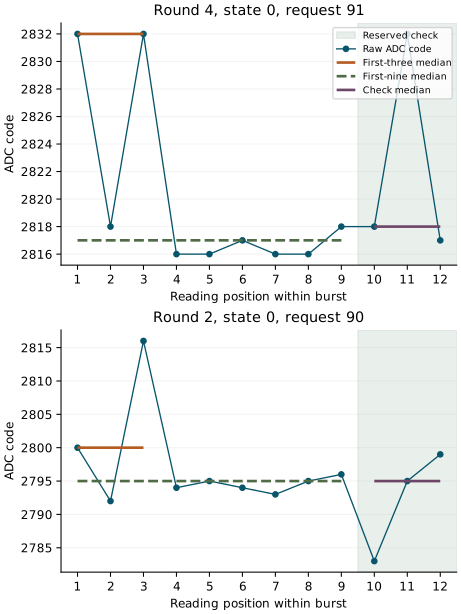
Hyphos creation under the existing calibration
Neither comparison candidate supplied Hyphos in this run. The existing target calibration uses all twelve reference-triple medians per state, including the final burst triples. It also rejected round 4: state-0 maximum 2832 and state-1 minimum 2834 gave guarded gap −3. Its subsequent recognition was 270 correct and 54 unavailable out of 324; the nominal baseline was 308 correct and 16 unresolved.
Thirty of the 36 scheduled creation/use cases passed, including later text attachment, exact raw-Hyphos recovery and carried successor execution. All six round-4 inputs were unavailable and Hyphos correctly returned rejection status 6; carried execution through those rejected entities was blocked. The six round-5 cases succeeded after the unavailable round. All 468 source operations were retained. Of 42 controls, 38 passed and four required a created entity that was absent in round 4. Those four are unassessable. The all-case creation criterion was not met; recorded behavior matched the available and unavailable prerequisites.
Recurrence and next investigation
Across the two boots, nine-reading calibration recognized 648/648 primary observations and 215/216 reserved checks, with one unresolved check retained from the first boot. Three-reading calibration recognized 592/648 primary observations, leaving two unresolved and 54 unavailable; its reserved checks were 196 correct, two unresolved and 18 unavailable. Both boots met the originally declared improvement criterion. Their shared inputs, within-round dependence and limited operating conditions prevent treating these counts as independent trials or a general reliability guarantee.
The existing target calibration supported 66/72 Hyphos creation/use cases across these two boots, with six correct prerequisite rejections. Source recovery was 936/936 operations; controls were 80 passed and four unassessable. These creation results remain separate from the nine-reading candidate's recognition results.
Proposed next investigation: make the already recorded nine-reading estimates supply the SEIGRASM calibration used by Hyphos. Retain the existing full-reference calibration as a recorded comparison, the same guards and acquisition schedule, all 36 fixed creation cases, unavailable-input rejection and all controls. Require the native candidate calibration and its selected Hyphos inputs to agree exactly with independent reconstruction. This tests whether the observed availability benefit reaches creation; the present returns do not establish that transfer. Conversion freshness, ADC accuracy, excursion origin, firmware replacement and broader Seigsit relations remain unresolved.
Recovery and provenance
Preparation BF8C6A7CF588 preserved all 49 instruction regions, 141 validated source identities and the complete Hyphos case schedule from the first boot. The payload changed only its run identity. Two read-only acquisitions of the returned SD agree; both boot files match the preparation, partition geometry is unchanged and both FAT copies agree. Seven metadata sectors changed outside the journal; their writer and timing are undetermined.
All 33681 occupied journal sectors were recovered, with 3119 empty reservations and no journal-integrity errors. Six block restorations completed; final restoration and pin-release status were zero. At the reported 54 MHz counter frequency, acquisition spanned 137.025 nominal seconds, trial start to the final electrical section 1421.021 seconds, and source execution 1.054 seconds. These intervals do not independently establish total powered duration, clock accuracy or completion of the final target readback.
Returned SHA-256: 96a54e7deaeeac993c6cde94ca86a8295ce118760359ffa377b5c292a87b0418. Trajectories and paired assessments · Hyphos outcomes · Boot-volume comparison · Artifact identities
Reference bursts: first return
28 September 2026: all 3888 acquisitions, 108 native burst summaries and 468 Hyphos operations were recovered. Every recorded three-reading, nine-reading and reserved-check median agrees exactly with its raw observations. The predeclared nine-reading improvement criterion passed in this boot: one additional primary observation was recognized correctly, with no wrong classifications in either candidate.
| Assessment | Three readings | Nine readings |
|---|---|---|
| Primary observations correct | 323/324 | 324/324 |
| Primary unresolved | 1 | 0 |
| Reserved checks correct | 106/108 | 107/108 |
| Reserved checks unresolved | 2 | 1 |
| Wrong or unavailable, either set | 0 | 0 |
| Accepted calibrations | 6/6 | 6/6 |
The differing reference
Round 1, state 1, request 92 began with [2848, 2848, 2833]. Its three-reading median was 2848. The next six readings were [2830, 2832, 2834, 2829, 2832, 2831], giving a first-nine median of 2832. The three-reading candidate accepted state 1 over 2837–2876; the nine-reading candidate accepted it over 2826–2876. A later probe at ordinal 1223 had median 2836: unresolved under the former and correct under the latter. This is the only differing primary outcome.
The disjoint final triple of that burst, [2840, 2830, 2832], also had median 2832 and was accepted only by the nine-reading candidate. A separate state-0/request-91 burst in round 2 began [2799, 2799, 2816]: its first-three median was 2799 and first-nine median 2813. Both deviations remain in the records. Their electrical causes are unestablished.
The remaining rejection
Round 0, state 1, request 94 produced first-three and first-nine medians of 2868. Its reserved final triple was [2880, 2863, 2880], with median 2880. Both candidate intervals ended at 2875, so both rejected this check. Longer reference estimation did not eliminate excursions in later three-reading observations. All five neighbouring-state guarded gaps were positive in every round: 10–29 codes for the three-reading candidate and 11–16 for nine readings.
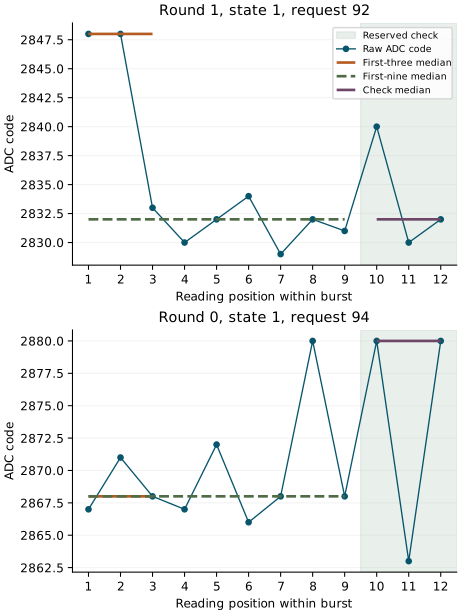
Creation and recovery
The existing target calibration accepted all six rounds and recognized 324/324 subsequent triggered medians; the nominal baseline recognized 309/324, with 15 unresolved. That target calibration includes all twelve reference-triple medians per state, including the final burst triples. Its result is therefore a separate assessment from the two candidates and their disjoint checks. Neither candidate governed creation in this run.
All 36 Hyphos cases completed creation before later content attachment, exact text and raw-source recovery, and execution of the carried successor. All 42 control assessments passed. All 468 scheduled source operations and retained values were recovered. No scheduled creation input was unavailable, so this boot does not add an unavailable-to-available transition.
All 33681 occupied journal sectors were recovered; 3119 reservations remained empty. Six block restorations completed, with final restoration and pin-release status zero. Counters span 137.020 nominal seconds for acquisition, 1421.131 seconds from trial start to the final electrical-section counter, and 1.166 seconds for source execution at the reported 54 MHz. These intervals do not independently establish total powered duration or completion of the final target readback.
Two read-only SD acquisitions agree. Both boot files match preparation 7B8F037F98A8; partition geometry and the two FAT copies agree. Seven boot-volume metadata sectors changed outside the journal; their writer and timing remain undetermined. Returned SHA-256: a31bd1069385fa9ddced49b19acb253af5260e4b7334f48301ef7a22fb1b6bb4.
Interpretation: the declared benefit is observed for this finite comparison, driven by one primary outcome in one boot. The remaining rejected check, shared estimator inputs and unknown conversion freshness prevent a general reliability claim. The grouped reference order differs from the preceding experiment, so the comparison with that earlier run cannot isolate median length.
Next test: repeat this exact burst procedure with a new identity and empty journal. Retain zero added wait, guard 2, all 324 primary observations, all 108 checks and every Hyphos case. Evaluate whether the gain recurs before allowing a candidate estimator to govern creation. An equal or worse result remains informative; do not alter bounds or omit a round to recover a passing outcome.
Trajectories and paired assessments · Hyphos outcomes · Artifact identities
Reference bursts: unchanged second boot
The first boot met the declared improvement criterion through one additional correct primary observation; one reserved check remained unresolved. The second boot tests whether that benefit recurs under the same procedure. Its result will be assessed separately against the original criterion. Equal recognition by both candidates does not count as repeated improvement.
Preparation BF8C6A7CF588 retains all 49 instruction regions, the raw Hyphos definitions, all 141 validated source identities, the acquisition order and electrical settings from 7B8F037F98A8. The only payload change is the run identity; the journal contains 36800 empty reservations under that identity. The existing 110-check software validation is reused after source-hash verification. The comparison retains all 324 primary observations, 108 reserved checks, 36 creation/use cases and 42 controls, including any unavailable or unresolved outcomes. Neither candidate estimator governs Hyphos creation.
The prescribed powered interval remains 27 minutes. Image SHA-256: ca08aaa3d2115f995bd9a6a8da1faa2ffaefcd0f06fdc52c3cebc4807c11ecb9. The manifest and byte comparison bind the unchanged procedure and new recording identity. The SD installation completed 4096 verified transfers and two matching full readbacks while locked; ejection succeeded. The second return met the estimator improvement criterion; its six unavailable creation inputs were correctly rejected.
Reference-burst protocol
Declared 28 September 2026. The preceding return rejected one calibration because two elevated readings determined a conflicting three-reading median. The question is whether a nine-reading estimate reduces this sensitivity while retaining separation and correct recognition of later observations. The cause of those excursions remains unknown.
The run retains 3888 acquisitions in six rounds. Each round begins with the same 216 nominal-reference readings. Its next 216 readings become eighteen bursts: twelve consecutive readings at each of three requested offsets for each state. State order rotates between rounds; offset order rotates through −1, 0 and +1, with outward endpoint offsets redirected inward as before. Each reading reissues its request. This procedure does not assert an uninterrupted analog hold or independent conversions. The final 216 observations per round retain the existing prime, omitted-trigger, triggered-transition and boundary-probe sequence.
| Reading positions | Role |
|---|---|
| 1–3 | Three-reading reference median |
| 1–9 | Nine-reading reference median, sharing the first three readings |
| 10–12 | Check median; enters neither candidate estimate |
SEIGRASM records all raw readings and 108 native summary records, each containing the three medians, final acquisition ordinal, counter, round, state and requested code. Returned records must reproduce the medians exactly. A failed or incomplete burst cannot supply a candidate reference. Zero added wait, the 1 ms settling interval, guard 2 and requests 90–105 remain unchanged.
The PC assessment constructs two candidate calibrations from the three offset estimates per state, using the existing extrema, separation, interval-expansion and rejection rules. Its primary comparison includes all 324 subsequent triggered medians. The 108 final burst triples provide a secondary check; these triples occur before acquisition of the entire calibration set has finished, so they are not prospective predictions by an already completed calibration. Unavailable rounds and unresolved or wrong classifications remain in both denominators.
Declared benefit criterion: with complete acquisition and valid summary provenance, the nine-reading candidate must recognize more of the 324 primary observations correctly, produce no more wrong classifications, and leave fewer unavailable or unresolved observations than the three-reading candidate. Report all five neighbouring-state gaps in each round, each request trajectory, and results by round and state. A wider estimate alone does not qualify as an improvement.
The existing target calibration still uses all twelve reference-triple medians per state. It supplies the same 36 Hyphos creation/use cases, 468 source operations and 42 control assessments. Neither new candidate calibration feeds those cases. This separates the new estimator comparison from changes to creation rules. The grouped acquisition order differs from the preceding run: comparisons with that run cannot isolate the effect of median length, whereas the two candidates within this run share the same acquired bursts.
Any observed benefit remains limited to these recorded observations. It does not establish independent conversion freshness, analog accuracy, continued physical state retention, general reliability or firmware replacement. The powered interval remains 27 minutes. The prepared identity, validated inputs and installation readbacks will accompany this protocol in the evidence archive.
Preparation 7B8F037F98A8 preserves the literal instructions, raw Hyphos, assessment code and this protocol. Image SHA-256: ed289be30bf69a17e1ef44abe5a147b6fb42b02279b4101579230a73341830e2. The 110 supplied-input validation checks passed. The returned results are recorded above.
Boot 2: rejection followed by creation
28 September 2026: the unchanged 36-case repeat recovered all 3888 acquisitions and 468 source operations. Round 0 rejected its six unavailable creation inputs with status 6 and blocked carried-source execution. Rounds 1–5 completed all 30 creation/use cases, including exact text recovery, raw Hyphos recovery and execution of the carried successor. All 36 scheduled cases remain in the denominator.
The predeclared agreement-with-prerequisites criterion passed, and creation following an unavailable round was observed. The all-case creation criterion did not recur: 30/36 cases completed creation and later use, while six correctly rejected their prerequisites. Of 42 scheduled control assessments, 38 passed and four were unassessable because the round-0 state-5 entity was unavailable. Those four are not counted as passes.
| Measure | Boot 1 | Boot 2 |
|---|---|---|
| Acquisitions recovered | 3888/3888 | 3888/3888 |
| Source operations recovered | 468/468 | 468/468 |
| Creation and carried use | 36/36 | 30/36 |
| Correct prerequisite rejections | 0 | 6 |
| Controls | 42 passed | 38 passed; 4 unassessable |
| Accepted calibrations | 6/6 | 5/6; round 0 rejected |
| Candidate triggered medians | 324 correct | 270 correct; 54 unavailable |
| Nominal baseline medians | 307 correct; 17 unresolved | 307 correct; 2 wrong; 15 unresolved |
| Perturbed neighbouring pairs separated | 120/120 | 119/120 |
| Creation after an unavailable round | Untested | Observed |
The limiting pair was state 1/2 in round 0. At request 94, ordinals 381–383 recorded [2884, 2884, 2867], giving median 2884 and the maximum state-1 reference. The preceding request-95 triple, ordinals 378–380, recorded [2882, 2887, 2887], giving median 2887 and the minimum state-2 reference. Their median separation was three ADC codes. Applying guard 2 to both reference extrema gives the declared gap 2887 − 2884 − 5 = −2, so the calibration failed its separation rule. The same local pair failed; this was not solely an overlap between observations far apart in the reference sequence.
The two elevated readings determine the state-1 median. Other request-94 reference triples in round 0 had medians 2870, 2869 and 2866. This identifies the recorded observations responsible for rejection, but does not establish their electrical cause. The earlier six-case repeat failed at state 3/4; that pair remained separated in every round here. A fixed explanation tied only to state 3/4 is therefore insufficient.
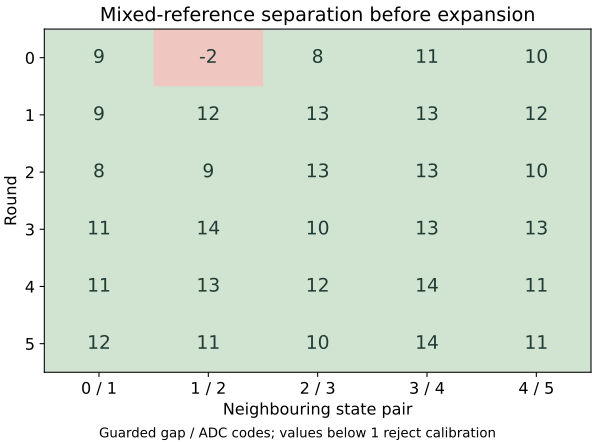
All 33594 occupied journal sectors were recovered, with 3206 empty reservations and complete source-value retention. Source execution returned normally. Six block restorations completed; final restoration and pin-release status were zero. Recorded acquisition counters span 138.048 nominal seconds, the trial start to the final electrical-section counter spans 1418.681 seconds, and source execution spans 1.054 seconds. These intervals use the reported 54 MHz counter frequency; they do not independently measure total powered duration or establish completion of the final target readback.
Scope: SEIGRASM processes the retained round-0 inputs before the retained inputs from rounds 1–5, after electrical acquisition, restoration and recording. The observed transition demonstrates the source-defined response to those ordered observations. It does not establish live reacquisition initiated by Hyphos, continued physical retention of the earlier states, independent conversion freshness or general cross-boot reliability.
Both read-only SD captures match. The configuration and payload match preparation 3B8A67D93528; both FAT copies agree. Seven sectors outside the journal changed in boot-volume metadata. Their writer and timing remain unestablished. Returned image SHA-256: 02d61d832ed33f53719c1b0cf3be834433665a2931718c7ec4db9522777f5bc0.
Source outcomes by round · Electrical assessment · Reference observations · Artifact identities
Boot 1: creation across all six rounds
28 September 2026: all 36 prespecified creation/use cases passed. The return contains 468/468 source operations, complete retained values and 42/42 control assessments. Every round supplied qualified creation inputs. No case was omitted or replaced.
| Round | Creation | Carried use | Controls | 3/4 gap |
|---|---|---|---|---|
| 0 | 6/6 | 6/6 | 7/7 | 13 |
| 1 | 6/6 | 6/6 | 7/7 | 14 |
| 2 | 6/6 | 6/6 | 7/7 | 13 |
| 3 | 6/6 | 6/6 | 7/7 | 14 |
| 4 | 6/6 | 6/6 | 7/7 | 14 |
| 5 | 6/6 | 6/6 | 7/7 | 13 |
Each case retained the initially empty carrier, then recovered the target-produced Hei Seigr text and the raw Hyphos successor source after separate attachments. The recovered source performed subsequent creation and qualification with the expected recorded request. All seven source and integrity controls passed in every round. The explicit unavailable-input control exercised rejection, but no scheduled electrical input was unavailable.
All six calibrations were accepted. Candidate recognition was correct for 324/324 triggered medians; the nominal baseline recognized 307/324 and left 17 unresolved. All 120 perturbed neighbouring reference pairs were separated. The state-3/4 guarded reference gaps were 13 or 14 codes; the corresponding gaps between expanded acceptance intervals were 5 or 6 codes. This boot did not reproduce the preceding round-0 calibration failure. The creation phase follows electrical acquisition, so successful creation cannot explain the earlier measured separation.
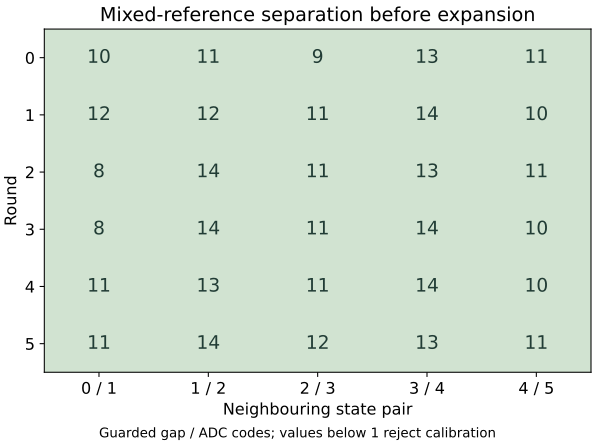
All 3888 acquisitions and 33594 occupied journal sectors were recovered; 3206 reservations remained empty. Six block restorations completed, with final restoration and pin-release status zero. Ordered acquisition counters span approximately 138.025 nominal seconds; the trial start to the final electrical-section counter spans 1418.619 seconds. Source execution spans 1.166 seconds. These are counter-derived intervals, not independent measurements of total powered duration. The complete result does not prove completion of the final target readback.
Qualification: the all-case creation/use criterion and agreement with observed prerequisites passed. The unavailable-to-available transition was untested because all six calibrations qualified. The earlier failed calibration remains evidence of between-boot variation. Independent conversion freshness, analog accuracy, physical recurrence of this expanded procedure, firmware replacement, automatic installation and the broader Seigsit relations remain unresolved.
Two read-only captures matched. Both boot files match the preparation; the FAT copies agree. Seven changed sectors lie in boot-volume metadata outside the journal. Their writer and timing are not established. The image, analysis and exact preparation are preserved. Returned image SHA-256: eae85278fff5bc130183939e27ce4d00f3c2ff22dc595f06ea6c13745aa34aef.
Source outcomes by round · Electrical assessment · Reference observations · Artifact identities
Recurrence across all six rounds
Second boot, 28 September 2026. The first expanded run completed all 36 creation/use cases and 42 control assessments. This repeat tests recurrence under the same procedure: all 48 instruction regions, raw Hyphos definitions, case selection, electrical settings and acceptance rules remain unchanged. Only the run identity and empty journal change.
Preparation 3B8A67D93528 retains all 36 scheduled cases and 468 source operations. Compare each round with the first boot, retaining failed prerequisites and their rejection consequences. If unavailable inputs precede qualified inputs, assess the corresponding change in creation outcomes. If every round qualifies again, that transition remains untested. Powered interval: 27 minutes. The returned results record six prerequisite rejections followed by 30 completed creation/use cases. Preparation comparison.
Creation across calibration rounds
Protocol, 28 September 2026. The unchanged repeat rejected all six creation inputs because they belonged to round 0, whose guarded state-3/4 envelopes had no unassigned code between them. Rounds 1 through 5 accepted their calibrations, but creation was not scheduled against those observations. The next run tests whether the same Hyphos rules correctly reject unavailable inputs and create, attach and execute carried source when later recorded inputs qualify.
The electrical procedure remains fixed: 3888 acquisitions, six scheduled rounds, guard 2, zero added acquisition wait, the 1 ms settling interval and the existing recognition rules. Each round contributes six prespecified final triple ordinals 648r + 440 + 36p, where round r and position p each range from 0 through 5. Their requested state is (r + p + 3) mod 6, following the existing state rotation. Each triple belongs to the first triggered-B case for that state in its round. Counts, ordinals and identities in this protocol are decimal. All 36 cases remain in the denominator. No retry, replacement observation, widening of intervals or favourable-round selection is permitted.
After acquisition, restoration, pin release and complete electrical recording, SEIGRASM executes the six creation/use cases and the same controls for round 0, then rounds 1 through 5. This is source execution against retained observations; it is not interleaved live electrical control. Each case has a distinct trial-local identity 36 + 6r + state and disjoint live allocation space. The raw Hyphos definitions remain unchanged. The complete sequence comprises 468 source operations, with 36 creation/use cases and seven control assessments per round.
Report each round's calibration status, creation prerequisites, explicit rejections, later text use, recovered-source execution and control outcomes. A case with a qualifying input must complete creation and later use. A rejected prerequisite must produce the source-defined rejection and block carried-source execution. Four controls require a created state-5 entity; retain them as unassessable when that prerequisite fails. They must not be counted as passed. The original all-case creation criterion remains separate from agreement with the observed prerequisites.
Creation following an unavailable round is observed only if an earlier round rejects all six unavailable inputs and a later round completes all six creation/use cases, with complete ordered records and the applicable controls. If every round qualifies, or every round is unavailable, that transition is untested. A successful transition concerns the recorded inputs within this boot; independent conversion freshness, continuous physical state retention and cross-boot reliability remain unresolved.
The expanded source report reserves 10680 words. The full run uses at most 33594 sectors; the journal now reserves LBAs 64 through 36863, with boot files beginning at LBA 36864. Only the native storage bounds change; the acquisition instructions and Hyphos rules are retained. Literal opcode streams are copied without foreign target compilation. The exception report and electrical-before-source persistence order are retained.
Powered interval: 27 minutes. This allows for the larger source journal and boot payload. The previous complete electrical phase took about 1418 seconds; 890 additional source sectors add recording work. Elapsed counters will be assessed on return. Preparation checks are not physical results.
Preparation 624E7CEB23B8 preserves the image, raw sources, software validation and comparison with C4144B71A6F4. All 88 software checks passed with unchanged inputs during validation. The physical return completed all 36 creation/use cases. Preparation comparison · Validation record.
Definition under test
The bounded definition connects a trial-local identity, a qualified recorded state, and an initially empty carrier layer. Its state retains identity, recognized value, raw ADC code, acquisition-triple origin, counter, recognition availability and status. The same identity links the entity, state and carrier. Future content is absent at creation.
Hyphos owns the field names, construction, validation, attachment and consumption rules. The SEIGRASM operations read declarations, resolve arguments, evaluate the admitted forms, retain values and execute recovered definitions. There is no assembly-defined Seigsit constructor.
The executable definitions are creation, qualification, attachment, consumption and the carried successor.
Unmarked numerals are senary. Explicit emit, @doc, and established comment forms are retained. Availability and status are separate from numerical values: zero ADC code or zero counter is not automatically missing data. Declaration names are read from the raw source; image packaging supplies extents rather than a discovered name table.
This is a bounded creation relation. The connected Quantum4D, Noesis and wider Seigsit behavior remain implementation and measurement work. The recorded state describes its acquired observation; this experiment does not establish continuous six-level storage or current electrical state after restoration.
Initial acquisition and source execution
The interleaved-reference procedure is retained: 3888 acquisitions, six rounds, unchanged operating guards, zero added acquisition wait, and the existing 1 ms settling interval. Its instruction regions are unchanged. Restoration and pin release precede the creation phase.
Six observations are fixed before acquisition: zero-based final triple ordinals 440, 476, 512, 548, 584 and 620, requesting states 3, 4, 5, 0, 1 and 2 respectively. These are the first triggered-B triples for each state in round zero. Unavailable, rejected or mismatched observations are retained; no later successful observation substitutes for them. Trial-local identities 36 through 41 are expressed here in decimal for analysis and are distinct from state values.
- Discover the six admitted definitions from their raw declarations.
- Create from the selected observation and retain the complete emitted value before attachment. Independently qualify it.
- Request absent content and retain the explicit absence result.
- Execute Hyphos to produce
Hei Seigr, attach it as text, and retain independently extracted text. - Attach raw Hyphos through the existing carrier, retain the connected value, and independently extract the carried source.
- Execute the recovered definition with its declared observation inputs. Independently qualify the subsequent entity and record its emitted trial request.
The subsequent request is a recorded Hyphos value; it causes no additional electrical request in this experiment. The consumer operations receive their declared entity inputs, without the first creator's argument environment. Borrowed source and allocated values remain live for the complete trial.
Discriminating controls
| Controlled change | Expected consequence |
|---|---|
| Change the creator's state-identity expression | The altered link appears in the retained structure; independent qualification rejects it. |
| Change the creator's upper admitted state from five to four | The same state-five observation is rejected by the changed Hyphos rule. |
| Supply observation-unavailable status | Explicit rejection without a created state-zero entity. |
Emit unmarked digit 6 | The source operation is rejected by senary admission. |
| Request an absent declaration | Source unavailability is recorded; no definition is substituted. |
| Change an existing identity link, then attempt an invalid emission | Execution rejects and restores the existing relation; subsequent qualification succeeds. |
| Successfully emit a deliberately altered identity link | Subsequent qualification rejects that entity. |
Construction, acceptance and integrity controls use the prespecified state-five observation. If its prerequisites fail, those controls remain unqualified. The explicit unavailable-input and malformed-source controls remain separately interpretable. Instruction bytes remain fixed across the source variants.
Initial six-case assessment
Assess electrical completion, source execution, creation, later use, carried execution and controls separately. The complete creation/use criterion requires all six prespecified cases to satisfy their source-defined creation prerequisites; retain the expected empty relation; preserve identity and state through later attachment; recover the produced text and carried source exactly; and execute that recovered source with the predicted independent consumer outcomes. All applicable controls, ordered operation counters, complete value retention and electrical diagnostic integrity must also pass.
Each of 78 source operations records its result, execution status, kind, start/end counters, executed source address and retention outcome. Selected operations additionally retain the full value tree, including names and text spans tied to immutable source. Independent analysis decodes those trees and compares their observation associations against the raw electrical record. Missing observations stay in the six-case denominator.
In the first preparation, section 9 reserves 1780 senary words. The complete journal occupies at most 32703 sectors, within the existing 32704-sector reservation. Existing electrical sections retain their schema and meaning. A complete recovered section does not prove its final target readback completed.
Execution and dependencies
Entry uses literal AArch64 SEIGRASM. The first preparation calls the electrical procedure, then the generic definition dispatcher and value recorder, followed by native SD persistence. The retest moves electrical persistence before source dispatch. The ten generic definition/value components reuse reviewed instruction bytes from earlier internal component work. The new dispatcher, recorder and acquisition connection have dedicated execution tests. Earlier physical claims are not inherited.
The PC copies literal instruction bytes, raw Hyphos and pointer tables. It implements neither target creation nor source evaluation. Validation supplies observations and device responses to execute the actual instruction bytes; physical results require the returned SD.
The apparatus still inherits the existing EEPROM entry and initial hardware state. Direct PMIC operations use known component addresses. This run does not establish automatic component discovery, firmware exclusion, firmware replacement or physical equivalence across instruction sets. Its Hyphos definitions express the tested relations independently of those register addresses.
Run and recovery
The initial creation runs used a 26-minute interval; the all-round investigation uses 27 minutes. Preserve the returned image before any subsequent preparation. Compare the immutable image and source identities, decode both electrical and Hyphos sections, and report failed prerequisites alongside completed operations.
Retest: source access and durable recovery
The retest uses the bytewise source reader while making electrical recovery independent of subsequent Hyphos execution. The six prespecified creation cases, raw Hyphos definitions, qualification rules and controls are unchanged. Electrical instruction regions, guard 2, zero added acquisition wait and the 1 ms settling interval are retained.
- Complete the electrical trial, restoration and pin release, then write and verify its full journal, including the final trial record.
- Install source-phase exception vectors and write a ten-word transition record. It identifies the inherited vector base, SCTLR and HCR controls, frequency and counter. This record establishes readiness for source execution; it does not by itself prove that a source operation began.
- Execute the same 78 Hyphos operations through the corrected SEIGRASM source reader.
- On ordinary return, restore the inherited vector base and append the complete source-result journal. On an exception during source execution, retain the syndrome, return address, raw fault address, processor state, memory controls, counters and reported progress; switch to an independent stack; append a twenty-word terminal fault record; then park.
Section 9 follows the complete electrical journal. The transition occupies one sector; ordinary source results require another 178 sectors, while the fault record requires two. The maximum remains within the existing 32704-sector reservation. Source-record absence or truncation leaves the already completed electrical record independently assessable. A complete recovered record does not prove that its own final target readback finished.
Fault recording is permitted only during source execution. A nested fault preserves the first RAM record and parks; a persistence failure is not retried. Faults before the protected source phase, faults in the recording path, or unavailable SD transport may still prevent a durable exception record. FAR interpretation depends on the syndrome and vector slot. The register roles and exception-vector behavior follow Arm's AArch64 exception model.
The original creation/use criteria remain fixed. A complete return enables their assessment; an exception identifies an execution constraint without establishing a semantic creation result. Changing both source access and persistence does not isolate either change as the sole cause of improved completion. The prescribed powered interval remains 26 minutes.
Unchanged repeat: recurrence across boots
The successful retest establishes the complete bounded relation in one boot. This repeat asks whether all six creation/use cases and seven controls pass again under the same procedure. The incomplete first return remains separate evidence and cannot count as a successful recurrence.
Preparation C4144B71A6F4 retains all 48 instruction regions, all raw Hyphos definitions, the 78-operation sequence and the electrical settings from E8D4FDC020FC. Payload comparison shows that only the 32-byte run identity changed. The journal contains 32704 empty reservations under that identity. All 132 validated source hashes match the preserved 83-check software validation; that validation is reused without a new test-run claim.
Keep the 26-minute powered interval, zero added acquisition wait, 1 ms settling interval and guard 2. Recovery applies the same creation, later-use, carried-execution and control criteria; retain all six prespecified cases in the denominator if observations are unavailable. Compare the independently decoded return with the successful retest, including electrical restoration, journal completeness and source provenance. The repeat return is complete; its creation criterion was not met.
Image SHA-256: 76e3d13cb705f6b004567b3c7c91d509037506e1f0196b43b26d13190c4df952. The manifest and byte comparison bind the unchanged execution and new acquisition identity. The SD installation completed 4096 verified transfers and two matching full readbacks while locked; ejection succeeded.
Six-case repeat: 28 September
The creation criterion did not recur. The unchanged repeat recovered all 32704 journal sectors, 3888 electrical acquisitions and 78 scheduled Hyphos operations. Source execution returned normally and retained the complete operation record. The first calibration failed its declared separation rule, making all six prespecified creation observations unavailable. Every creation returned the Hyphos-defined unavailable-observation status 6. No replacement observation was selected.
| Observed measure | Successful retest | Unchanged repeat |
|---|---|---|
| Accepted calibrations | 6 / 6 | 5 / 6; round 0 rejected |
| Candidate triggered medians | 324 correct / 324 | 270 correct, 54 unavailable / 324 |
| Fixed-baseline triggered medians | 302 correct, 22 unresolved / 324 | 307 correct, 17 unresolved / 324 |
| Recorded Hyphos operations | 78 / 78 | 78 / 78 |
| Creation, later use and carried execution | 6 / 6 cases passed | 0 / 6; six correct input rejections |
| Controls | 7 passed | 3 passed; 4 unassessable |
| Completed block restorations | 6 / 6 | 6 / 6 |
The three assessable controls were unavailable-observation rejection, invalid-definition rejection and unavailable-declaration rejection. The construction-rule, acceptance-rule, rollback and altered-relation controls required a successfully created state-5 entity, which was absent. Their prerequisite was unmet; they are neither passing controls nor independent evidence of a new language defect.
Limiting state-3/4 reference gap
In round 0, the highest state-3 reference median was 2993 and the lowest state-4 reference median was 2998. Guard 2 produced an upper state-3 boundary of 2995 and a lower state-4 boundary of 2996. The number of unassigned codes was 2996 - 2995 - 1 = 0; the declared rule requires at least one. These guarded envelopes were adjacent, with insufficient separation, rather than numerically overlapping.
The limiting state-3 triple, acquisition ordinals 237–239 at request 100, contained raw codes [3008, 2993, 2984]. The limiting state-4 triple, ordinals 219–221 at request 101, contained [2998, 2998, 3000]. Values and ordinals here are decimal renderings of the recovered records. The limiting medians came from different acquisition pairs.
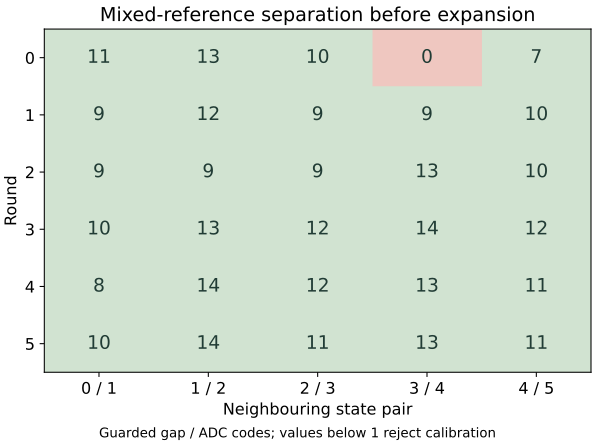
All 120 perturbed neighbouring pairs remained locally separated. In round 0, state-3/4 paired gaps were at least 12 codes in ascending order and 4 in descending order; the full-round envelope had gap zero. The result locates the availability loss in aggregation across reference observations. It does not identify the physical cause of their variation or establish a replacement acceptance rule.
Creation prerequisites and later recovery
The six creation cases use acquisition origins 440, 476, 512, 548, 584 and 620, all in round 0. Calibration status 3 made each corresponding observation unavailable. Later rounds 1–5 accepted their calibrations and each recognized 54/54 candidate triggered medians, but this protocol schedules no creation cases from those later observations. Those readings cannot substitute retrospectively for the fixed six cases.
All source operations remained recorded, including their rejection consequences. The text-producing operation still emitted Hei Seigr
, but carrier extraction did not recover that text from a created entity in this repeat. Carried-source execution therefore did not succeed. The previous successful boot remains valid evidence for its own six cases; successful creation has not been established across both boots.
Capture and timing
Both read-only acquisitions agreed. The executable and boot configuration match preparation C4144B71A6F4; all 48 instruction regions and raw Hyphos definitions match the successful retest. The returned journal has no CRC, sequence, padding or gap errors. Final restoration and pin-release status were zero. The source record reports ordinary return with no terminal exception record.
The acquisition interval was 138.018 nominal seconds; trial to final electrical section was 1418.414 nominal seconds. The Hyphos interval was 0.082769 nominal seconds at the reported 54000000 Hz frequency. The shorter source interval includes rejection paths and is not a like-for-like speed comparison with successful creation. Total powered duration and absolute clock accuracy were not measured.
Partition geometry and both FAT copies agree with the expected layout. Seven sectors outside the journal changed, including System Volume Information metadata, while the boot payload remained unchanged. Their writer and timing are not established. Recovery does not prove completion of the final target readback; physical exception recovery remains untested.
Retest preparation
Preparation E8D4FDC020FC passed 83 selected software checks. All 44 common instruction regions outside the declaration reader, function reader and creation entry remain byte-identical to the first preparation; the exception-recording component is new. Every raw Hyphos definition and all electrical parameters are unchanged. The retest protocol retains the 26-minute powered interval. The returned record contains the complete electrical and Hyphos journals.
Image SHA-256: 19f2f51bad592e04b87e96ff6319b8cf41b23e082814ed62e1fd7c582680a13a. The manifest binds the placement and source identities; the comparison records the changed and unchanged instruction regions. The preparation archive preserves 132 validated source files. The SD was written in 4096 verified transfers, matched the image in two complete locked readbacks, and was safely ejected.
Successful retest: 27 September
The declared creation/use criterion passed in this boot. The return contains all 32704 journal sectors, 3888 electrical acquisitions and all 78 scheduled Hyphos operations. Source discovery and dispatch returned status zero. All retained values decoded, counters were ordered, and no journal CRC, sequence, padding or gap errors were found. The source record reports ordinary completion; no terminal exception record is present.
Each of the six prespecified cases created the Hyphos-defined experimental Seigsit with an empty carrier. Reading before attachment returned the declared empty-content status. Later text attachment and recovery both yielded Hei Seigr
. Source attachment and extraction preserved the raw Hyphos definition exactly; execution at its recorded source address created a subsequent entity that passed qualification and emitted the declared request value.
The request remains action data: this sequence does not apply that emitted value to the PMIC. The text was recovered from the journal; this experiment does not demonstrate a screen or network message. Numeric values in the following evidence table are rendered in decimal.
| State | Acquisition origin | Raw ADC code | Creation/use outcome |
|---|---|---|---|
| 3 | 440 | 2965 | Creation, later use and carried execution passed |
| 4 | 476 | 3019 | Creation, later use and carried execution passed |
| 5 | 512 | 3077 | Creation, later use and carried execution passed |
| 0 | 548 | 2794 | Creation, later use and carried execution passed |
| 1 | 584 | 2851 | Creation, later use and carried execution passed |
| 2 | 620 | 2908 | Creation, later use and carried execution passed |
All seven controls passed. An unavailable observation returned creation status 6; an invalid declaration returned execution status 1; an unavailable declaration returned status 3. A changed construction identity was rejected by qualification with status 2. A changed acceptance rule returned status 1. A rejected alteration preserved the previous qualified state 5; a valid alteration that broke the identity relation was subsequently rejected with status 2. These outcomes connect the source rules to the recorded consequences.
Electrical observations
All six local calibrations were accepted. Candidate recognition was correct in 324/324 triggered comparisons: 108 prime observations, 108 triggered transitions and 108 probes at the declared offsets. The fixed baseline recognized 302/324 and left 22 unresolved. All 120 perturbed neighbouring reference pairs were separated after the declared guard. Six block restorations completed, final restoration and pin-release status were zero, and no diagnostic-ordering failures were found. Omitted-trigger controls remain separate from this denominator.
The six creation inputs came from the prespecified acquisition origins; no failed case was replaced. Candidate median recognition does not establish individual-reading reliability, independent analog conversion freshness or cross-boot recurrence. The earlier electrical exceptions remain relevant to those questions.
Execution and recovery
The electrical acquisition interval was 138.046 nominal seconds. The trial-to-final-electrical-section interval was 1418.717 nominal seconds, including native recording. The later 78-operation Hyphos interval was 0.194771 nominal seconds. These intervals use the reported 54000000 Hz counter frequency; they do not measure total powered duration or establish absolute clock accuracy.
The source transition records SCTLR_EL2 = 0x30c50830 and HCR_EL2 = 0x80000000. Electrical persistence preceded the source transition and complete source journal as declared. Successful recovery does not prove the final source-journal readback completed, and the exception-recording path was not physically exercised by this ordinary return.
Two read-only SD acquisitions agreed. The boot configuration and executable payload match the prepared image; partition geometry and both FAT copies agree. Seven sectors outside the journal changed, including System Volume Information metadata. Their writer and timing are not established.
First preparation
Preparation BD1D52149CD9 passed 409 software checks. The 64 MiB image was written to the identified SD, verified in 4096 transfers and two complete locked readbacks, and safely ejected. The first returned journal is incomplete.
Image SHA-256: bd564ac2895d4a8c87563612148afca18db37fee0bdc525cb2b73de5a3e4c5f7. The manifest records the source and placement identities; its preparation archive preserves 167 validated source files, the protocol, comparison and installation records.
First return: incomplete record
The complete creation/use criterion was not met. The returned journal contains configuration and three checkpoint records, but no detailed electrical observations or Hyphos operation results. Creation, later use and carried execution remain unassessed.
| Recovered evidence | Observation and limit |
|---|---|
| Journal integrity | 25 contiguous valid sectors; 32679 unchanged reservations. No CRC, ordinal, padding or gap errors in the recovered prefix. |
| Sections 1, 6, 7 and 8 | Configuration, initial, preflight and completion checkpoints. Execution reached the checkpoint preceding Hyphos source dispatch. |
| Completion checkpoint | Stage 6; primary, pin-release, ADC and condition status zero; acquisition invoked. The electrical operation reports successful completion and release. Detailed restoration readbacks are absent. |
| Checkpoint interval | 7481264697 ticks at reported 54000000 Hz: 138.542 nominal seconds. Time between the recorded endpoints; total powered duration is not measured. |
| Electrical sections 2–5 | Absent; zero detailed observations recovered. Recognition rates and completed acquisition counts cannot be reconstructed. |
| Hyphos section 9 | Absent. The number and outcomes of completed source operations are unknown. |
The final checkpoint records 3889 condition observations, including preflight. This count does not reconstruct individual acquisitions. The electrical report remained in memory while the subsequent Hyphos sequence ran; its persistence was scheduled after that sequence. A stop in source execution can therefore leave both sets of detailed results unavailable.
Two read-only acquisitions of the returned 64 MiB image agreed. Partition geometry, boot configuration and executable payload match the preparation. The two FAT copies agree. Seven sectors outside the journal changed, including a new System Volume Information directory; these changes do not alter the boot payload. Their writer and timing are not established.
Source-access alignment
The configuration records SCTLR_EL2 = 0x30c50830 at configuration word 11: stage-1 translation is disabled and the explicit alignment-check bit is clear. The installed declaration reader uses a halfword load at an arbitrary source-text address. The default data-memory attributes with translation disabled are Device-nGnRnE, which require aligned accesses independently of that bit. See Arm, AArch64 memory attributes and properties, section 3.2. The inherited virtualization controls were not recorded in this return.
Replay of the frozen executable with an explicit memory-access observer stops at instruction 0x79400008, PC 0xb808c: a two-byte read at odd address 0x3f0141. This is the first fun token, source offset 233, in the creation definition. The replay supplies counters and enters source dispatch directly; it does not replay the electrical sequence.
Inference: an alignment exception is a concrete candidate explanation for the persistence boundary. The SD contains no saved exception syndrome, fault address or exception return address, so the physical cause is not confirmed.
The original 409 software checks did not enforce this alignment requirement. Unicorn 2.1.3 allowed the access in its flat memory mapping; the replay adds an explicit access-alignment observer. The corrected declaration and function readers assemble token comparisons from byte loads; the inherited memory controls are unchanged. The electrical instruction regions and Hyphos creation rules are unchanged.
All 25 targeted software checks pass. An independent memory-access observer now rejects unaligned multi-byte accesses throughout the 78-operation source sequence. The checks also cover source discovery, creation, controls, value retention, the placed boot failure/restoration path and strict reading of this incomplete return. The retest completed the source sequence on the Pi. Source access and persistence changed together, so completion does not isolate the earlier physical cause.
Interpretation and next test
The expanded procedure has two complete physical runs. Across 72 scheduled creation/use cases, 66 completed creation and later use; six correctly rejected unavailable inputs. All 936 source operations were recovered. Eighty control assessments passed and four remained unassessable. Agreement with recorded prerequisites held in both boots; success for every scheduled creation did not recur.
The second boot establishes rejection followed by successful creation from later qualified observations under the same Hyphos definitions. Creation precedes later text and source attachment in every successful case, and recovered Hyphos performs a subsequent creation. This is a bounded creation/use result. Broader Seigsit relations, live Hyphos-directed acquisition and silicon-independent installation remain further work.
Electrical reference availability remains a limiting prerequisite. The latest failure arose at state 1/2, whereas the earlier six-case repeat failed at state 3/4. Two elevated readings in one triple determined the latest conflicting median. The electrical cause remains unresolved; the later source phase cannot explain the preceding acquisitions.
The subsequent reference-burst return met its declared primary benefit criterion: 324/324 correct with nine readings versus 323/324 with three. One reserved check remained unresolved under both candidates. All 36 Hyphos cases passed through the unchanged target calibration. The unchanged second boot also met the estimator benefit criterion, with 324/324 primary observations recognized by the nine-reading candidate. That candidate retained availability in a round rejected by the existing target calibration. The native-supply return subsequently demonstrated that connection in one boot. The carried-action return then established the subsequent action and creation in all six fixed cases; independent conversion freshness remains unresolved.
The first incomplete return remains separate. Its initial stop was not causally isolated because source access and persistence order changed together before the retest.
Evidence and reproducibility
Repeat preparation C4144B71A6F4 and return 20260928-044557 preserve the unchanged executable, run identity, raw image, independent assessments and limiting reference observations. The source and electrical readers match the copies preserved before the run.
Repeat returned image SHA-256: e89e1534aea4ffb5275327a965856a6128de1c4b3af09a0ea5b7c0a59815df0c.
Repeat source outcomes · Repeat electrical assessment · Reference observations · Repeat artifact identities
Retest preparation E8D4FDC020FC preserves the exact executable, Hyphos sources and analysis tools. Return 20260927-184447 preserves both-read identities, the raw 64 MiB image, independent electrical and source assessments, and boot-volume comparison. Actual powered duration and boot count were not independently measured.
Returned retest image SHA-256: 49d102f2cf050d8cf0f9f4ee18f0a92a08f274b2b2006d01578ef8da9e48138e.
Hyphos operations and retained values · Electrical assessment · Retest artifact identities
Preparation BD1D52149CD9 preserves the installed instruction bytes and raw Hyphos definitions. Return 20260927-170143 preserves the matching reads, checkpoint analysis, boot-volume comparison, frozen-source alignment replay and correction-validation record. Active source links above include the bytewise-read correction; the preserved preparation contains the exact implementation used on the Pi.
Returned image SHA-256: 087ff0995a61e002bb5aa428e4aa6d70280147a4c77489a830658f1e2aca3ce3.
Checkpoint assessment · Frozen-source replay · Correction validation · Artifact identities